
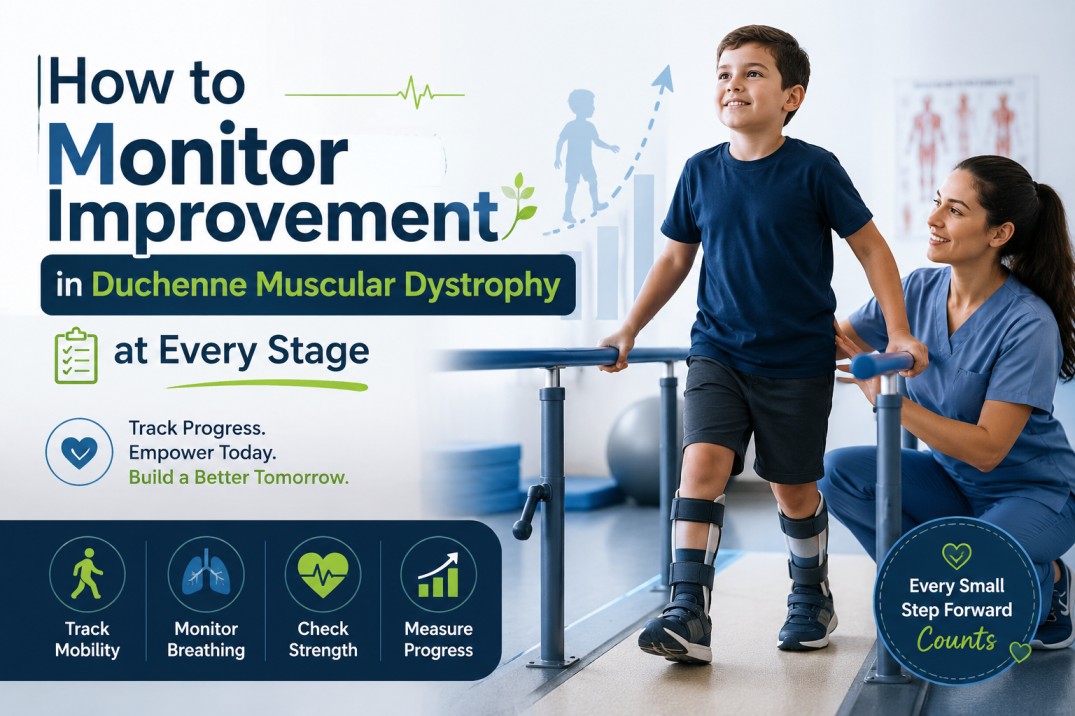
Some days, your child surprises you. They may move more easily or don’t seem as worn out. It feels hopeful, but it’s important to know whether the treatment and therapies they are undergoing are working for them.
That’s why knowing how to monitor improvement in Duchenne muscular dystrophy matters so much for families.
DMD doesn’t change overnight. Progress comes in slow, small bits, a little more movement, a touch more stamina, steadier balance, or managing daily routines with less help.
Truly, you can miss those tiny shifts without realizing it. And that leaves you wondering, “Are things getting better or not?”
Luckily, you can use practical ways to track how your child’s doing at every step. When you pay attention and jot down what you see, it’s easier to make sense of the changes, talk things through with your doctors, and choose the care that fits.
This vlog walks you through what improvement actually looks like, easy ways to keep tabs on it at home, and how doctors measure progress in Duchenne over time.
What Does Improvement Actually Mean in DMD?
When you hear the word “improvement” in the context of Duchenne muscular dystrophy (DMD), your mind usually jumps to big physical changes, like a child suddenly walking much farther or regaining lost abilities. In reality, though, improvement in DMD looks a little different at each stage, and sometimes it’s subtler than people expect.
There are three key ways to think about improvement in DMD:
1. Functional Improvement
This is about what a child can do day to day. They may walk farther without stopping, climb stairs with less help, get up from the floor a little quicker, or not tire out so fast doing routine things. Even small gains in strength, balance, or energy can make a world of difference for a child’s daily life.
2. Structural Improvement
Here, the focus shifts to what’s happening inside the body, such as slowing muscle degeneration or helping muscles function as long as possible. Doctors look for these changes with muscle strength tests, breathing checks, heart monitoring, and labs or scans. In DMD, slowing the progression counts as real, meaningful progress.
3. Experiential Improvement
Sometimes, the most valuable changes come through quality of life. A child feels less worn out, sleeps better at night, gets more involved with friends, or becomes more independent both physically and emotionally. These things matter as much as hitting certain physical milestones.
You need to realize that, in a progressive disease like DMD, staying stable is a genuine improvement. If a child holds on to their ability to walk, continues to breathe comfortably, or stays independent in daily activities longer than doctors predicted, that’s a real, measurable win.
Age and the stage of DMD play an important role here.
- At 5 years old, improvement might mean stronger balance, better coordination, or smoother motor skills.
- At 12, it can be about keeping mobility, good posture, and lung strength.
- By 17, the focus may shift again to keeping upper body movement, comfort, breathing support, and making sure life still feels rich and full.
So when parents ask, “What kind of improvement can we hope for in Duchenne muscular dystrophy?” the answer always depends on age, treatments, therapies, and where the child is in the disease.
Many times, success doesn’t mean reversing the disease but holding onto abilities, keeping decline at bay, maximizing comfort, and giving as much independence as possible for as long as possible.
Can Children with DMD Actually Improve with Therapy?

Yes, some children with Duchenne muscular dystrophy (DMD) can improve with therapy, especially if they start early and continue with it. Parents ask this all the time: “Can children with Duchenne improve with therapy?”
The truth is, therapy won’t cure DMD, but it helps. Children can boost their abilities, hang on to their independence a bit longer, and enjoy a better quality of life.
Most children don’t use one approach. They’ll go through physiotherapy, stretching, respiratory therapy, occupational therapy, medications, and all sorts of supportive care together. This mix helps manage symptoms and slow things down.
You might see things like this:
- walking longer without getting so tired
- fewer falls when they’re moving around
- standing taller and staying balanced
- stronger arms and hands
- getting upstairs or out of a chair more easily
- breathing a little easier and handling more activity
With DMD, holding onto mobility for longer counts as progress.
It’s important to realize not every child reacts the same way. Age, stage of disease, genetics, overall health, and how steady the therapy is matter in this case. Some children gain back physical skills.
For others, progress comes as a slower decline, more comfort, or a little more daily independence. Every bit of progress in DMD counts.
Signs That DMD Treatment Is Working. What to Look For
Parents find themselves wondering if the therapies and treatments are making any real difference for their child. The encouraging part? There are signs DMD treatment is working, though sometimes the progress shows up in tiny steps.
Mobility Signs
One clear indicator of improvement in mobility in muscular dystrophy is when daily movement gets a little easier. You might notice:
- your child walking farther without stopping,
- fewer tumbles throughout the day,
- getting off the floor with less of a struggle,
- some progress in the Gowers’ manoeuvre,
- steadier balance when standing or climbing stairs.
Even small improvements in mobility can bring real relief to everyday routines.
Upper Body Signs
Treatment sometimes helps sustain or improve upper-body skills, too. Look for:
- a stronger grip,
- arms lifting higher than before,
- smoother shoulder movements,
- better posture when sitting,
- Self-feeding or writing tasks are becoming less challenging.
These differences become especially meaningful as children get older.
Endurance Signs
Progress isn’t always an obvious strength. Sometimes, stamina tells the story. You may catch your child
- Staying active at school for longer stretches.
- Taking part in more playtime.
- Bouncing back quicker after exertion.
- Turning down fewer activities because of tiredness.
Growing endurance really helps children feel more capable and independent.
Subtle Signs Parents Miss
Some changes go unnoticed, but they still matter, like
- less tiredness after meals or therapy,
- more restful sleep,
- easier breathing at night,
- fewer cranky moments from exhaustion,
- better energy in the mornings.
One handy way to keep track is to use your phone to record short videos each month of everyday actions like walking, standing up, or raising arms, always at the same time of day. Looking back at these clips side by side makes it easier to spot those slow, steady gains that can be hard to catch in the rush of daily life.
Not Sure If the Treatment Is Working?
A multidisciplinary medical expert team can help evaluate physiotherapy progress, functional scores, lab markers, and daily activity changes more accurately.
How to Monitor Improvement in Duchenne Muscular Dystrophy at Home
Parents want to know how to keep track of Duchenne muscular dystrophy at home without always waiting for hospital visits. Small changes you notice every day can actually tell you a lot about your child’s progress between appointments.
The 3-Minute Daily Log
Keeping a short daily log goes a long way. Spend three minutes jotting down the following:
- Energy levels
- Number of falls
- Walking troubles
- Stair-climbing challenges
- How tired does your child get after activities
- Changes in breathing or sleep
No need to document every little thing. Focus on patterns and changes that stand out. Bring these notes to appointments. Your care team can use them to see how things are going at home.
Track Mobility Weekly
If you’re curious about ways to watch mobility at home with Duchenne, remember: consistency beats perfection. Once a week, make a note of:
- How far does your child walk without trouble
- how much distance they cover at school or outside
- How many stairs do they climb
- when they need support to walk
Looking at these records week by week usually shows changes better than looking day by day.
Simple Strength Micro-Tests at Home
Parents also want tips for tracking muscle strength in DMD at home safely. Everyday activities can actually help you spot changes, like:
- The number of times your child stands up from the floor
- How high can they reach with their arms
- If they can easily lift light objects
- Their grip strength during daily tasks
These aren’t official medical tests, but they can help you notice a slow improvement or decline.
Weekly Win Log Template
One page is enough for a “weekly win log.” You can include:
- One physical change you noticed
- An activity that got easier
- Changes in mood or stamina
- Any new trouble that came up
It keeps tracking progress simple and stops it from feeling overwhelming.
When Your Observations Matter Most
Home monitoring matters.
- Between clinic visits
- After starting a new treatment or medicine
- During illness recovery
- If your child’s mobility or energy shifts suddenly
What you see every day gives practical, real-world information. It reveals information that short hospital visits can’t show.
Clinical Tests That Measure Real Improvement
When a child with Duchenne muscular dystrophy begins treatment or physiotherapy, families want answers. Is this actually making a difference? Are things moving in the right direction?
To track changes, doctors use a handful of tests that check how well a child can walk, balance, keep up their stamina, coordinate movements, and use muscle strength.
Some of the important ones are the North Star Ambulatory Assessment (NSAA), the 6-Minute Walk Test (6MWT), the 4-Stair Climb Test, the Timed 10-Meter Run, and hand-held dynamometry.
Each one focuses on something a little different.
- The NSAA looks at basics like standing, walking, and getting up and down stairs.
- The 6MWT is all about endurance and how far a child can walk in six minutes without stopping.
- The 4-Stair Climb and Timed 10-Meter Run measure speed, leg strength, and coordination.
- Hand-held dynamometry gives a more focused read on grip and arm strength.
Doctors don’t look once and move on. They repeat these tests over months or even years to spot changes, sometimes big, sometimes subtle. They’re watching to see if the child is
- holding steady
- getting a little stronger
- taking longer to lose abilities.
A few extra meters walked without stopping? That’s progress. Climbing the stairs a bit faster or standing with better balance, all of these can make everyday life simpler and boost a child’s independence.
Here’s a snapshot of these tests and what they show:
Clinical Tests Used to Monitor Duchenne Muscular Dystrophy
| Test | What it measures | What improvement looks like | How often done |
|---|---|---|---|
| North Star Ambulatory Assessment (NSAA) | Walking, standing, balance, and stair climbing ability | A higher score, such as improving from 18 to 22 out of 34 | Every 6–12 months |
| 6-Minute Walk Test (6MWT) | Walking endurance and stamina | Walking farther with less fatigue, such as 30 extra metres | Every 6 months |
| 4-Stair Climb Test | Lower body strength and coordination | Climbing stairs more quickly and with better stability | Every 6–12 months |
| Timed 10-Metre Run | Mobility and movement speed | Completing the distance in less time | Every 6–12 months |
| Hand-held Dynamometry | Grip and arm muscle strength | Measurable increase in strength during testing | During regular therapy reviews |
All together, these tests give families, doctors, and therapists clues about whether treatments, rehab, and ongoing care are making life a bit easier or keeping decline at bay. Even small steps forward can mean more independence and a better quality of life.
How to Monitor Improvement in Duchenne Muscular Dystrophy? How to Know that a Specific Treatment Is Helping?
One of the first pieces of information families want to know after starting therapy is, “How do we figure out if the treatment’s actually helping?”
With Duchenne muscular dystrophy, doctors track changes in strength, mobility, endurance, flexibility, and daily activities over time. Some therapies make a difference you can see within weeks. Others get to work deep inside the muscle before you notice anything on the outside.
This is why specialists use a structured monitoring plan that pulls together clinical assessments, physiotherapy tracking, movement tests, blood biomarkers, and observations from caregivers.
MedicoExperts has a medical expert team that combines allopathy, Ayurveda, homeopathy, rehabilitation, physiotherapy, nutrition, CBT (Cognitive Behavioral Therapy), respiratory care, and medical treatment, all working together to protect function and quality of life.
Steroid-Based Therapy
Steroid therapy is a common way to slow muscle loss and help children keep moving.
Doctors look for early improvements in the first 4–12 weeks: better stamina, climbing stairs more easily, improved balance, fewer falls, and getting up from the floor with less effort.
Before starting, doctors will record
- walking ability
- stair climbing time
- weight and height
- muscle strength
- joint flexibility
- Fatigue
- behavioral or mood patterns.
This gives everyone a baseline for later comparisons.
Exon-Skipping and Gene-Based Therapies
Newer treatments like exon-skipping or gene therapies are tracked a bit differently.
Early results might show up as dystrophin restoration, muscle biopsy findings, blood biomarkers, or lab test results. You usually don’t see clear changes right away. The muscle repair process is slow and takes time to show in daily life.
Doctors keep monitoring walking endurance, breathing, muscle strength, and activity levels to figure out if the treatment is working in a practical sense.
Physiotherapy and Rehabilitation Progress
Physiotherapy is key to watching how Duchenne changes and how children respond to treatment.
Physiotherapists measure range of motion, flexibility in the joints, posture, walking pattern, muscle tightness, and the risk of contractures.
Signs that therapy is helping could be smoother walking, better flexibility, less stiffness, less pain, and joint contractures slowing down. Physiotherapists record progress at every session, making this a hands-on way to keep up with changes over time.
CBT and Emotional Well-Being
CBT (Cognitive Behavioral Therapy) sometimes comes into the picture, especially if children deal with anxiety, frustration, social withdrawal, or stress from treatment.
Better emotional coping, getting involved in daily life, and sticking with treatment all help rehab and quality of life.
What to Ask Your Doctor During the 3-Month Treatment Review
Questions to ask at follow-up:
- 1. Have any functional test scores improved since we started?
- 2. Is muscle strength holding steady, getting better, or getting worse?
- 3. Are there real changes in flexibility or contractures?
- 4. What signs show the treatment is working at this stage?
- 5. Should we adjust the rehab or physiotherapy program?
Duchenne changes for every child at its own pace, so doctors focus on steady monitoring over months, not instant results, to judge if treatment works.
Tracking Physiotherapy Improvement in DMD
Physiotherapy plays a key role in long-term Duchenne care. Since changes in Duchenne muscular dystrophy happen slowly, physiotherapists pay close attention to small shifts in function over time.
Keeping track of physiotherapy progress in Duchenne muscular dystrophy helps doctors and families see if mobility, flexibility, posture, and muscle strength are staying the same or getting better.
How Physiotherapists Use SMART Goals
Physiotherapists set goals using the SMART framework to make progress clear and practical.
SMART stands for:
- Specific
- Measurable
- Achievable
- Relevant
- Time-based
A physiotherapy goal might look like this:
“Stand without help for 10 seconds by month 3.”
Other examples include:
- walking farther with less fatigue
- getting better at going up stairs
- loosening ankle tightness
- sitting with better posture
These goals let families notice smaller, day-to-day improvements rather than waiting for major changes.
Joint Range-of-Motion Scores
Range-of-motion tests show how easily joints move, especially in areas Duchenne affects most, like:
- ankles
- hips
- knees
- shoulders
Better ankle flexibility can mean:
- smoother walking
- improved balance
- less toe walking
- safer standing
Improved hip flexibility supports:
- easier transfers
- better posture while sitting
- more comfortable walking
Even small gains in flexibility can take stress off muscles and help delay contractures.
Hydrotherapy: Why Gains in Water Matter
Hydrotherapy uses water to make moving easier and reduce strain on muscles and joints.
In the water, children tend to:
- move more freely
- walk longer distances
- work on balance with more comfort
- try exercises that are tough on land
Since water supports the body, progress in hydrotherapy can look different from land-based therapy, but those improvements still matter. Benefits include:
- more endurance
- increased confidence with movement
- greater joint mobility
- better overall participation in therapy
Many children also feel less pain and get tired less quickly during water sessions.
How to Share Helpful Home Observations With Your Physiotherapist
Noticing what happens at home can reveal things that don’t show up during short clinic visits.
Watch for changes like:
- alling less often\
- managing stairs more easily
- standing for longer stretches
- being less stiff in the morning
- getting tired more quickly after activity
- changing how they walk or stand
Also share:
- Which tasks have gotten easier
- Which movements feel harder
- When fatigue usually happens
- If stretching is going smoothly
Detailed observations help physiotherapists adjust plans, tweak exercises, and create better goals for the next phase of therapy.
Take a look at our guide on “Best DMD Physiotherapy Exercises”
Lab Tests & Biomarkers That Show Improvement
Doctors don’t rely on physical movement tests to track Duchenne muscular dystrophy. Lab tests and imaging studies help them see if muscle damage is slowing down or if treatment is helping muscles work better.
These markers matter when figuring out how to track muscle strength in DMD, along with physiotherapy checks, walking tests, and noting what a child can do every day.
Creatine Kinase (CK): A Marker of Muscle Damage
Creatine kinase (CK) is an enzyme that gets released into the blood whenever muscle cells are damaged.
In Duchenne muscular dystrophy, CK runs very high because muscle cells are stressed and breaking down all the time.
When treatment starts, a drop in CK might mean:
- Less muscle damage is happening
- Muscles are more stable
- The disease is slowing down
Doctors look at CK patterns over many visits, not one number. Many families wonder: “Is the CK normal now?” But it matters more to ask: “Is CK holding steady or going down compared with before?”
Dystrophin Levels After Treatment
Some newer therapies try to get the body making more dystrophin—the protein that’s missing or low in Duchenne muscular dystrophy.
Doctors may look for this by:
- taking muscle biopsies
- running lab tests for proteins
- doing special biomarker studies
Doctors explain this to parents like this:
“Your son’s muscles are making more of the protein they need.”
When dystrophin levels go up, it’s a good sign the therapy’s working at the cell level, even if it takes a while before you see big changes physically.
MRI Muscle Scans
MRI scans let doctors look closely at muscle structure. Over time, Duchenne replaces healthy muscle with fat and scar tissue. MRI can show:
- fat building up more slowly
- healthier muscle sticking around longer
- less rapid decline in muscle structure
That hints treatment might be slowing the disease from the inside, even before it shows in how a child moves.
MRI results matter a lot for long-term tracking. Lab tests are not enough. Also, biomarkers and scans help, but they don’t capture everything.
A child might show steady lab numbers, better flexibility, and improved endurance and move more easily at home before any major change shows on a blood test or MRI.
That’s why doctors use a mix of the following:
- lab results
- movement tests
- physical therapy reviews
- reports from family
- how the child does with daily tasks
All of these together help show if treatment is truly making life better and muscles stronger.
Digital Tools & Wearables That Make Tracking Easier
Keeping an eye on Duchenne muscular dystrophy at home is much simpler now, thanks to digital tools and wearable devices. These gadgets let families pick up on the little day-to-day shifts that usually slip past during quick clinic visits.
Smartwatches and Gait Sensors
Smartwatches, fitness bands, and gait sensors do a lot behind the scenes. They record things like the following:
- daily steps
- walking speed
- movement patterns
- stride length
- how active someone is, hour by hour
By following these trends, families can spot whether their child’s mobility or stamina is changing; it may be getting better, maybe it holds steady, or maybe it’s a little harder lately. Say the step count creeps up slowly or walking seems smoother; that points to better endurance and function.
Understanding Stride Velocity 95th Centile (SV95C)
Here’s a more advanced tool, Stride Velocity 95th Centile (SV95C). This metric captures the fastest natural walking speed a child reaches in daily life. The FDA even recognizes SV95C as an important measure in some Duchenne studies.
In plain English, a rising SV95C score usually means a child
- walks with more confidence
- moves faster without extra effort
- keeps pace with day-to-day activities
- shows better mobility where it matters, in real life
Because SV95C reflects real movement at home or at school, it provides clinicians with extra insight beyond what clinic tests alone can provide.
Free and Low-Cost Apps Families Can Use
Many apps and trackers help parents keep up with daily functions between doctor visits. Many families use them to log things like the following:
- falls or changes in getting around
- fatigue levels
- therapy activities
- sleep quality
- physical activity trends
Even basic phone notes or spreadsheet logs become helpful if you use them regularly.
Why Sharing Digital Data Matters
When families share their digital tracking with doctors and therapists, the care team can react more quickly and with better information. Data collected over weeks or months highlights the following:
- whether therapy works
- warning signs of decline
- any effects after a new treatment starts
- spots where extra help is needed
These digital tools aren’t a substitute for clinic visits, but they bring valuable, real-world detail and help families and care teams see the everyday picture more clearly.
Quality-of-Life Improvements — The Wins the Tests Don’t Capture
Health and overall wellness improvements don’t always reflect in test results with Duchenne muscular dystrophy. Sometimes, progress isn’t about numbers or scores.
It’s about small, everyday moments only families catch, like a child joining in at school, making a new friend, or taking on a little task alone. Moments like these speak volumes. DMD doesn’t affect muscles; it touches every part of life, from self-esteem to social connections to emotional health.
Families spot changes first:
- A child sleeps through the night more easily
- Complains less of pain
- Asks for seconds at lunch
- Seems happier in the morning
- Signs up for an activity they used to avoid.
These moments tell you something’s working, whether it’s the medicine, therapy, rehab, or a little more support day to day.
Parents usually feel these shifts before doctors can measure them. When a child is less tired, lights up more often, acts more independently, or has an easier day, those changes ripple through the whole family. Less stress, fewer fights over the basics, even a few normal days—those things lift parents and siblings, too.
Doctors and researchers get it. That’s why many clinics use DMD Quality-of-Life (DMD-QoL) scales. These tools look at mood, comfort, social life, fatigue, and independence, areas that families notice at home but standard tests can miss. It makes care more personal and, frankly, a bit more human.
These days, most specialists focus on more than slowing the disease. They want to help kids live better, not longer. That means drawing on everything:
- Rehabilitation
- Physio
- Meds
- Nutrition
- Check-ins so children can keep up and feel comfortable
- Stay involved as much as possible.
Multidisciplinary programs, like those from MedicoExperts, bring all these aspects of treatment together to help families hang onto the good moments, however small they seem.
Having a “Progress Review” Conversation with Your Care Team
Parents spend months watching for signs that DMD treatment is making a difference, but clinic visits tend to feel rushed and leave you with more questions than answers. If you prepare for a focused progress review before each appointment, it’s much easier to see what’s getting better, what’s staying the same, or what deserves a closer look.
At your 6-month follow-ups, try to ask pointed, practical questions:
- Has the NSAA score changed since last time?
- Are walking endurance and stair-climbing abilities improving, or at least holding steady?
- What about CK levels or other lab results—how are they looking lately?
- Have we met any recent physiotherapy goals?
- Is breathing function holding up?
- Are there new issues with posture, flexibility, or joints getting stiffer?
- Do we need to adjust the treatment plan?
- Is there anything specific we should be watching or tracking at home before the next visit?
Getting into these details helps you feel more informed and involved during the conversation.
Sharing Your Home Tracking Clearly
Clinicians appreciate a clear, organized summary far more than a jumble of details. Instead of bringing up scattered memories, come prepared with:
- A brief weekly log noting changes in mobility,
- Short phone videos, showing the same activities over time,
- A list of changes in fatigue, falls, sleep, or stamina,
- Your main questions, written down ahead of time.
Showing clear patterns matters more than reporting random, isolated events. A simple, focused overview gives neurologists and therapists a real picture of how things look day to day, not in the clinic.
When “No Change” Does Matter
Probably the toughest part of DMD care is hearing there’s “no major change.” For most families, that sounds discouraging. But in a disease that naturally gets worse over time, holding steady actually means something important. The treatments may help keep things in check.
When you see stable mobility, breathing, posture, or strength through a stretch of months, it signals that therapies could be slowing progression. Don’t hesitate to ask your care team to put results in plain, practical terms.
When you really understand the progress, including both small wins and steady stretches, it can ease anxiety and give you more confidence when planning for the future.
Conclusion – Every Step Forward Is Worth Counting
Tracking progress in Duchenne muscular dystrophy is a way of showing care, of paying attention, and of standing up for someone you love. Every extra step taken, every missed fall, a better night’s sleep, and even a small moment of independence are factors that matter more than you realize.
Progress with DMD happens slowly and can feel deeply personal. Sometimes you’ll notice changes in clinic results. Other times, progress shows up at home, in a bit more confidence, new comfort, extra energy, or simply by being part of everyday moments. Each of these victories deserves recognition.
Not sure where to start? Keep it simple. Try jotting down a weekly progress note. A few lines on mobility, tiredness, or what’s happened during the week can help you spot changes you might have missed.
You can also look into supportive rehab techniques like physiotherapy or use simple tracking tools to make sense of it all.
Frequently asked questions
Q1. How do you know if Duchenne treatment is actually working?
Look for signs like fewer falls, better stamina, stronger grip, easier time with stairs, improved posture, or less tiredness. Your doctor also keeps track by checking clinical tests, seeing how things look in physiotherapy, and following lab results over time.
Q2. Can children with Duchenne get better with therapy?
Some kids definitely see improvement with physiotherapy. They might move more easily, have better balance and flexibility, handle daily tasks with less trouble, or just stay independent longer. Even holding onto abilities for a while is pretty meaningful.
Q3. What should families expect to improve in Duchenne muscular dystrophy?
You can hope for things like slowing down how fast the disease progresses, walking farther without getting worn out, sitting or standing with less effort, falling less often, breathing easier, sleeping better, and sometimes being able to do more for themselves.
Q4. How can parents keep an eye on their child’s mobility at home?
Watch things like how far your child walks, how they handle stairs, how often they lose their balance or fall, how wiped out they get after playing, and how easily they get up off the floor. Taking short videos once a month on your phone makes it easy to spot changes.
Q5. How do doctors measure progress with Duchenne therapy?
Doctors look at scores like the NSAA, six-minute walk test, stair climb times, muscle strength checks, breathing function, and blood tests like CK. These numbers help show what’s changing.
Q6. How often should kids with DMD get checked?
Most do well with a full check-up every six months, but physiotherapy sessions and home check-ins might happen more frequently, depending on their care plan.
Q7. Do DMD symptoms ever get better for a little while?
Yes, kids sometimes have short-term gains in stamina, strength, or how well they move after therapy, rehab, steroids, or support care. Still, DMD keeps progressing, so regular follow-up is important.
Q8. What’s an easy way to track muscle strength at home?
Try simple things: count how many times your child stands up from the floor, lifts their arms overhead, holds objects, or climbs stairs comfortably. Keep track over time.
Q9. Why does physiotherapy matter for Duchenne muscular dystrophy?
It helps keep joints loose, posture steady, balance sharp, and muscles working. It also slows stiffness and delays contractures or loss of independence.
Q10. When should families call their care team right away?
Reach out if your child suddenly has trouble breathing, loses strength or mobility fast, gets extremely tired, has chest pain, has trouble swallowing, falls a lot more, or seems to lose abilities quickly.
Q11. Can wearable devices make a difference in monitoring DMD?
Definitely. Smartwatches, movement trackers, and gait sensors can show patterns in walking, activity, and endurance—helping spot changes even between doctor visits.
Q12. What should parents bring to a DMD follow-up visit?
Jot down a quick log of how your child’s moving, any tiredness or falls, any changes in meds, notes on therapy progress, and bring short videos showing how they handle everyday activities since the last visit.
References
Relevant Articles
Medically Reviewed by MedicoExperts Editorial & Clinical Review Board on 17 May 2026
Medical Disclaimer: This content is for informational purposes only and is not intended as medical advice, diagnosis, or treatment. Always seek the advice of your physician or other qualified healthcare provider regarding any medical condition or dietary needs.