
Last updated on April 21st, 2026 at 05:16 pm
Most people hear about muscle weakness with DMD, but learning about cognitive challenges in DMD becomes a task in itself. If your child has trouble paying attention, remembering things, or keeping up at school, it’s totally normal to feel confused or even overwhelmed.
You probably ask yourself, “Is this just DMD, or is there something else going on?” That kind of doubt can leave you searching for answers, and sometimes, those answers aren’t easy to find.
In this blog, you’ll get to the heart of why these struggles show up, what signs to look for early on, and how all of these factors can shape your child’s day-to-day life and learning.
Our goal is to give you simple, actionable tips to help your child. You’ll walk away feeling more prepared, informed, and ready to support your child at home and in school.
Why DMD Affects the Brain
Most people think Duchenne muscular dystrophy just means weak muscles. But the brain gets hit, too, and as a caregiver, that part can be confusing.
The same genetic glitch that causes muscles to break down messes with how your child thinks, pays attention, or learns new things. Knowing this isn’t just about medical facts; it helps you focus on what your child needs instead of losing sleep over what might be wrong.
Dystrophin is Not Just a Muscle Protein
Dystrophin doesn’t remain only in muscles. It’s active in the brain, helping brain cells stay organized and talk to each other. This protein matters most in parts of the brain that handle memory, focus, and emotions.
Without dystrophin, like in DMD, those brain connections end up a bit shaky. So, you might notice your child struggling to pay attention, processing information more slowly than their friends, or having trouble with language or reading.
Which Mutations Affect the Brain Most?
Cognitive problems with DMD vary from person to person. The affected piece of the dystrophin gene determines the outcome.
If the mutation affects versions of dystrophin important in the brain (like Dp140 and Dp71), you’re more likely to see learning or behaviour differences. So, two children with DMD might look similar physically, but their brains can work pretty differently.
Key Statistics on DMD Cognitive Challenges
- 30–40% of boys with DMD have some form of cognitive difference
- ~30% higher risk of Attention Deficit Hyperactivity Disorder compared to the general population
- ~1.2 years delay in average reading level below age-appropriate standards
- ~19% meet criteria for autism spectrum traits (related to Autism Spectrum Disorder)
The 6 Cognitive Challenges in DMD
Duchenne muscular dystrophy primarily draws attention for its impact on muscles, but this is only a partial view. Many children with DMD face cognitive and learning problems, too. You see it in the classroom, at home, everywhere.
The severity changes from child to child, but these challenges usually affect academics, communication, and everyday life. If parents and teachers identify these challenges early, they can provide significant assistance.
Here are six cognitive challenges in DMD that your child tends to face:
Verbal Working Memory
Reading and Phonological Processing
Attention and Executive Function
Social Communication and Autism Spectrum Traits
Processing Speed
Emotional Regulation
What Indian Parents Most Miss: 5 Common Problems
Parents naturally tend to zero in on the physical challenges that come with DMD. That’s why children might miss out on help when they need it the most. Let’s examine the most frequently overlooked aspects and explore how you can assist.
| What Parents Miss | Why It Matters — and What to Do Instead |
| 1. Attributing school struggles to physical fatigue alone | DMD indeed leaves children tired and their muscles weak. However, the brain plays a larger role in real learning struggles than mere fatigue. What helps: Treat your child’s thinking and learning struggles as just as important (and as separate) as the physical ones. Request a comprehensive neuropsychological assessment from your child’s neurologist to ensure you understand exactly what your child requires. |
| 2. Waiting for academic failure before seeking assessment | DMD-related thinking challenges start early, way before they show up on report cards. If you delay addressing issues, your child misses out on valuable years of learning. What helps: Don’t wait until there’s a problem. Set up an assessment early, ideally between the ages 5 and 7, even if your child seems to be doing okay. Starting early just works better in the long run. |
| 3. Assuming a ‘normal IQ’ means no cognitive support is needed | Many children with DMD score at or above average on IQ tests. But that doesn’t mean they don’t have trouble with things like memory, attention span, or how quickly they process information, all of which matter in school. What helps: Don’t just accept the IQ score and move on. Ask for a detailed cognitive evaluation so you understand what your child is proficient at and where they might need help. |
| 4. Not informing the school about the cognitive dimension of DMD | Many Indian schools see DMD as a physical condition. When teachers don’t know what’s going on, they can mistake real struggles for laziness or lack of motivation. What helps: Be open with the school about your child’s needs. Discuss with them how DMD can affect learning. Speak up for the accommodations your child deserves. The Rights of Persons with Disabilities Act, 2016 is on your side. |
| 5. Treating emotional outbursts as behavioural problems | Tantrums, anxiety, or big emotions, especially at school, may be more about how your child deals with frustration than discipline. Often, these are challenges rooted in their brain, not just “acting out.” What helps: Move away from punishing. Instead, use steady routines, break up big tasks into smaller steps, and help your child manage their emotions with patience and support. Noticing these things early doesn’t just help in school. It gives your child more confidence and independence, setting them up for a better life overall. |
How to Get a Cognitive Assessment in India
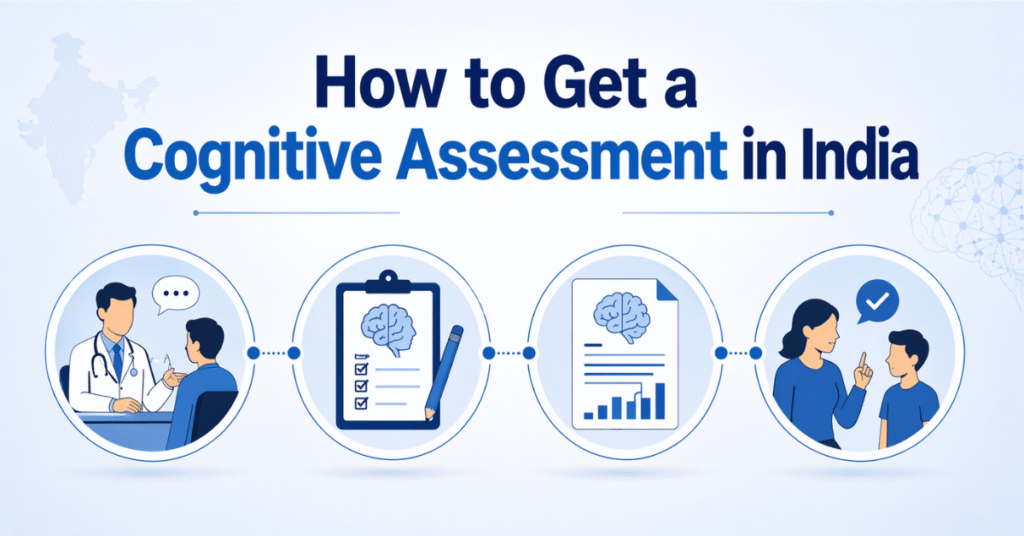
A detailed neuropsychological assessment checks the specific ways DMD affects a child’s thinking and learning. Just a basic evaluation misses a lot. If you want a complete picture, the right person for the job is usually:
- A pediatric neuropsychologist (you’ll mostly find them in big-city hospitals and neurology centers)
- A clinical psychologist who’s worked with neurodevelopmental disorders
- Or, if things like ADHD or anxiety are a big concern, a child psychiatrist with neurodevelopmental experience
What the Assessment Should Cover
| Domain | What It Measures | Tests Commonly Used |
| Intelligence (IQ) | Your child’s overall thinking skills and problem-solving don’t just look at the final number. The subtest scores show the details | WISC-V (Wechsler Intelligence Scale for Children) |
| Working Memory | How well your child can hold and use information on the spot | Digit Span, Letter-Number Sequencing |
| Processing Speed | How quickly your child’s mind works through simple, routine tasks | Coding, Symbol Search subtests |
| Reading & Language | Phonological skills, understanding what they read, and language fluency | NIMHANS Neuropsychology Battery, or adapted tools |
| Attention & Executive Function | Focus, switching between tasks, impulse control | ADHD Rating Scale, CPT (Continuous Performance Test) |
| Social & Emotional Profile | Social awareness, emotional balance, anxiety or autism-related traits | ADOS-2 (if ASD traits present), SCARED, CBCL |
A thorough assessment does two things. It points out where your child is struggling. Just as important, it identifies their strengths. Both are key to building the kind of support that actually helps, whether at home or at school.
If you don’t know how to get started, MedicoExperts can help you find the best assessment centres or specialists in your area, making the process a little less overwhelming.
The Role of Combination Therapy in Cognitive Support
Supporting cognitive challenges in Duchenne Muscular Dystrophy (DMD) requires a personalized approach. Children with DMD confront hurdles like memory issues, trouble focusing, learning struggles, and managing emotions. So it only makes sense that supporting them takes a mix of different strategies, personalized for every child.
Why Do You Need a Combination Approach?
There’s no single therapy out there that addresses every aspect of cognitive function in DMD. If you only focus on getting attention, that doesn’t fix reading problems or make emotional ups and downs disappear. A coordinated plan is more effective because it ensures that each component receives the necessary attention, collectively driving significant progress.
Educational Interventions
Cognitive and Behavioural Therapy
Speech and Language Therapy
Occupational Therapy
Support at Home
Medical Support
The most effective approach is for everyone to work as a team. When teachers, therapists, doctors, and families stay on the same page, children get steady support wherever they are.
If you ever feel lost building this kind of game plan, tools like MedicoExperts connect you with all the right people, so you can piece together a solid, whole-child approach that really fits your child.
Takeaway

Your child’s brain needs as much attention as their body does, especially if they’re living with Duchenne muscular dystrophy.
If school feels like a struggle, if focusing is tough, or their emotions swing all over the place, it’s not just “how they are.” It’s part of living with DMD. And with the right support, these challenges get easier to handle.
That’s why a whole-person approach matters. MedicoExperts brings together a team of specialists who don’t just target muscle strength. They work on cognitive skills and emotional balance, too, using a care plan that actually fits your child. Everything gets coordinated, so you don’t have to handle it alone.
Check Your Child’s Eligibility for Combination Therapy
Frequently Asked Questions (FAQs):
Q1. What are working memory problems in children?
A. Working memory problems in children mean difficulty holding and using information for short periods, like following instructions or solving problems. Working memory problems in children can make learning tasks like reading and math more challenging.
Q2. Do all children with Duchenne muscular dystrophy have learning difficulties?
A. No, not every child with DMD struggles with learning. But some of these children do run into specific challenges like paying attention, remembering, or keeping up with how quickly information comes at them. It’s different for each child. Some get by without much trouble, but others need more structured help in school.
Q3. How is DMD related to learning problems?
A. DMD happens because the body doesn’t make dystrophin. While this protein keeps muscles healthy, it matters for the brain too. Without it, certain parts of the brain process information differently, which can mess with learning, attention, and even behaviour. These issues don’t always match up with how strong or weak the muscles are.
Q4. What tests can identify cognitive challenges in a child with DMD?
A. A neuropsychological assessment gets to the heart of these issues. It usually involves IQ tests like the WISC-V, plus checks for working memory, attention, processing speed, language skills, and emotional health. The results lay out where a child’s strengths and difficulties really are, so teachers and parents know how to help.
Q5. Can a child with DMD attend regular school in India?
A. Absolutely. Many children with DMD go to mainstream schools in India, especially when they get the right support. Things like extra time on tests, adapted assignments, or personalized learning plans can make things easier. The Rights of Persons with Disabilities Act, 2016, also backs up their right to this kind of education.
Q6. Is ADHD common in children with duchenne muscular dystrophy?
A. Yes, ADHD symptoms are more common in children with DMD than in other children. They might have trouble focusing, acting on impulse, or finding it hard to organize themselves. It’s important for a specialist to check for these symptoms so they get the right support.
Q7. What is the Dp140 isoform, and why does it matter for cognition?
A. The Dp140 isoform is a type of dystrophin found mostly in the brain. Children with DMD who don’t have Dp140 are more likely to face trouble with learning, especially with language and memory. If doctors know a child is missing this isoform, they can watch for these issues early and step in with help when it counts.
References
Relevant Articles For You
DMD Child Heart Problems
The main cause of heart issues in DMD is dystrophin deficiency. Dystrophin is a vital protein that keeps muscle…..Read More
Why DMD is Progressing Faster?
Not all children with DMD lose muscle strength at the same speed. Some stay active longer, while others see…..Read More
How Does DMD Affect Daily Life?
DMD impacts the movement, breathing, heart health, bone health, cognitive skills, and behaviour of the…..Read More
Innovations in MD Therapy
Muscular dystrophy typically manifests its symptoms during childhood or adolescence, affecting…..Read More
Recommendations To Understand Different Treatments
Combination Therapy for Muscular Dystrophy
Muscular dystrophy affects every patient differently. So we don’t believe in single-track treatments. Our approach blends…..Read More
Medically Reviewed by MedicoExperts Editorial & Clinical Review Board on 15 April 2026
Medical Disclaimer: This content is for informational purposes only and is not intended as medical advice, diagnosis, or treatment. Always seek the advice of your physician or other qualified healthcare provider regarding any medical condition or dietary needs.