
Last updated on April 29th, 2026 at 05:02 pm
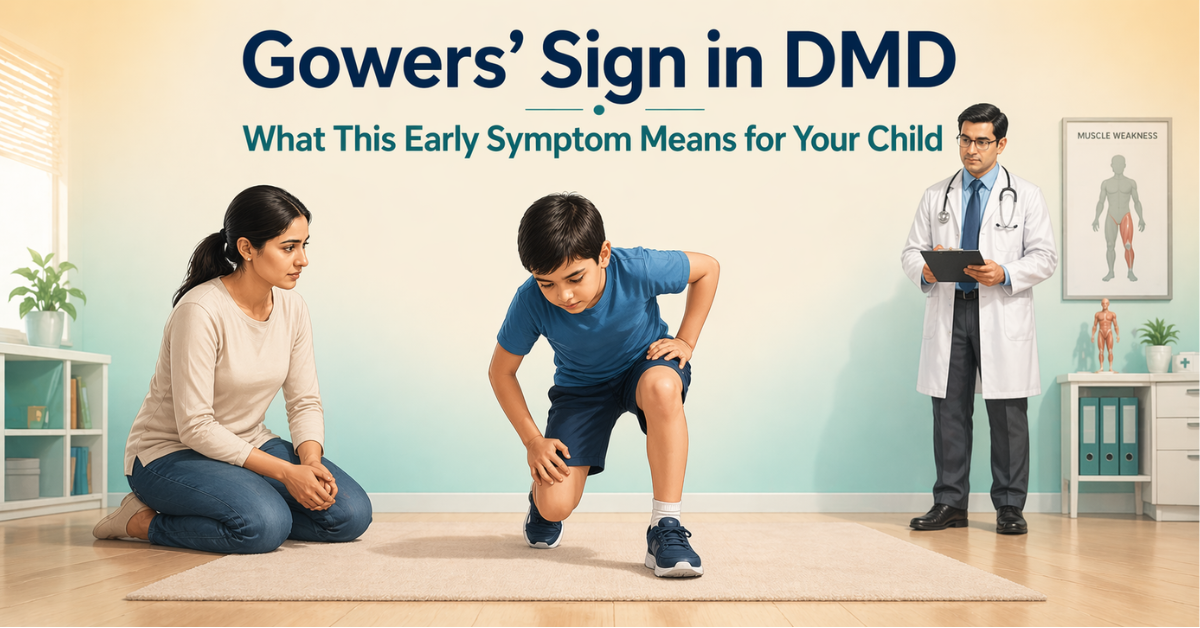
If your 3-year-old is trying to rise from the floor and instead of pushing up smoothly with their legs like other children, your child rolls over, leans on their hands for support, and slowly “climbs” up their thighs to get to their feet.
It may look like just a quirky way of standing. Or maybe a doctor recently mentioned Gowers’ sign in DMD, and now you’re wondering what that means.
For many parents, this is the moment when worries start. Is this just a phase, or is it an early warning sign of something more serious?
Here, you’ll learn about what Gowers’ sign in DMD actually looks like, why it happens, and what it tells you about your child’s muscle health, so you’re ready to make informed, timely choices about what to do next.
What is Gowers’ Sign in DMD?
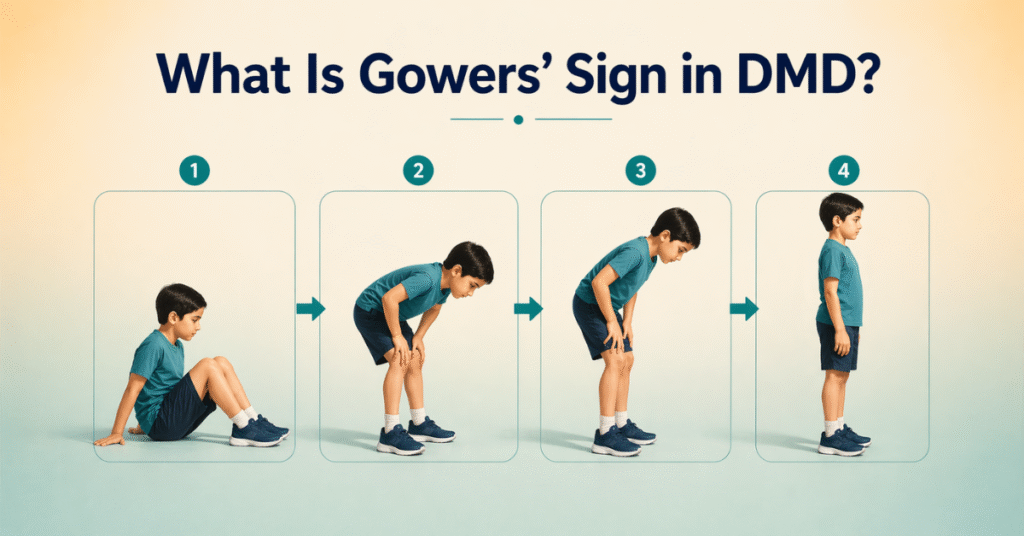
Gowers’ sign shows up in children with DMD as a peculiar way of getting up from the floor. Their hip and thigh muscles are weak, so instead of rising quickly, they push with their hands and arms, almost “climbing” up their bodies for support. It’s a classic red flag for Duchenne muscular dystrophy, though you sometimes see it in other neuromuscular disorders too.
The Step-by-Step Movement Described:
- Child Starts From a Seated or Lying Position on the Floor: First, the child sits or lies on the floor. Normally, children push up with their legs and hips. Children with DMD can’t. They struggle because those muscles are weak.
- Child Rolls or Shifts to a Face-Down (Prone) Position: Next, the child shifts or rolls to a prone position. This move spreads out their weight so their arms can help.
- Child Pushes Up onto Hands and Knees (All Fours): Then, they push themselves onto all fours, stabilizing briefly. Their legs splay out for balance.
- Children Straighten Their Legs While Keeping Their Hands on the Floor: Now comes the tripod stage. Legs straighten, but hands stay planted on the floor. The hips go up, creating that signature inverted “V” posture.
- Children Walk Their Hands Up Their Shins, Knees, and Thighs: As they stand up, the child walks their hands up their shins, knees, and thighs. They “climb” their legs, using their arms to boost their weak torso. That’s the hallmark of Gowers’ sign.
- Child Reaches Fully Upright Standing Position: When the child finally stands upright, you’ll notice the whole process takes longer than usual, usually around five to ten seconds. That delay gives away the underlying muscle weakness.
Who First Described It, and Why It Matters Historically?
Sir William Richard Gowers first described this sign, and even now it remains one of the earliest clues physicians look for during neurological exams.
Here’s a bit of background that helps put things in perspective. Back in 1879, Sir William Richard Gowers, a British physician, was the first to spot and describe this movement pattern while he was studying progressive muscular atrophy.
He noticed that children who used their hands to push themselves up their legs were making up for weak hip and thigh muscles. Gowers nailed the explanation right. Doctors still rely on this observation over a century later. His precise description has made the sign a widely recognized diagnostic clue in neurology, known by his name.
Experts emphasize its role as an early, clear indicator that a child has trouble with proximal muscle strength (the force generated by muscles closest to the body or the center of the body or trunk).
Why Does Gowers’ Sign Happen? The Muscle Science
If you want to understand why Gowers’ sign happens in Duchenne muscular dystrophy (DMD), you have to move past what you see on the outside and learn more about what’s going on inside the muscles. The answer starts at the microscopic level: how muscle cells are built, how they’re protected, and which muscles get affected first.
The Role of Dystrophin in Healthy Muscles
Which Muscles Weaken First in DMD?
Why the Arms Must Compensate?
What Gowers’ Sign Tells Doctors – The Clinical Picture
For doctors, Gowers’ sign in Duchenne Muscular Dystrophy (DMD) is more than an unusual way a child stands up. For them, it’s a window into where the muscle weakness begins and how it changes as the disease progresses.
Gowers’ Sign as a Proximal Muscle Weakness Marker
Is Gowers’ Sign Always DMD?
How Doctors Formally Test for Gowers’ Sign?
At What Age Does Gowers’ Sign Appear?
When does Gowers’ sign show up in kids with Duchenne muscular dystrophy? It’s consistent, and there’s a pattern, and knowing it helps you and your doctors spot the right moment for action.
The DMD Developmental Timeline
Here’s the usual timeline:
| Age / Stage | What Happens | Parent / Doctor Action |
| Birth – 12 months | Usually no signs, though some babies have mild hypotonia (low muscle tone). | No action unless high-risk or family history. Sometimes CK screening. |
| 12 – 24 months | Walking might be late (after 18 months). Kids can seem awkward and fall more. | Watch closely. Talk to your pediatrician. CK test if worried. |
| 2 – 3 years | Gowers’ sign often appears here. Calves may get bigger, walking looks “waddling.” | Get a pediatric neurologist involved right away. Don’t wait. |
| 3 – 5 years | Gowers’ sign gets obvious. Running, jumping, stairs are tough. Lordosis (arched back) appears. | If not yet diagnosed: urgent neurological assessment + genetic testing. If diagnosed: begin treatment protocol. |
| 5 – 7 years | Decline gets worse. Gowers’ sign stands out. Steroid treatment starts | Fine-tune the treatment plan; look at advanced therapies. |
| 8 – 12 years | Gowers’ sign can disappear, not because things improve, but because standing up is hard. | Plan mobility supports; start heart and lung monitoring. |
| Critical Point for Indian Parents |
| For parents in India, don’t assume your child will “outgrow” Gowers’ sign. With Duchenne, this is a sign that the disease is getting worse. If you spot it, see it as your chance for early intervention. |
Other Early Signs That Accompany Gowers’ Sign in DMD
Other signs that show up with Gowers’ sign are as follows:
| Early Sign | What Parents See at Home |
| Calf pseudohypertrophy | Calves look big and firm, but that’s not muscle. It’s fat and fibrous tissue replacing it. |
| Waddling gait | Child wobbles side-to-side when walking, hips tilt. Not steady like other kids. |
| Toe-walking | Walking on toes happens a lot, especially when tired. Not a quirky habit. |
| Frequent unexplained falls | Falls, even when playing on flat ground. |
| Difficulty climbing stairs | Needs help—holds rail, climbs one step at a time. |
| Delayed running or jumping | Isn’t running or jumping like others by age 3–4. |
| Lordosis (swayback posture) | Lower back arches a lot when standing up. |
A Parent’s Action Guide: What to Do If You See Gowers’ Sign?
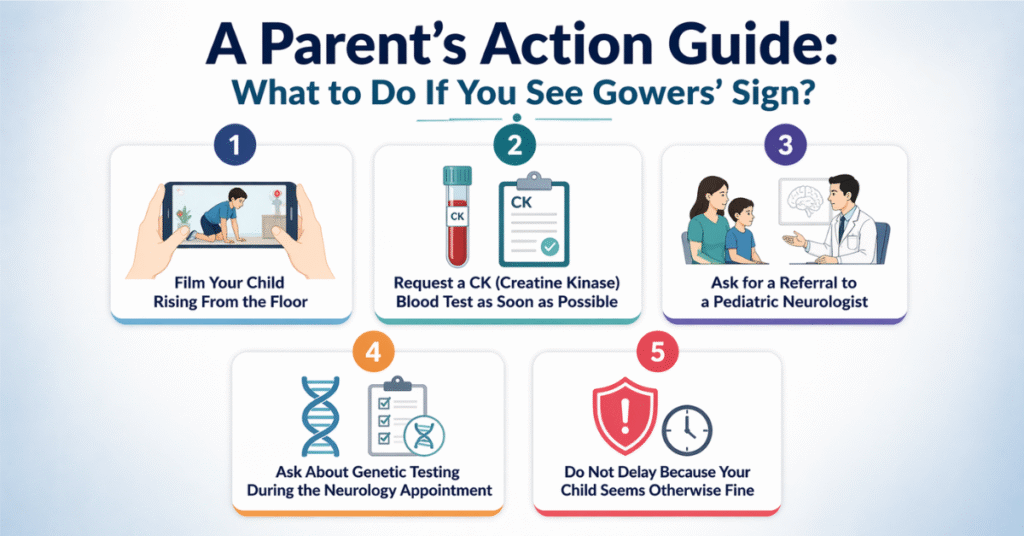
If you have noticed Gowers’ sign in your child, here are the steps you should take:
1. Film Your Child Rising From the Floor
A short 30–60 second video during normal play is enough. It helps doctors see how your child moves in a natural setting.
2. Request a CK (Creatine Kinase) Blood Test as Soon as Possible
This test is quick and commonly available. In Duchenne Muscular Dystrophy (DMD), CK levels can be significantly higher than normal.
3. Ask for a Referral to a Pediatric Neurologist
If you notice Gowers’ sign along with other warning signs, consult a specialist rather than waiting for a routine visit.
4. Ask About Genetic Testing During the Neurology Appointment
Tests such as MLPA or NGS can help confirm DMD and guide treatment decisions.
5. Do Not Delay Because Your Child Seems Otherwise Fine
Early DMD symptoms can appear mild, but early diagnosis and treatment can make a major difference over time.
What to Say to Your Doctor?
“My child uses their hands to climb up their legs while getting up from the floor. I have a video of it. I’m concerned about Duchenne Muscular Dystrophy. Can we do a CK test and discuss a neurology referral?”
How DMD Is Confirmed After Gowers’ Sign: The Full Diagnostic Pathway
Gowers’ sign is the beginning of the diagnostic journey, not the end. Here is what happens next, once a neurologist is involved:
| Diagnostic Step | What It Involves & What It Shows |
| Step 1: CK Blood Test | CK hits 10,000–20,000 U/L in DMD. Shows muscle damage. |
| Step 2: Full Muscle Enzyme Panel | LDH, ALT, AST also rise due to muscle breakdown. |
| Step 3: Genetic Testing (MLPA / NGS) | Finds the DMD gene mutation. This clinches the diagnosis. |
| Step 4: Muscle Biopsy (if genetic testing inconclusive) | Checks for dystrophin protein. Not done much now, since genetic tests are best. |
| Step 5: Cardiac Evaluation (ECG + Echo) | ECG and echocardiogram to see if the heart is affected. |
| Step 6: Pulmonary Function Test (in older children) | Start at age 5–6 to check lung function. |
| Reassuring Note for Parents |
| Don’t let the process scare you. It’s well-established, and families usually get answers quickly. Early action opens the door to better care and clearer decisions. For a more detailed guide to each diagnostic test and where to access them in India, see our full article: ‘How Is Muscular Dystrophy Diagnosed in India? Step-by-Step Guide for Families’. |
From Diagnosis to Action: The Role of Early Intervention
Once you spot Gowers’ sign in a child with Duchenne muscular dystrophy (DMD), everything changes. Suddenly, you’re not just watching and waiting. You’re caught up in decision-making, medical appointments, tough conversations, and a process to understand medical terms.
It’s a stressful stretch, especially for parents, but this is also the moment when acting quickly matters. What you do in the first weeks and months isn’t just about putting a name to what’s happening.
It’s about grabbing the chance to protect your child’s muscle strength and set up the best possible care.
Why the First Months After Gowers’ Sign Matter Most in DMD?
MedicoExperts’ Combination Therapy: Why Timing Is Everything?
If You’re Seeing Gowers’ Sign, What to Do Next?
If Your Child Has Gowers’ Sign, Check Eligibility Now
The presence of Gowers’ Sign may indicate that the diagnostic window is open. Do not spend this valuable time only waiting for test results.
Contact MedicoExperts while the diagnostic process is underway.
A Parent’s Story

My son Aarav was just over three when I started to notice something odd. Every time he got up from the floor, he’d push on his knees and kind of climb up his legs, instead of just standing straight up. At first, we brushed it off. My in-laws said some kids just move differently, and my husband figured he’d grow out of it.
Still, it stuck with me. One day, while he was playing, I recorded a quick video of him getting up and showed it to our pediatrician. That was a turning point. The doctor ordered a CK blood test and sent us to a neurologist.
Aarav’s CK levels were high, and after more tests, we got the diagnosis: Duchenne muscular dystrophy. All that happened within a few weeks. When I think back, I’m so grateful I listened to my gut and took that video. It meant we caught things much earlier than we otherwise would have.
— Raksha Bhatt
Conclusion

Noticing something as small as how your child gets up might not seem like a big deal at first, but Gowers’ sign in DMD can be one of the first signals that something’s going on. It doesn’t diagnose anything by itself, but it definitely tells you to take action, start asking questions, and move quickly.
Here’s what matters most. The sooner you spot the signs, the sooner you can step in, and that changes everything about how the condition gets managed. Whether it’s recording a simple video at home, getting a CK test, or talking with a specialist, every move you make helps clear things up and gets your child closer to the right care when it matters most.
If you notice this pattern in your child, trust what you’re seeing. Get advice, follow through with tests, and don’t wait. Even when things feel uncertain, taking clear, timely action can change the course of your child’s experience.
If you’re noticing Gowers’ sign in DMD, don’t wait. Get expert guidance early to understand the right next steps for your child. MedicoExperts can help you explore care options for Duchenne muscular dystrophy with confidence.
Frequently Asked Questions (FAQs):
Q1. Is Gowers’ sign always linked to muscular dystrophy?
A. Not always. While people usually connect Gowers’ sign with muscular dystrophy, this movement pattern shows up in other neuromuscular problems, too. Doctors look at it alongside the child’s age, how symptoms move over time, and lab results before making any diagnosis.
Q2. My 2-year-old uses their hands to stand up. Should I worry?
A. If you notice your child always using their hands to push up, especially if they’re also falling or started walking late, it’s worth getting it checked.
Parents Google, “My child uses their hands to stand up. Is that normal?” The real answer depends on how it happens and if there are other concerns. If you’re not sure, talk to a doctor sooner rather than later.
Q3. Can Gowers’ sign show up in girls?
A. It can, but it’s uncommon. Duchenne muscular dystrophy mostly affects boys because it’s X-linked. Still, girls who are carriers or have other muscle disorders can rarely show symptoms.
Q4. What’s the first test doctors do if they see Gowers’ sign?
A. Usually, a CK (creatine kinase) blood test comes first. It’s a quick way to check for muscle damage. This test is especially important for detecting DMD early in India. It’s easy to get and points doctors in the right direction fast.
Q5. Is Gowers’ sign painful for children?
A. No, the movement itself isn’t painful. It’s how children with weak muscles get up from the floor. As muscle weakness gets worse, though, children might get tired or feel uncomfortable with effort.
Q6. Does Gowers’ sign go away as DMD gets worse?
A. Yes, but that isn’t a good sign. Early on, when children can still stand up on their own, Gowers’ sign is easy to spot. As DMD advances, the child can’t stand up from the floor anymore, so you don’t see the sign because they lose that ability.
Q7. How is Duchenne diagnosis done in a toddler?
A. A Duchenne diagnosis in a toddler usually starts with a CK (creatine kinase) blood test to check for muscle damage. If levels are high, doctors confirm the diagnosis with genetic testing for Duchenne muscular dystrophy.
Q8. How do doctors test for muscular dystrophy in toddlers?
A. Doctors begin with a physical exam and developmental history, often observing movements like difficulty standing. They then order a CK (creatine kinase) blood test, followed by genetic testing to confirm conditions such as Duchenne muscular dystrophy.
Q9. What are the signs of muscular dystrophy in toddlers?
A. Common signs of muscular dystrophy in toddlers include frequent falls, difficulty standing up, delayed walking, a waddling gait, and enlarged calves. These early features may point toward conditions like Duchenne muscular dystrophy and should be evaluated by a doctor.
References
Relevant Articles For You
Why DMD is Progressing Faster?
Not all children with DMD lose muscle strength at the same speed. Some stay active longer, while others see…..Read More
DMD Cognitive Challenges
Duchenne muscular dystrophy primarily draws attention for its impact on muscles, but this is only a partial…..Read More
Recommendations To Understand Different Treatments
Duchenne Muscular Dystrophy Treatment
DMD is a genetic condition caused by changes in the DMD gene that affect the production of dystrophin…..Read More
Combination Therapy for Muscular Dystrophy
Muscular dystrophy affects every patient differently. So we don’t believe in single-track treatments. Our approach blends…..Read More
Medically Reviewed by MedicoExperts Editorial & Clinical Review Board on 21 April 2026
Medical Disclaimer: This content is for informational purposes only and is not intended as medical advice, diagnosis, or treatment. Always seek the advice of your physician or other qualified healthcare provider regarding any medical condition or dietary needs.