

Dealing with muscle weakness, fatigue, or a heavy feeling in your limbs isn’t just frustrating. It can throw off your whole day. You may have heard about the CK test for muscle weakness and aren’t sure what it is or if your symptoms are something to worry about.
The CK test checks for muscle damage. It’s a way to figure out what’s going on in your body. Knowing about it early reduces confusion and helps ease some of that anxiety. It also sets you on a clearer path to proper care.
In this post, we will walk you through what the CK test actually measures, why doctors suggest it, and when to think about getting it.
What is a CK Test for Muscle Weakness? Why is it also called a CPK Test?
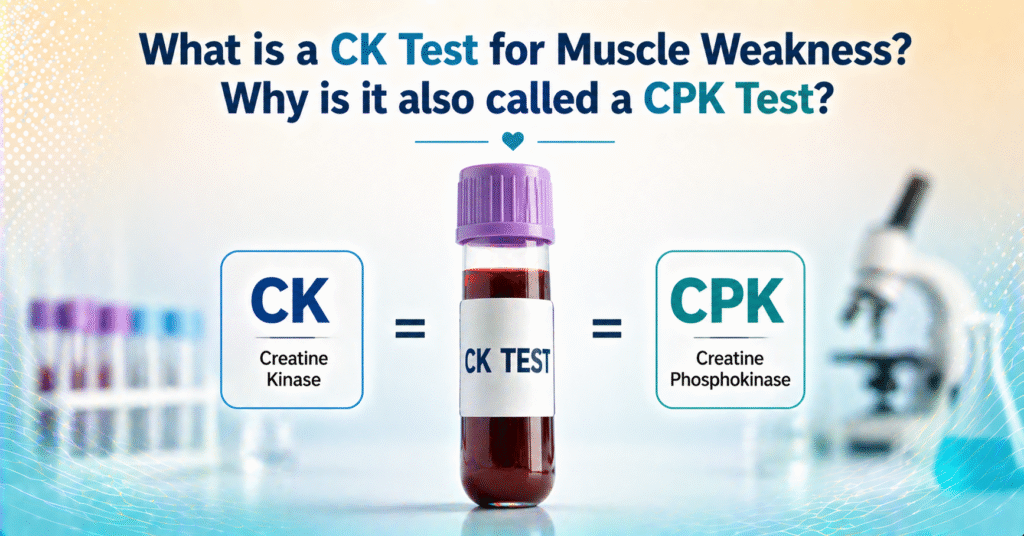
A CK test, or creatine kinase test, checks how much of the enzyme creatine kinase is floating around in your blood. This enzyme is mostly found in your skeletal muscles, heart, and brain.
It’s important in the process that lets your muscles contract and use energy. Normally, CK is in your cells, so blood levels stay pretty low.
But if you damage your muscles, it may be from an injury, intense exercise, inflammation, or some health problems. Those muscle cells break open, and CK spills into your bloodstream. When that happens, blood CK levels increase.
You might also hear people refer to this as the CPK test. That stands for creatine phosphokinase. It’s the older name for the same thing. Both terms mean the same test and refer to the same enzyme. You still see “CPK” used in many hospitals and clinics.
CK actually comes in three main types, or isoenzymes:
- CK-MM: mostly in your skeletal muscles
- CK-MB: mostly in the heart muscle
- CK-BB: mostly in brain tissue
Measuring CK gives doctors some important details about your health. It’s a basic way to check for muscle damage, neuromuscular disorders, heart issues, and even some metabolic conditions.
If you come in complaining about chronic muscle weakness, aching muscles, or exhaustion you can’t explain, CK testing gives doctors early clues, even before more obvious signs show up.
Why Would a Doctor Order a CK Test for My Child?

Sometimes children show strange muscle weakness. They may fall a lot, or their motor skills seem stuck, or they complain about their muscles hurting.
When that happens, a doctor wants to look deeper, to see what’s going on inside those muscles. The CK test does just that. It helps spot any muscle damage or stress that you can’t see from the outside.
For children, doctors use CK as an early screen for neuromuscular problems. It’s backed up by research and clinical guidelines. Take muscular dystrophies, inflammatory muscle disorders, or even injuries. These conditions set off higher CK levels. And in cases like Duchenne muscular dystrophy, the CK level can skyrocket long before the symptoms get truly obvious.
You’ll see a doctor order this test when
* A child has ongoing muscle pain or stiffness.
* They’re struggling with stairs, running, or getting up off the floor.
* Walking or coordination milestones aren’t happening on time.
* Their urine turns dark. Sometimes a sign that the muscles are breaking down.
But keep this in mind: The CK test isn’t the answer box. It won’t confirm a diagnosis. Think of it as the first puzzle piece. Doctors take the results and then figure out if they need more tests, like genetic screens or scans.
For parents, the CK test brings some early answers, or at least a direction. If there’s something serious going on, catching it early means starting treatment sooner and giving your child the best chance.
CK Normal Range for Children: What the Numbers Mean?
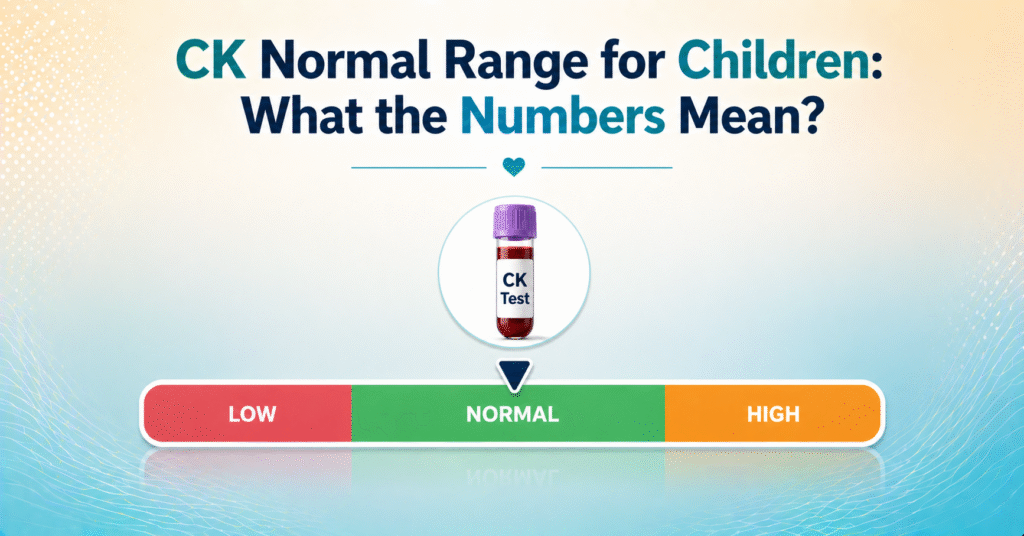
When your child gets a CK test, the report usually starts with the “normal range.” That’s just the expected creatine kinase level in the blood for healthy children. These numbers aren’t set in stone. They shift depending on age, sex, and how active your child is. So, doctors never interpret them blindly.
Most lab references put CK levels for children somewhere between 20 and 200 U/L. Newborns tend to score higher, especially in the first days after birth. If your child has been running around or exercising a lot, those numbers can bump up a bit, too.
Don’t stress over the idea of a “normal” CK. Every lab has its own reference points, and slight differences don’t mean trouble. What matters more are dramatic spikes, which can signal
- Muscle injury
- Inflammation
- Genetic conditions like muscular dystrophy.
Low CK levels rarely point to anything serious. Doctors usually don’t worry about them.
CK values alone never tell the whole story. Your doctor looks at these numbers along with your child’s symptoms, medical history, and other tests to figure out what’s going on. That’s how you get an accurate diagnosis.
8 Reasons Why CK Can Be High in a Child (Not Just Muscular Dystrophy)
Seeing a high creatine kinase (CK) level in your child’s lab results can be worrying, but it isn’t dangerous or long-lasting. CK is an enzyme you mostly find in muscles, so whenever muscles get stressed, worked, or injured, CK can spike.
One high CK on a lab isn’t a diagnosis. It signals the doctor to have a closer look at the child’s symptoms. Usually, they’ll look at the child’s symptoms and medical history, examine them, and may recheck the CK before making any decisions.
1. Viral Illness or Flu-Related Myositis
2. Recent Intense Exercise
3. Intramuscular (IM) Injections
4. Trauma or Falls
5. Hypothyroidism
6. Inflammatory Myopathy
7. Rhabdomyolysis
8. Muscular Dystrophy
Most of the time, CK goes up briefly and drops back down. That’s why doctors usually repeat the test and check your child carefully before deciding anything. There’s more to the story than just one number.
Worried About Your Child’s Muscle Weakness?
Understand what CK levels may indicate and when expert evaluation becomes important.
CK Levels and Muscular Dystrophy: What the Connection Actually Means?

When doctors suspect muscular dystrophy, they usually start with a CK test. Muscular dystrophy isn’t one disease. It’s a group of genetic disorders that slowly weaken and damage muscles over time. As these muscle cells break down, they release creatine kinase (CK) into the bloodstream, which sends CK levels soaring, sometimes dramatically.
That’s why high CK levels serve as an early red flag, especially in children who show signs like:
- delayed walking
- frequent tumbles
- trouble getting up off the floor
- difficulty climbing stairs.
But high CK doesn’t always point straight to muscular dystrophy. Many other factors, such as viral infections, tough workouts, injuries, or inflammation, can push CK higher, too.
So, doctors don’t just rely on the CK test. They study your symptoms and medical history using details like
- physical exams
- family history
- genetic testing
- sometimes muscle imaging or nerve studies.
In forms like Duchenne muscular dystrophy, you might see CK levels spike long before muscle weakness sets in. That makes the CK test valuable for spotting children who need more in-depth checks or early support.
The CK test is for screening and monitoring. On its own, it won’t give you a definite answer.
What Happens After a High CK Test? The Diagnostic Journey Explained

A high CK result doesn’t mean there is a serious issue. It signals that more investigation is needed to find the real cause. When doctors spot elevated CK levels, their main concern is figuring out why the muscles are pumping extra creatine kinase into the bloodstream.
What happens next depends on the child’s symptoms, overall health, and the level of their CK. Often, the first thing doctors do is repeat the test a little later, sometimes after a few days or weeks. This is especially true if the child recently battled a virus, exercised hard, or was injured, since these can temporarily raise CK levels.
From there, doctors have a closer look:
- They do a full physical and neurological exam.
- They go through the family’s medical history.
- They check thyroid function and screen for inflammation with blood work.
- If they suspect an inherited muscle problem, they’ll order genetic tests.
- Muscle MRI or other imaging can help clarify what’s going on.
- In some cases, they use nerve conduction studies or EMG to get more details.
If muscular dystrophy or another neuromuscular disease is on the table, catching it early is crucial. That way, families can get the right treatment, rehab, and support sooner.
But here’s the thing: not every child with high CK has a serious muscle disorder. Doctors take their time and look at everything step by step. They know one high result can’t tell the whole story.
Need Help Understanding a High CK Report?
Get guidance on possible causes, next diagnostic steps, and specialist consultation support.
How to Prepare Your Child for a CK Blood Test?

Getting your child ready for a CK blood test doesn’t have to be a stressful experience. The test itself is straightforward, but a little preparation goes a long way, not just for more reliable results but to help your child feel at ease.
Since physical activity can push CK levels higher, doctors often say to skip things like running, sports, or any tough workouts for a day or two before the appointment. Here’s what helps most:
- Talk to your child about the test in simple, calm language so it doesn’t feel scary.
- Make sure they drink enough water that day.
- Let the doctor know if your child’s been sick, hurt, or recently vaccinated.
- Don’t forget to tell the doctor about any medicines or supplements your child is taking.
- Dress your child in something soft and comfortable. It makes things easier when it’s time to roll up a sleeve.
Usually, your child won’t need to fast, unless the doctor ordered other blood tests.
The needle might sting for a second, but the blood draw is fast and very safe. If you stay calm and reassuring, your child will pick up on that, and the whole thing goes smoother.
Takeaway

A high CK level can be unsettling, but it’s just a starting point. A CK test for muscle weakness doesn’t give a final answer. It just opens the door for further investigation.
For children, CK levels spike for many reasons: a recent viral infection, exercise, or something that needs more attention. What counts is looking at the whole picture, acting quickly, and following up with the right care.
Parents need proper and helpful advice early on, something to help cut through the uncertainty and guide next steps. When families have access to the right specialists and a team that knows how to coordinate care, they’re not walking the path alone. MedicoExperts can help you achieve the same.
That support matters every step of the way, from diagnosis through treatment, especially for pediatric muscle and neuromuscular concerns.
Looking for the Right Neuromuscular Care Pathway?
Connect with MedicoExperts for expert guidance, treatment coordination, and support for pediatric muscle health concerns.
Frequently Asked Questions (FAQs):
Q1. Is the CK test the same as a CPK test?
A. Yes. CK stands for creatine kinase, and CPK stands for creatine phosphokinase. They’re different names for the same enzyme and the same blood test. “CPK” is an older term you’ll still see used in many hospitals and labs.
Q2. What’s a CK test for muscle weakness?
A. A CK test checks how much creatine kinase is in the blood. Doctors use it to see if muscle damage, inflammation, or muscle stress could be behind symptoms like weakness, pain, stiffness, or fatigue.
Q3. Why can creatine kinase be high in children?
A. Children can have high creatine kinase for a bunch of reasons: viral infections, heavy exercise or sports, muscle injuries, shots, inflammation, thyroid issues, or certain neuromuscular disorders. A high CK by itself doesn’t always mean something serious.
Q4. Does high CK always mean muscular dystrophy?
A. No. Muscular dystrophy can raise CK a lot, but plenty of other, less serious or temporary things can, too. Doctors look at the CK result together with symptoms, a physical exam, and sometimes genetic tests before making a diagnosis.
Q5. What counts as a dangerously high CK in a child?
A. There’s no single “dangerous” CK number for every child. Doctors weigh the CK result with symptoms like severe muscle pain, weakness, dark urine, dehydration, or fever. Extremely high CK may need urgent attention to rule out serious muscle damage.
Q6. Can exercise make CK go up in children?
A. Yes. Running, sports, roughhousing, and many physical activities can bump up CK for a short time, since muscles release more creatine kinase after working hard.
Q7. My child has high CPK but no symptoms. What happens next?
A. Doctors repeat the test later and go over your child’s medical history, recent activity, any sickness, medications, and development. Most of the time, a temporary rise in CK goes back to normal without causing problems.
Q8. How do doctors test for muscular dystrophy in children?
A. They usually start with a CK blood test. If the result is high or symptoms point that way, they follow up with a physical exam, talk about family history, and may order genetic testing. Sometimes, doctors also use MRI scans, nerve tests, or even a muscle biopsy to confirm what’s going on.
Q9. My child has high CPK levels. What’s next?
A. Doctors usually repeat the test and review your child’s symptoms, recent illness, activity level, and medical history. If CK levels remain high, further tests like genetic testing or muscle evaluation may be recommended.
References
Relevant Articles For You
Genetic Testing For MD
Genetic testing for muscular dystrophy checks for mutations in the genes that cause different forms of the…..Read More
Is Muscular Dystrophy Curable?
Is muscular dystrophy curable? We can understand that this question is bothering you, as you or your loved one may be…..Read More
How Does DMD Affect Daily Life?
DMD impacts the movement, breathing, heart health, bone health, cognitive skills, and behaviour of the…..Read More
Innovation in MD Therapy
Currently, there is no cure for muscular dystrophy. However, researchers are constantly working on new…..Read More
Prevalence & Incidence of MD
Muscular dystrophies (MDs) are a group of inherited muscle-wasting disorders. In India, precise epidemiological…..Read More
Early Signs of MD
The early signs of muscular dystrophy may be different for different people depending on the type of it. But here are…..Read More
Recommendations To Understand Different Treatments
Combination Therapy For Muscular Dystrophy
Muscular dystrophy affects every patient differently. So we don’t believe in single-track treatments. Our approach blends…..Read More
Medically Reviewed by MedicoExperts Editorial & Clinical Review Board on 30 April 2026
Medical Disclaimer: This content is for informational purposes only and is not intended as medical advice, diagnosis, or treatment. Always seek the advice of your physician or other qualified healthcare provider regarding any medical condition or dietary needs.