
When a child with cerebral palsy manages to take a step, sit up without wobbling, or even reach for something, that’s a big deal. Gross motor function in cerebral palsy shapes the way these children move, balance, and connect with the world.
For them, things most people take for granted, like sitting up straight or walking across a room, can be a huge challenge. It takes grit, patience, and often a whole team cheering them on.
You need to understand their condition very well to help and support them as a parent. Progress isn’t a straight line. Every child faces their own set of obstacles and celebrates victories that are truly their own.
The right start matters. Early intervention, steady therapy, and a supportive environment do wonders. With that kind of backing, children get stronger, learn new moves, and start to feel more confident. Families who see both the struggles and the possibilities find a way to stay hopeful. It keeps them grounded as they ride out the highs and lows of rehab.
Worried about your child’s motor development? Early guidance can clear confusion and help you understand exactly what your child needs. Get a development-focused assessment, expert therapy insights, and clear next steps to support their progress with confidence.
What is Gross Motor Function in Cerebral Palsy?
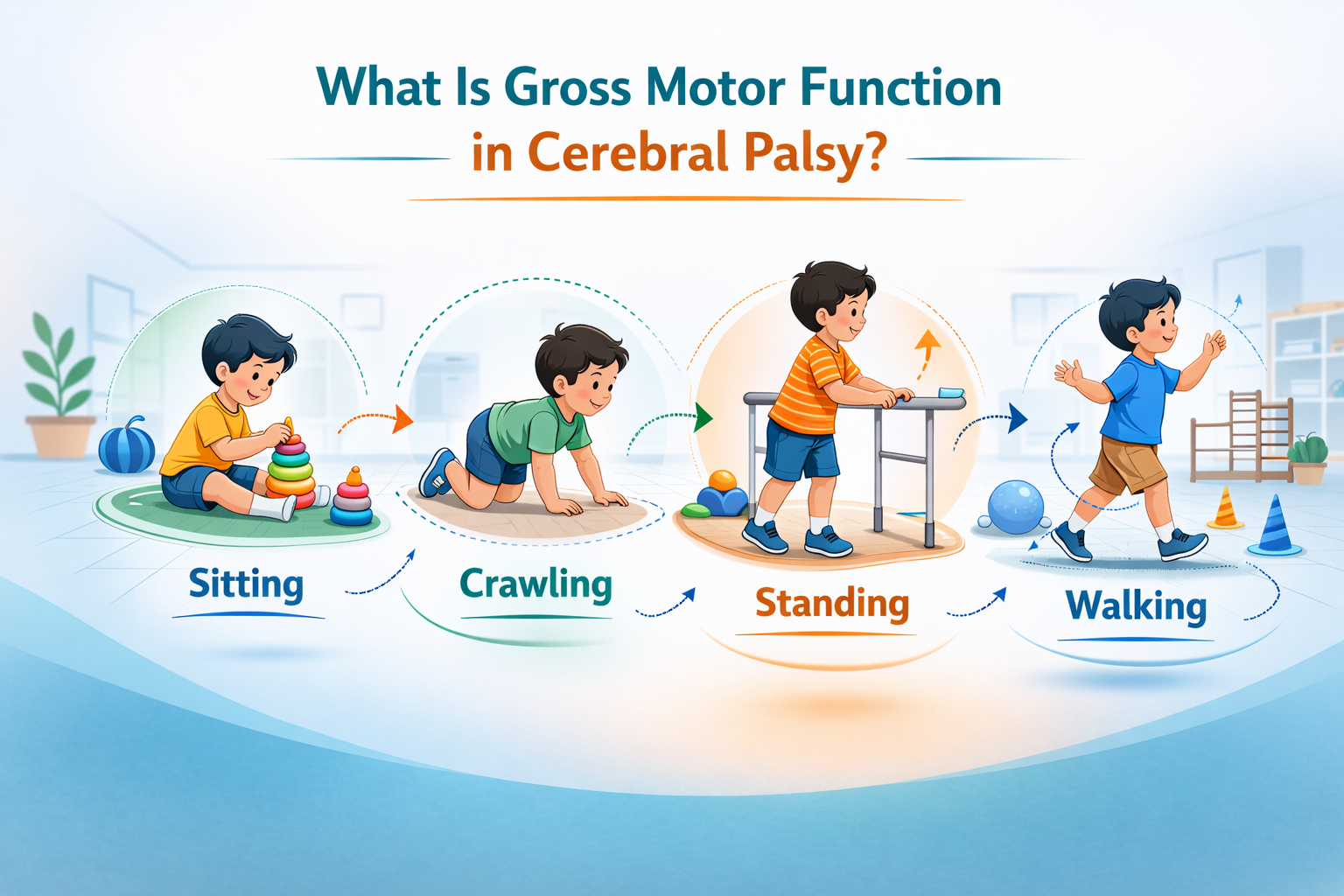
Gross motor function in the context of cerebral palsy is about movement, using your arms, legs, and core muscles to do things like sit up, crawl, or walk around. These are the skills that help your child hold themselves steady, switch positions, and explore the world.
Now, a child with cerebral palsy faces extra hurdles with these movements. The way their brains send signals to their muscles is different, which can cause muscles to feel stiff, weak, or sometimes move on their own.
Because of that, things other children do without thinking, like standing up or climbing stairs, can need more effort and sometimes special therapy.
Here’s what we’re talking about when we mention gross motor function in cerebral palsy:
- sitting upright without needing to lean on anything
- rolling over
- crawling
- standing
- walking
- climbing stairs,
- keeping their balance while moving.
Cerebral palsy comes from an early brain injury. It doesn’t get worse as time goes on, but it can impact muscle control, movement, and balance. The main reasons these activities become complicated for the child are problems with coordination and unusual muscle tone.
Not every child is affected in the same way. Some might just be a little slower to pick up these skills, while others need a lot more help to get moving.
Gross Motor Function Classification System (GMFCS) Levels Explained
The Gross Motor Function Classification System (GMFCS) is a tool doctors use to figure out how children with cerebral palsy move around in daily life. It’s mainly about their movement, which includes sitting, standing, or walking. It has nothing to do with their intelligence.
GMFCS categorizes movement into five levels. It doesn’t predict the future or measure effort. It only describes how a child moves right now.
Here’s what the levels look like:
Level 1
Level 2
Level 3
Level 4
Level 5
So, the GMFCS gives a snapshot of how a child moves today. It helps doctors and families make plans and reminds everyone that ability isn’t just about mobility.
Not sure if your child’s motor progress is on the right track?
Cerebral Palsy Motor Milestones vs Functional Ability
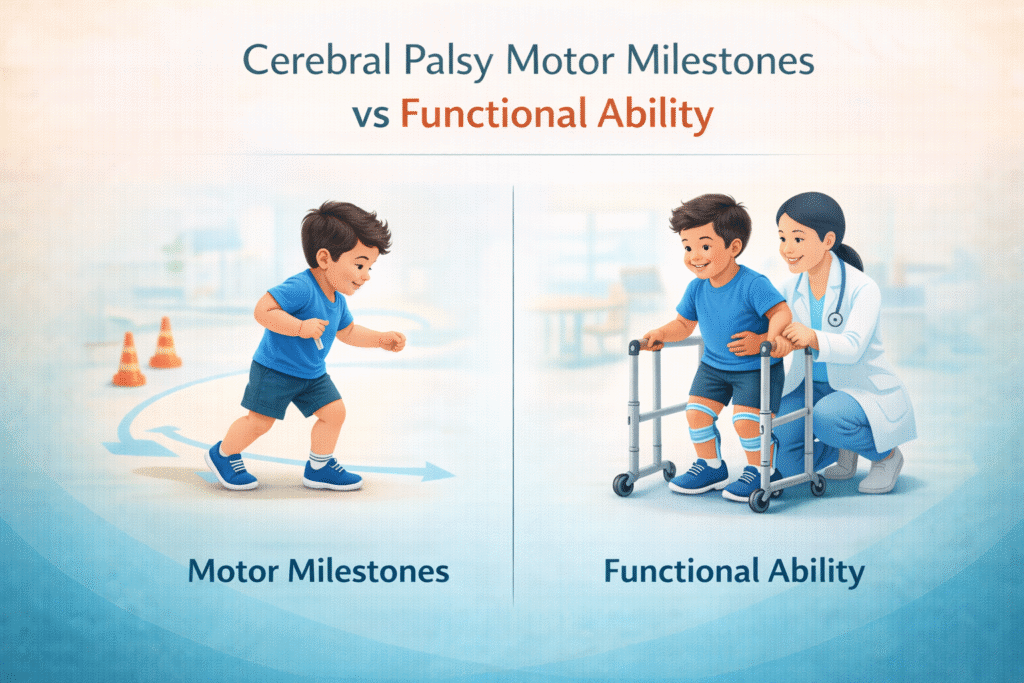
When we talk about cerebral palsy and motor milestones, it is important not to mix up two big ideas: developmental milestones and functional ability.
Milestones are basically a checklist built from what most children do at certain ages, like sitting up, crawling, standing, and walking. But these charts are based on kids who don’t have movement challenges.
Functional ability is different. Functional ability is what your child can do right now, today. Children with cerebral palsy don’t follow a set timeline. Muscle tone, balance, and coordination are shaped by their own unique path forward.
If you compare your child to the typical milestone charts, it can just make things harder than they need to be. Progress with cerebral palsy isn’t a straight line. If you focus only on age, you might miss real wins, like more strength, better control, and growing independence.
So what’s the real difference?
- Milestones are about age. Function is about ability.
- Milestones look at when skills show up. Function cares about how your child gets it done.
- Milestones are one-size-fits-all. The function celebrates what’s possible for your child.
Sometimes kids with cerebral palsy pick up certain skills later than the milestone charts say, but they’re still making big strides. When you put the focus on what they can do, it keeps expectations realistic and gives you more reasons to celebrate every bit of progress, no matter what the timeline says.
Can Gross Motor Function Improve in Cerebral Palsy?
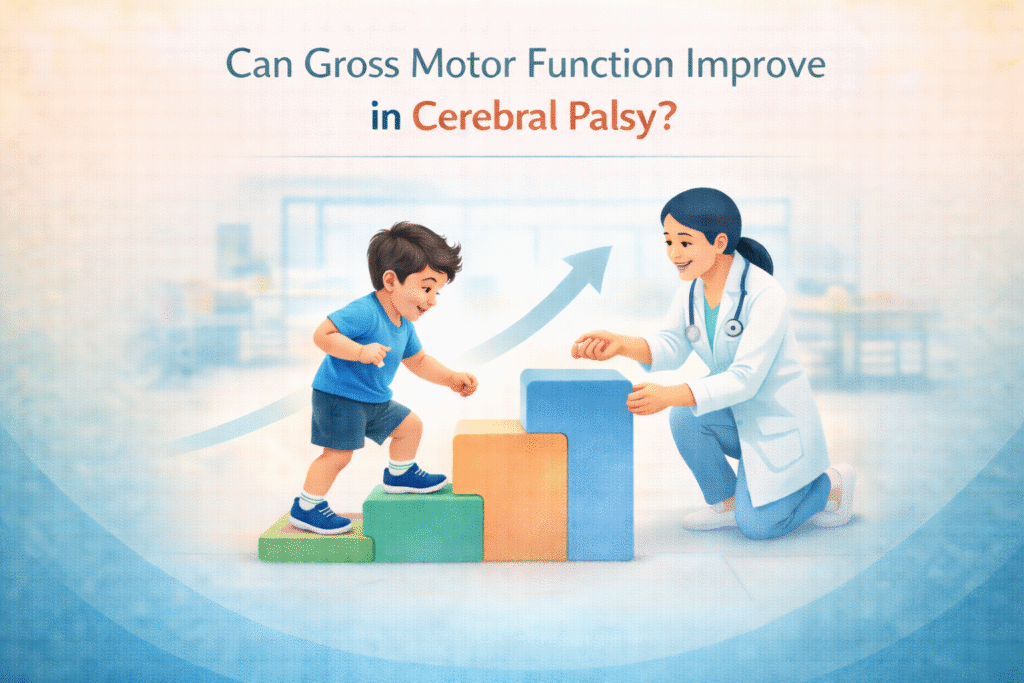
You may be wondering if your child can get better at moving around.
The answer is they usually can, especially if they start therapy early and are consistent with it.
When children are young, their brains are highly adaptable. This is called neuroplasticity, and it lets them build new connections. So, over time, they can find better ways to move, get stronger, and do more for themselves. Every child’s journey looks a bit different, though.
Improving gross motor skills in cerebral palsy does not cure it or make it disappear. It’s not about a cure. The goal here is to help the child be more independent, move more easily, and do daily chores without any discomfort.
Expect progress to be slow, as it is not a quick fix.
Many factors shape how much improvement you will see in your child. These factors are how steady and good their therapy is, how severe their symptoms are, the support they get from family, school, and therapists, how motivated they feel, and any other health issues they might have.
With solid support and patience, lots of kids make real progress. They build confidence and enjoy a better quality of life.
Gross Motor Function Therapy for CP
The goal of improving gross motor function in cerebral palsy is to help the child move better and feel more independent in everyday life.
You may want to know how they can help your child improve gross motor skills. It usually takes a combination of therapies personalized for your child’s specific needs.
You may also want to know whether physical therapy changes a child’s GMFCS level. The answer is that physical therapy’s goal isn’t to move the child from one level to another. It is to help them do as much as possible within their current abilities. And yes, with the right support, kids can get stronger, gain more control, and move around more easily.
Physical Therapy
Occupational Therapy
Assistive Devices
Advanced Therapies
What Parents Should Remember About Gross Motor Function in Cerebral Palsy
Parenting a child with cerebral palsy is a wild mix of hope, worry, and a million decisions, sometimes all in one day. Sure, all the therapies, medical jargon, and classifications matter. But a few big-picture ideas can make things feel a little less heavy.
1. Every Kid Moves at Their Own Pace
Cerebral palsy doesn’t come with a set schedule. One child might pick up a skill quickly; another might take their time. Muscle tone, balance, how they learn, and other conditions all play a part. Comparing your child to others just leads to frustration. What actually matters is how far your child has come from where they started.
2. GMFCS Doesn’t Say Anything About Intelligence & Achievements
The Gross Motor Function Classification System just describes movement. That’s it. It doesn’t say anything about intelligence or drive or what your child will achieve. With the right support, the child may surprise everyone, even the experts.
3. Therapy Takes Time
There’s no shortcut or magic solution. Tangible changes show up with steady, long-term effort. As children grow, their goals shift, and therapy plans need to shift too. Some families find that working with a team of specialists makes a huge difference.
In India, MedicoExperts helps parents connect with pros who can build a combination therapy plan that actually fits the child’s needs. This plan may include allopathy, the traditional therapies, Ayurvedic therapies, homeopathy, and regenerative medicine. A team of experts comes up with these personalized plans after evaluating your child’s condition.
4. Tiny Gains Matter
Maybe your child sits a little straighter, moves with less effort, or gets tired less easily. Those small changes are huge. They shape comfort, independence, and how your child feels in their own body. Progress is steady and sturdy, with improvements that help the child live a better life.
5. Don’t Forget the Emotional Side
Children do better when they feel safe and cheered on. Patience, encouragement, and celebrating the little wins all build confidence and grit. In the end, it’s about your child’s happiness, their place in the world, and the joy your family finds together.
Need Guidance for Your Child’s Motor Development?
Dealing with motor development in cerebral palsy can feel like a lot, since progress often comes slowly and no two kids follow the same path. If you’re wondering about the best therapy, how to handle movement challenges, or what you should realistically expect, you’re definitely not alone.
Getting help from professionals really does clear things up. When specialists take time to evaluate your child, they get a sense of what your child does well, where they struggle, and what’s possible going forward. With that kind of understanding, therapy plans start to make a lot more sense for your child.
Here’s what support might look like:
- A full developmental assessment
- Therapy advice tailored to your child
- A team of specialists reviewing your child’s needs
- Suggestions for mobility and assistive tools
Having access to experienced clinicians takes a lot of the guesswork out of the process. MedicoExperts connects families with doctors, therapists, and rehab specialists who actually talk to each other, so you get coordinated advice, second opinions, and help planning care. And you can do all of this online, making it much easier to fit into your life.
Takeaway
When you understand how gross motor function works in cerebral palsy, you feel more sure about the decisions you make for your child. The right advice and jumping in at the right time can change things for the better. If you reach out to experts early, you get rid of guesswork, pick therapies that actually fit, and make sure your child gets the kind of support that works for them, not just something generic.
Speak with a specialist to better understand your child’s motor abilities and therapy options. Early guidance can make intervention more focused and effective.
Frequently Asked Questions (FAQs):
Q1. Can a child’s GMFCS level change over time?
A. Yes, it can, but not in the way many parents expect. The Gross Motor Function Classification System describes how a child moves at a particular stage of life.
As children grow, their abilities, body proportions, muscle control, and therapy exposure change. Because of this, clinicians sometimes reclassify a child.
But improvement in strength or skills does not automatically mean a level change. Many children make meaningful functional gains while remaining within the same GMFCS level. The system is meant for description and planning, not as a scorecard of success or failure.
Q2. At what age is it best to start therapy for gross motor function in cerebral palsy?
A. Therapy should begin as early as possible once developmental concerns appear. Early childhood is a period of high neuroplasticity, meaning the brain is more adaptable and responsive to training.
Early intervention helps prevent secondary complications like contractures, poor posture habits, and learned non-use of muscles.
That said, older children still benefit from therapy. Progress may look different, but gains in strength, endurance, and functional independence remain achievable at many ages.
Q3. How often should a child with cerebral palsy attend therapy?
A. There is no single rule that fits every child. Therapy frequency depends on severity, goals, fatigue levels, access to services, and how well home programs are followed. Some children may need multiple sessions per week, while others progress well with fewer supervised visits and structured home exercises.
Consistency matters more than intensity alone. A sustainable routine that families can realistically maintain often produces better long-term outcomes than short bursts of very frequent therapy.
Q4. Are home exercises really necessary if my child attends therapy sessions?
A. Yes, they are extremely important. Clinic sessions provide guidance, corrections, and progression, but motor learning requires repetition. Skills improve when movements are practised regularly in real-life environments.
Home activities reinforce what therapists teach and help children integrate movements into daily routines. Without carryover practice, progress may slow, even with excellent professional therapy.
Q5. Can cerebral palsy cause worsening mobility as the child grows?
A. Cerebral palsy itself is non-progressive, meaning the original brain injury does not worsen. However, physical challenges can change with growth. Muscle tightness, joint stress, increased body weight, and reduced activity can affect mobility over time.
Proactive management through therapy, stretching, strengthening, and appropriate assistive devices helps minimize these secondary difficulties. Regular monitoring is key to preserving function.
Q6. How do doctors measure progress in gross motor function?
A. Progress is usually tracked using standardized functional assessments rather than casual observation alone. Tools such as the Gross Motor Function Measure (GMFM), gait analysis, balance testing, and goal-based evaluations help clinicians quantify changes.
Equally important are practical improvements, like easier transfers, better sitting stability, longer walking tolerance, or reduced fatigue. Small functional gains often represent meaningful neurological and biomechanical progress.
Q7. How to improve gross motor skills in cerebral palsy?
A. Improving gross motor skills in cerebral palsy typically involves consistent, targeted therapy and supportive care. Physical therapy helps build strength, balance, and coordination, while regular home exercises reinforce progress.
Assistive devices may enhance mobility and safety. Early intervention, individualized therapy plans, and ongoing professional guidance play a crucial role in achieving meaningful functional improvements.
References
Relevant Articles For You
Is Cerebral Palsy Curable?
Is cerebral palsy curable? This is the first and most urgent question parents ask after a diagnosis. The honest answer is that…..Read More
Early Intervention for CP
Early intervention for cerebral palsy is for children from birth to 3 years of age. Your child deserves the best care evidence-based…..Read More
CP Child Daily Routines
It is extremely essential for you to maintain a routine for a child with cerebral palsy because it gives the child a sense of…..Read More
Speech Delay in Cerebral Palsy
Seeing your child struggle with speech brings pain and a feeling of helplessness. But one thing you need to keep in…..Read More
Spasticity in Cerebral Palsy
Spasticity is a condition in which the muscles of a person’s body become tight and stiff because their brain cannot…..Read More
Parents Guide To CP Prevention
Do you want to protect your child from cerebral palsy (CP)? You should know about cerebral palsy prevention to keep your…..Read More
Best Food for Cerebral Palsy
The best food for individuals with cerebral palsy should be rich in vitamins, minerals, proteins, and other…..Read More
How To Diagnose Cerebral Palsy?
Understanding how to diagnose cerebral palsy (CP) in infants is crucial for their development and well-being. CP is typically…..Read More
Can CP Patients Walk?
A spectrum of different motor impairments come under cerebral palsy. It affects how a person moves, balances, and…..Read More
Seizures in Children with CP
Seizures in children with cerebral palsy are a common symptom. This happens because the areas of the brain that…..Read More
Cerebral Palsy in Adults
Adult CP has multiple symptoms like premature aging and mental illness. The problems can be related to…..Read More
Sleep Problems in Children with CP
When you say sleep problems in children with cerebral palsy, it means you are talking about ongoing difficulties with…..Read More
Recommendations To Understand Different Treatments
Stem Cell Therapy for CP
Stem cell therapy is a simple and completely safe procedure that requires only injections and no surgery is…..Read More
Homeopathy for CP
Homeopathy is a system of medicine that stimulates the body’s innate healing mechanisms using diluted natural…..Read More
Ayurveda for CP
In Ayurveda, CP is linked to an imbalance in the Vata dosha, which governs movement and coordination. When Vata is out of…..Read More
Combination Therapy for CP
Cerebral palsy affects movement, muscle tone, and coordination. Relying on a single therapy often falls short because…..Read More
Medically Reviewed by MedicoExperts Editorial & Clinical Review Board on 20 February 2026
Medical Disclaimer: This content is for informational purposes only and is not intended as medical advice, diagnosis, or treatment. Always seek the advice of your physician or other qualified healthcare provider regarding any medical condition or dietary needs.