
Speech delay in cerebral palsy is one of the first challenges that makes you worried about your child’s future.
When you see your child’s struggle to form words, make clear sounds, or express simple needs, you may be pained to see them that way.
You may also wonder if your child will ever be understood by others or feel anxious about what the future holds.
We understand all your worries and pains.
The reason speech delays in cerebral palsy occur is because of how the condition affects the brain and the muscles involved in speech.
There are different causes that can hamper the clear communication ability of your child.
Without the right guidance, these delays can be confusing and emotionally draining for families.
But speech delay in cerebral palsy can be managed with early intervention and the right therapies. So let’s learn about its causes, early signs, and also therapies that help your child achieve better communication.
If you’re worried about your child’s speech, don’t ignore that feeling. Early understanding is the first step toward meaningful support.
What Is Speech Delay in Cerebral Palsy?
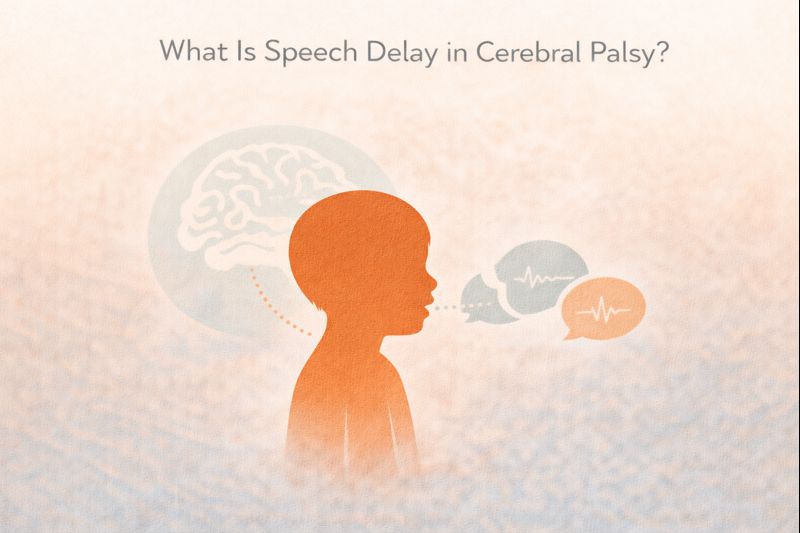
Seeing your child struggle with speech brings pain and a feeling of helplessness. But one thing you need to keep in mind is that speech delay in your child with cerebral palsy doesn’t reflect their intelligence level.
Their speech delay is directly related to the loss of muscle control due to cerebral palsy. In fact, the condition affects speech and language development in several ways. One we have already mentioned: inability to control muscles.
Also, because cerebral palsy affects breathing, it leads to issues with speaking. Along with eating and drinking, swallowing difficulties impact speech production.
What Speech Delay Means?
When doctors use terms like “speech delays,” you may think in terms of your child’s intelligence. But most children with cerebral palsy have normal intelligence. A speech delay means your child understands words and ideas but struggles with the physical act of speaking.
A language delay means your child may need more support with understanding words, forming sentences, or expressing thoughts.
What Causes Speech Delay in Cerebral Palsy?
Children with CP have differences in how their brains control muscles, which can affect many areas, including speech. Speech involves a complex set of muscles, breathing control, and coordination between the brain and body.
Here are the causes of speech delay in cerebral palsy:
Muscle Tone Issues
Motor Coordination Problems
Breathing and Oral Motor Challenges
Hearing or Cognitive Impairments
Brain Injury Location and Severity
If those regions are more involved, the child may experience more challenges with speech. Every child’s brain injury is unique, so the severity of speech delay can differ widely.
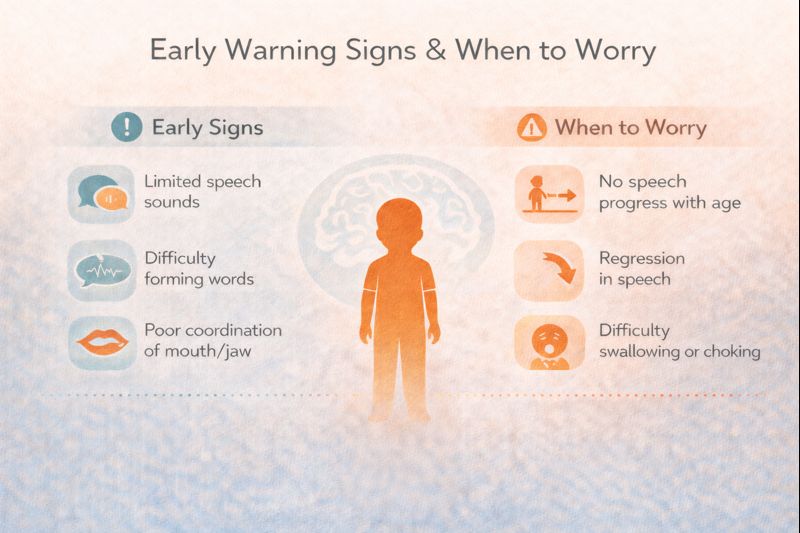
Early Warning Signs & When to Worry
As a parent, you know your child better than anyone else.
Sometimes, small signs can signal that your child may need extra support with speech. Noticing these early does not mean something is “wrong” with them, but it simply helps you act at the right time.
1. Missed Speech Milestones
Every child achieves their milestones at their own pace, but some speech milestones act as general guideposts.
If your child is not babbling by around 6–9 months, not using simple words by 18–24 months, or not trying to communicate using sounds, gestures, or expressions, you should not ignore it.
2. Limited Babbling or Unclear Sounds
Babbling is an important step toward proper speech. So when you see your child making very few sounds, using the same sound repeatedly, or their sounds remaining unclear for a long time, it can be a sign of difficulty controlling the muscles needed for speech. Which means you should approach a specialist.
3. Difficulty Forming Words or Sounds
Your child may be trying hard to speak but struggling to shape sounds into words. You may notice that your child knows what they want to say but becomes frustrated because the words don’t come out clearly. This can be an early sign of a speech delay, and you should approach a professional.
4. Poor Breath Support
Speech needs steady breath control. If your child runs out of air quickly while trying to speak, speaks in very short bursts, or sounds strained, breath support issues may be affecting their speech clarity. Don’t ignore these signs.
5. Difficulty with Feeding or Drooling
Speech and feeding use many of the same muscles. If your child has feeding difficulties, trouble chewing or swallowing, or excessive drooling beyond the typical age, these can be linked to oral motor challenges that also affect speech.
When to Consult a Specialist?
If you notice several of these signs, trust your instincts. Consulting a speech-language pathologist, pediatrician, or pediatric neurologist can bring clarity and reassurance. Early guidance doesn’t mean you need to rush into labels.
Instead, it means giving your child the best possible support, at the right time, with care and understanding.
If you’re noticing some of these signs in your child, consider speaking with a qualified speech-language pathologist to get clarity and guidance.
How Speech Delay Is Diagnosed in Children With CP?
Diagnosis of speech delays in cerebral palsy is a step-by-step process. You should have a clear goal of making your child a better communicator, not to compare them with other kids around them. Also, you need to understand what may be making speech difficult and how best to support them.
These assessments will be done by a team of specialists to give insights that will help your child improve their communication.
Speech-Language Evaluation
Oral Motor Assessment
Hearing Tests
Cognitive Assessment
Early evaluation can make a huge difference in your child’s communication and speech abilities. Identifying speech challenges sooner allows you to opt for therapy early, when the brain is most adaptable.
More importantly, it helps you feel informed and confident about the next steps to get the best care to improve your child’s speech.
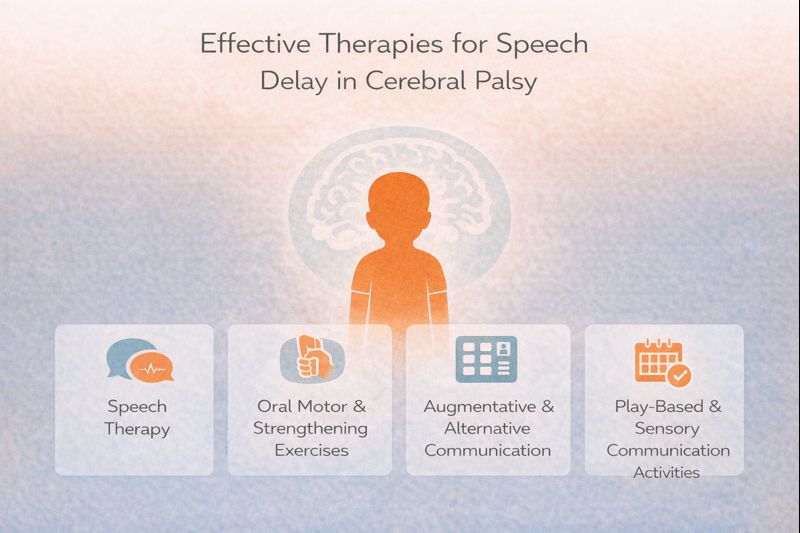
Effective Therapies for Speech Delay in Cerebral Palsy
You can support your child in overcoming speech delay by finding the right therapies that match their needs and strengths.
Each child’s speech development experience is different. But the following approaches are used and supported by clinical practice to help children communicate more clearly and confidently.
Speech Therapy (Core Treatment)
Speech therapy is the most essential treatment for speech delay in CP. You need help from a speech-language pathologist who will help improve your child’s speech.
The therapy plan will be as per your child’s needs and abilities and focus on forming sounds, building words, improving voice control, and boosting communication.
It will improve your child’s communication abilities, and they will be better at expressing their needs and emotions. But for that, consistency is the most important factor.
Oral Motor & Strengthening Exercises
Sometimes a child with CP has difficulty controlling the muscles used for speech. Oral motor and strengthening exercises focus on improving muscle control, coordination, and breath support.
The child needs to do exercises that involve movements of the lips, tongue, and jaw, as well as activities that support better airflow and voice production.
These exercises should be done under professional guidance so that they can support clearer and more controlled speech.
AAC (Augmentative & Alternative Communication)
AAC is used when your child’s speech is limited or unclear. It needs tools such as picture boards, communication books, and electronic communication devices.
AAC does not replace speech therapy. Rather, it supports speech development by reducing frustration and giving your child a reliable way to communicate. Using AAC alongside speech therapy may help your child express themselves more fully.
Play-Based & Sensory Communication Activities
Children learn best through play. Play-based and sensory communication activities use games, toys, music, and everyday routines to encourage your child to communicate naturally and in a fun way
These activities help build interaction, turn-taking, and early communication skills while keeping therapy engaging and child-friendly.
Best Speech Therapy Techniques for CP
Speech therapists use evidence-based techniques like the following:
- PROMPT method: Hands-on cues to guide the muscles needed for speech sounds
- Oro-motor stimulation: Gentle stimulation to improve awareness and movement of speech muscles
- Breathing control exercises: Activities that support steady airflow for better voice and speech
- Visual cueing: Using pictures, gestures, or mirrors to help your child understand how sounds are formed
- Repetition-based training: Practicing sounds and words regularly to build consistency and confidence
With patience, consistency, and the right therapeutic support, your child can make much better progress in communication.
Exercises for Speech Delay in CP
Speech exercises work best when you and your child work like a team and come together using clinic-based therapy and simple practice at home.
You should remember that these activities are not for pushing your child to “perform.” Instead, you should create safe and encouraging opportunities to build strength, coordination, and confidence in your child to communicate better.
Always follow the guidance of your child’s speech-language pathologist and adapt activities to your child’s comfort level.
Breath Control Drills
Lip & Tongue Movement Exercises
Sound Imitation & Repetition Activities
Strengthening Oral Muscles Through Play
With consistency, patience, and encouragement, these exercises, both at home and in the clinic, can support your child’s speech journey in meaningful ways, while respecting their pace and individuality.
Advanced Speech Intervention Techniques Used in CP
When basic speech therapy doesn’t work well, your child may need advanced intervention techniques to develop clearer and more effective communication.
You need trained speech-language pathologists for these therapies, and these are carefully chosen based on a child’s challenges, comfort, and readiness.
PROMPT Therapy
Oral Placement Therapy
Constraint-Induced Language Therapy
Multisensory Speech Training
But at this point, you need to keep in mind that these advanced techniques are most effective when integrated into a personalized therapy plan, guided by a skilled professional who understands both cerebral palsy and your child’s unique communication needs.
Age Milestones & Progress Expectations in Children with CP
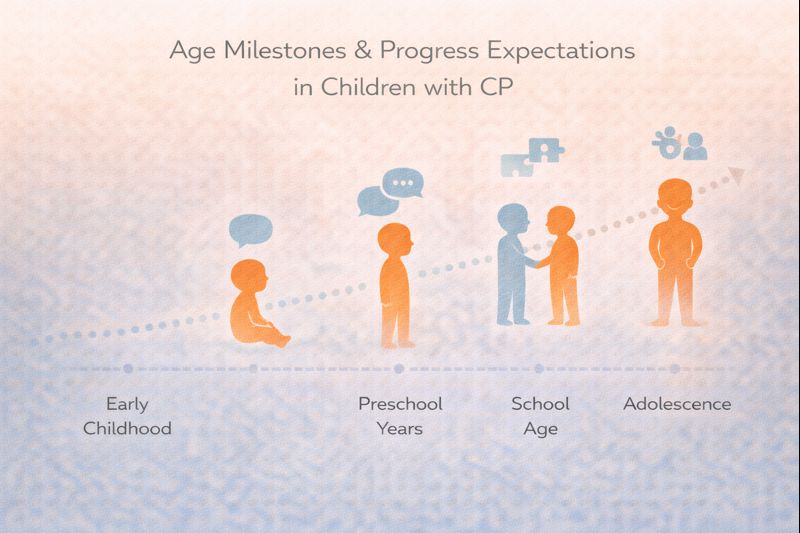
When your child has cerebral palsy, questions about milestones and progress can worry you a lot. You may also think, “Are we on the right track?”
Learning about how development may look different in children with CP can help set kinder, more realistic expectations.
In developing children, speech and communication milestones are mostly the same.
But in children with CP, these patterns may look different or delayed, mainly because muscle control, coordination, or breath support takes longer to develop.
A delay does not mean that the progress has stopped because many children reach milestones later or in a different order, and some of them may use alternative ways to communicate before speech becomes clearer.
What Slow but Steady Progress Looks Like?
Progress in CP happens slowly and gradually. You may notice small but positive changes like better eye contact, more vocal attempts, clearer sounds, longer attention during communication, or less frustration when trying to express needs.
In fact, these signs show that therapy is working and speech will be fluent eventually. In short, consistency matters more than speed.
Why Comparison With Other Children Is Misleading?
We know that you want to see your child speak like most children around them. But comparing your child’s progress to siblings, cousins, or peers can be emotionally draining for them and also inaccurate.
Every child with CP has a unique brain injury, muscle pattern, and learning pace. What looks like “slow progress” from the outside may actually be strong progress for your child. Growth should always be measured against your child’s own starting point, not someone else’s timeline.
When to Adjust the Therapy Plan?
If progress seems to be taking more time than your expectation, or if your child appears frustrated, fatigued, or disengaged, it may be time to review the therapy plan.
Adjustments could include changing techniques, introducing assistive communication tools, or setting new short-term goals.
Apart from that, you need to have regular reviews with your child’s therapy team to ensure that support continues to match your child’s evolving needs.
When to Seek Additional Medical Help?
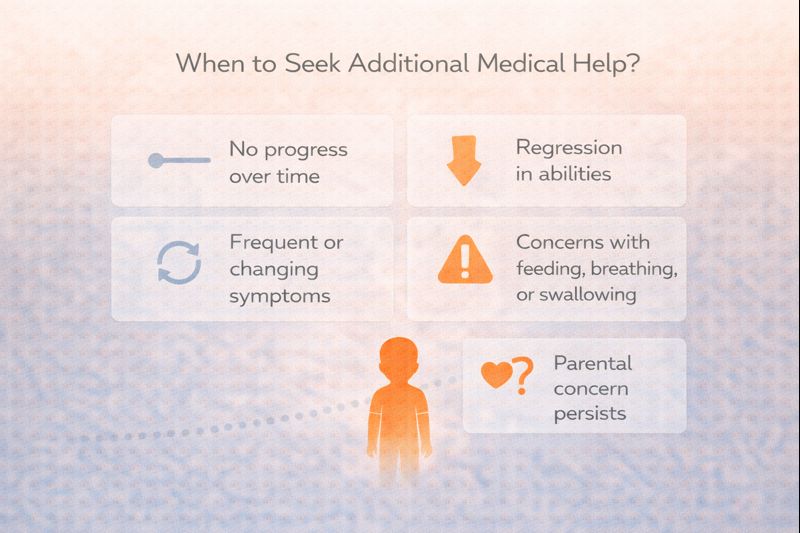
You should think about seeking further medical support if your child shows little or no progress despite consistent therapy, or if you notice possible hearing difficulties that may be affecting speech.
Signs of apraxia or dysarthria, such as difficulty planning speech movements or consistently unclear speech, also need professional attention.
If speech challenges are accompanied by swallowing or feeding difficulties, further evaluation is important. In such cases, a referral to a pediatric neurologist or developmental specialist can help ensure your child receives the right diagnosis and coordinated care.
Takeaway: Early Intervention Makes the Biggest Difference, and CBT Therapy

You may be worried about the speech delay of your child, but you should also keep in mind that it does not define your child’s intelligence or future.
You should focus on the early. Go for the therapies consistently. Consistency and professional guidance can help your child communicate much better.
Also, be patient and take small steps, focusing on achievements like clearer sounds, less frustration, or better connections with others.
At the same time, you should get help from professionals who understand CP.
You don’t have to navigate this journey alone. Seek early evaluation, stay consistent with therapy, and advocate for your child’s communication needs because every child deserves to be heard.
Frequently Asked Questions (FAQs):
Q1. Can a child with cerebral palsy eventually speak normally?
A. Some children with CP develop clear, understandable speech over time, while others may always have some difficulty. Many children improve significantly with therapy, and some use AAC tools alongside speech. “Normal” looks different for every child, but the real goal should be effective communication.
Q2. Does using AAC delay or stop speech development?
A. No. Research and clinical experience show that AAC does not prevent speech development. In fact, it supports it by reducing frustration and encouraging communication while speech skills continue to develop.
Q3. How often should my child attend speech therapy?
A. This depends on your child’s needs and the severity of speech challenges. Some children benefit from 2–3 sessions per week, while others may do well with fewer sessions combined with regular home practice. Your speech-language pathologist will guide you.
Q4. Can speech therapy start even if my child is very young?
A. Yes. Early intervention is strongly recommended for your child. Speech therapy for young children focuses on play, interaction, sounds, gestures, and early communication, not just words.
Q5. What if my child understands everything but can’t speak clearly?
A. This is common in CP and typically indicates a speech (motor) delay, rather than a language or intelligence issue. In this case, therapy focuses on helping the muscles and coordination needed for speech while also supporting communication in other ways.
Q6. How to help a child with CP speak better?
A. You can help a child with cerebral palsy speak better by starting early speech therapy, practicing simple exercises at home, and encouraging communication during daily activities without pressure.
Use play, repetition, and positive reinforcement, and consider assistive communication tools if needed. Most importantly, be patient and consistent because small, steady efforts make a real difference over time.
References
Relevant Articles For You
Epilepsy in Cerebral Palsy
Children with cerebral palsy have epilepsy or repeated seizures due to abnormal electrical activity in their…..Read More
Early Intervention for Cerebral Palsy
Early intervention for cerebral palsy is for children from birth to 3 years of age. Your child deserves the best…..Read More
Developmental Delay
Developmental delay is generally described as a situation where your child fails to achieve developmental…..Read More
Is Cerebral Palsy Genetic?
The genetic aspects of cerebral palsy point towards a complex interplay between genetic factors and environmental…..Read More
Recommendations To Understand Different Treatments
Stem Cell Therapy for CP
Stem cell therapy lessens the symptoms, prevents complications in the future, and maximizes the independence of…..Read More
Combination Therapy for CP
Cerebral palsy affects movement, muscle tone, and coordination. Relying on a single therapy often falls short because…..Read More
Cerebral Palsy Treatment Options
There are many non-surgical treatment options for cerebral palsy and choosing one of them can be confusing without…..Read More
Hypotonic Cerebral Palsy Treatment
The main goal of treatment for Hypotonic Cerebral Palsy is to help the child reach his/her full potential. This can be done through…..Read More
Cerebral Palsy Symptoms
Cerebral palsy is usually visible within the first few months of a child’s life. However, the diagnosis may not be confirmed until…..Read More
Types of Cerebral Palsy
Cerebral palsy is classified into different types based on how it affects a person’s muscle tone and movement. These…..Read More
Causes and Risk Factors of CP
Cerebral palsy happens when your baby’s brain doesn’t develop properly. This can occur before birth, during…..Read More
Medically Reviewed by MedicoExperts Editorial & Clinical Review Board on 19 December 2025
Medical Disclaimer: This content is for informational purposes only and is not intended as medical advice, diagnosis, or treatment. Always seek the advice of your physician or other qualified healthcare provider regarding any medical condition or dietary needs.