
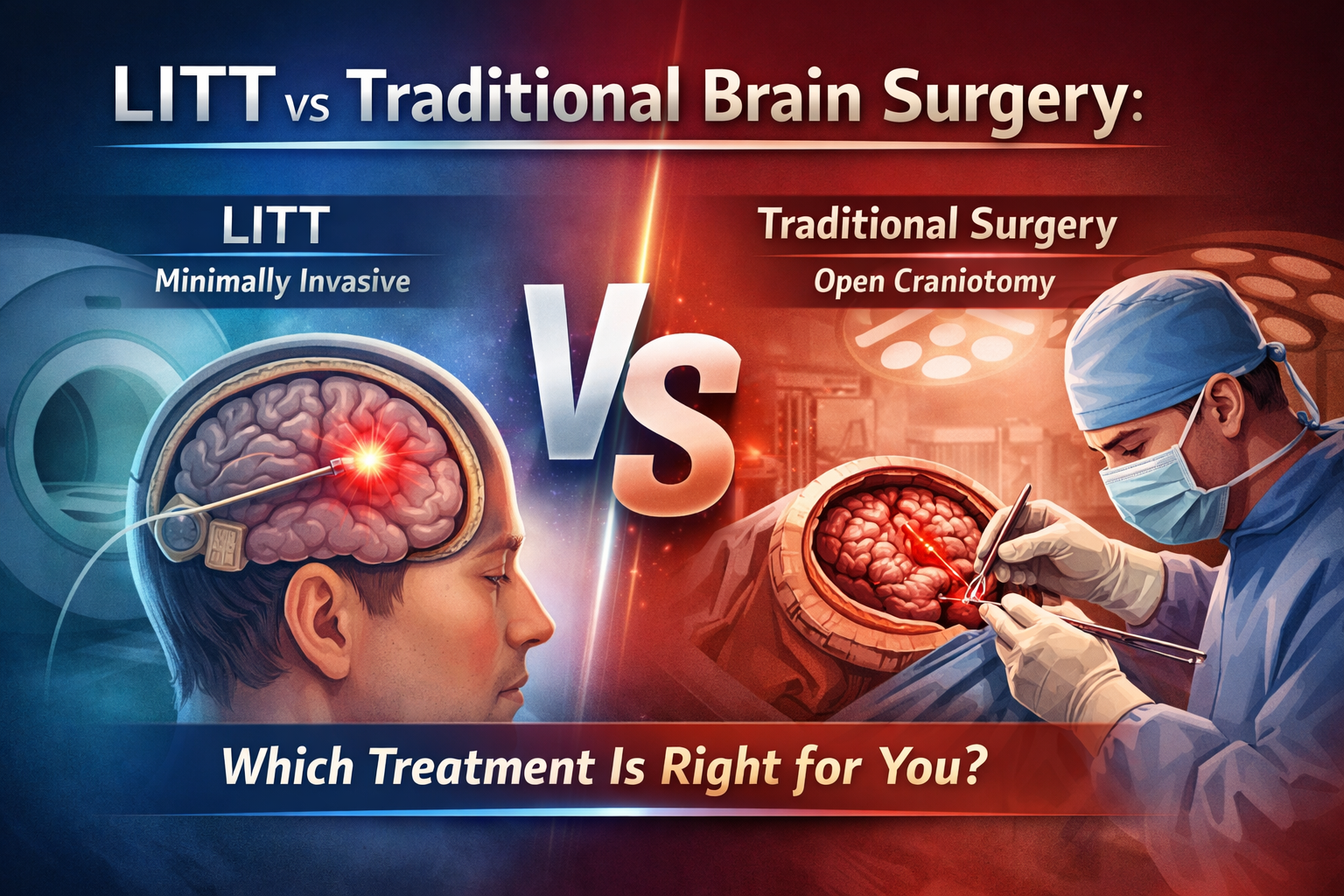
When doctors talk about treating a brain tumor or epilepsy, it can feel overwhelming – especially if you suddenly hear two very different options:
- Laser Interstitial Thermal Therapy (LITT)
- Traditional neurosurgery (open brain surgery or craniotomy)
Most people immediately wonder:
Which one is safer? Which has a faster recovery? And which makes sense for my condition?
Let’s go through this calmly and clearly, in simple language – so you can feel prepared for your next discussion with a specialist.
LITT vs Open Brain Surgery – The Short Answer
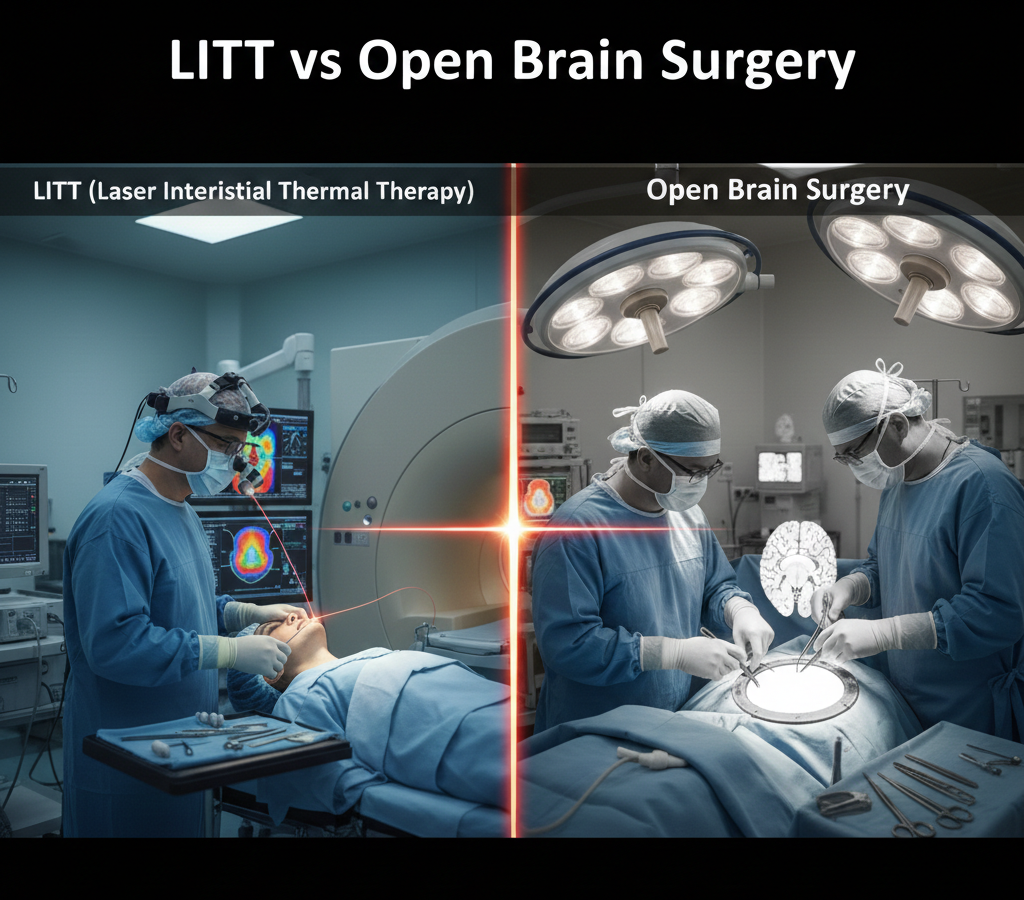
LITT is a minimally invasive, MRI-guided laser treatment best for small or deep brain lesions and some epilepsy cases, with faster recovery.
Traditional neurosurgery involves opening the skull and is better for large tumors, complex disease, or emergencies.
What Is Traditional Brain Surgery?
Traditional neurosurgery usually involves a craniotomy, which means:
- A section of the skull is temporarily opened
- The surgeon directly reaches the brain
- The tumor or abnormal tissue is removed or treated
This method is essential for:
- Large tumors
- Pressure inside the brain
- Bleeding or swelling
- Emergency situations
- Disease affecting wide areas
Because it is more invasive, patients often stay in the hospital longer and need more recovery time.
What Makes LITT Different?
LITT takes a highly targeted approach.
Instead of opening the skull widely, surgeons:
- Make a tiny opening in the scalp (about 2 mm)
- Insert a thin laser probe
- Use real-time MRI scans to watch temperature changes
- Heat-destroy only the abnormal tissue
Nearby healthy brain tissue is carefully protected.
You can think of LITT as spot-treating a problem, while traditional surgery is opening the area to fully remove it.
LITT vs Open Brain Surgery: Key Differences
| Feature | LITT | Traditional Neurosurgery |
|---|---|---|
| Incision size | Pin-hole | Larger skull opening |
| Guidance | MRI-guided laser | Direct surgical view |
| Hospital stay | Often 1–2 days | Several days or more |
| Recovery | Faster for many | Slower |
| Blood loss | Minimal | Higher |
| Best for | Small or deep lesions | Large or complex tumors |
| Scar | Very small | More noticeable |
Recovery Time – Which Gets You Back to Life Faster?
After LITT
- Walking usually begins the next day
- Discharge in 1–2 days
- Earlier return to daily activities
After Traditional Surgery
- Longer hospital stay
- Pain control for several days
- Weeks to months of recovery
- Rehab therapy in some cases
Recovery always depends on lesion location and your overall health, not just the technique.
Risks – How Do They Compare?
Both procedures involve the brain, so doctors carefully weigh benefits and risks.
Possible risks with LITT
- Temporary swelling
- Headache
- Weakness or numbness
- Infection (rare)
- Bleeding (uncommon)
Possible risks with open surgery
- Higher infection risk
- More blood loss
- ICU stay
- Longer anesthesia
- Larger scars
Your neurosurgeon will explain what applies to your case.
Which Has Better Outcomes?
There isn’t one best option for everyone.
LITT often works well for:
- Small tumors
- Tumors that came back
- Radiation-damaged tissue
- Certain epilepsy cases
Traditional surgery is usually better for:
- Large tumors
- Pressure on vital brain areas
- Emergencies
- Widespread disease
The decision is based on MRI scans, symptoms, and long-term goals.
How Doctors Decide Between LITT and Open Surgery
Before recommending either approach, specialists usually review:
- MRI and advanced imaging
- Tumor size and depth
- Seizure mapping (for epilepsy)
- Overall health
- Previous treatments
- Risk to speech, movement, or memory areas
Often, cases are discussed in a multidisciplinary team meeting involving neurosurgeons, neurologists, radiologists, and oncologists.
What Happens Before and After the Procedure?
Before Surgery
- Blood tests and imaging
- Medication review
- Fasting instructions
- Consent and counseling
- Planning the laser path (for LITT)
After Surgery
- Monitoring for swelling
- Pain control
- Follow-up MRI
- Steroids if needed
- Gradual return to activity
- Outpatient visits
Patients are given clear recovery instructions before going home.
Cost Comparison – LITT vs Traditional Surgery
Cost is a major concern for most families.
Typical Estimated Ranges
- LITT: USD 8,000 – 25,000 (INR 7,23,032 – INR 22,59,475)
- Traditional surgery: USD 10,000 – 40,000+ (INR 9,03,790 – INR 36,15,160), depending on ICU stay and complexity
Why Costs Vary
- MRI time and laser probes
- ICU care
- Hospital tier and city
- Surgeon experience
- Length of stay
Although LITT uses advanced technology, its shorter hospitalization may reduce overall recovery expenses in selected cases.
Want a personalized estimate?
A specialist can review your scans and guide you on which option fits your situation, and what costs to expect.
Final Takeaway
Both approaches aim for the same goal:
Treat the problem while protecting as much healthy brain tissue as possible.
LITT offers a less invasive path for carefully selected patients.
Traditional neurosurgery remains crucial for complex or emergency cases.
The best option is the one tailored to you.
Still unsure which path is right?
Speaking with a specialist can bring clarity and confidence.
Frequently Asked Questions
Q1. Is LITT safer than open brain surgery?
For selected patients, yes – because it is minimally invasive. But safety depends on lesion location and health history.
Q2. Can LITT replace traditional surgery?
No. LITT is ideal for certain cases, while open surgery remains essential for large or urgent problems.
Q3. Which has faster recovery?
Most patients recover faster after LITT.
Q4. Is LITT more expensive?
Not always. Shorter hospital stays can offset technology costs.
Q5. How do doctors decide which is better for me?
By reviewing MRI scans, symptoms, past treatments, and your long-term goals.
References
Medically Reviewed by MedicoExperts Editorial & Clinical Review Board on 4 February 2026
Medical Disclaimer: This content is for informational purposes only and is not intended as medical advice, diagnosis, or treatment. Always seek the advice of your physician or other qualified healthcare provider regarding any medical condition or dietary needs.