If Laser Interstitial Thermal Therapy (LITT) has come up in your consultation, you might be feeling anxious, confused, or simply trying to make sense of what it actually means for you or your loved one.
That’s completely understandable.
Let’s take this step by step.
In this guide, I’ll walk you through what LITT really is, how the procedure works, who it is meant for, and what recovery typically looks like. We’ll also talk honestly about benefits, possible risks, and cost considerations – using clear, simple language, not medical jargon.
What Is Laser Interstitial Thermal Therapy?
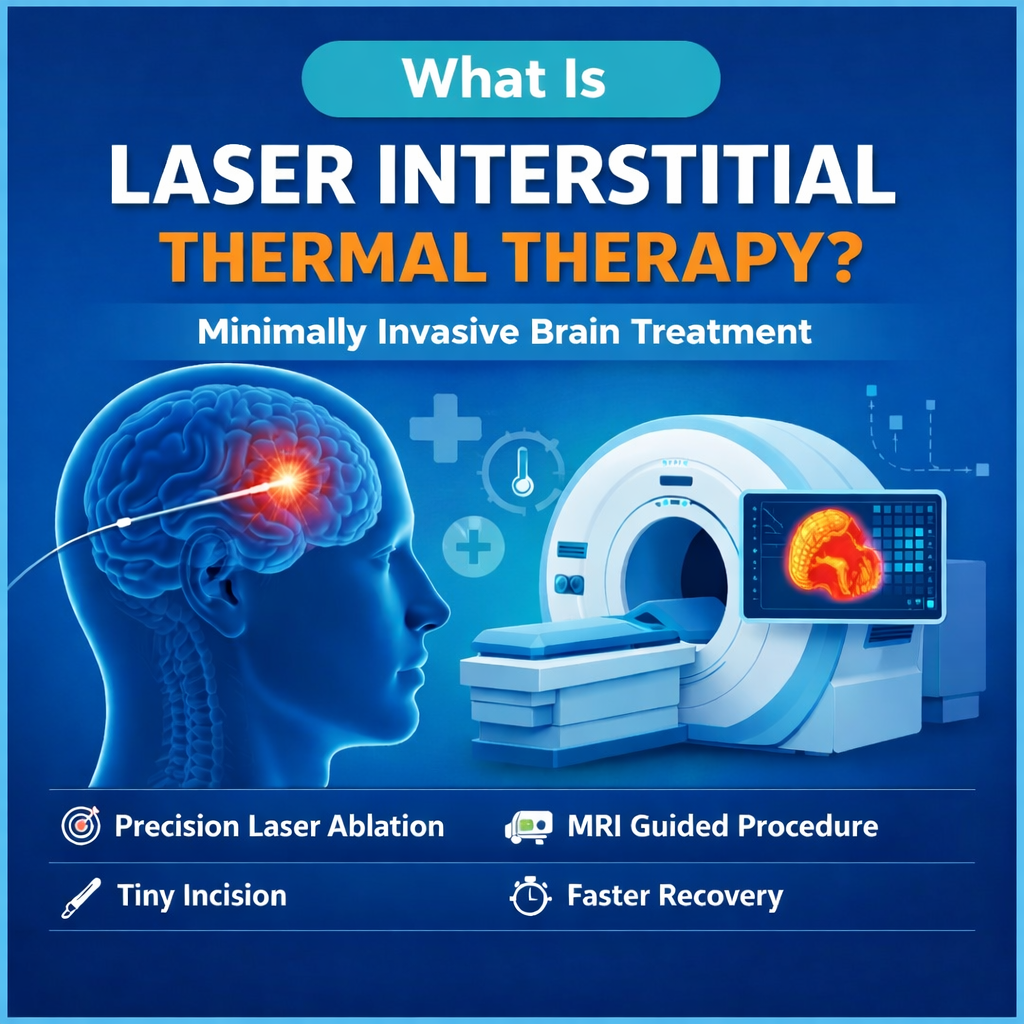
Laser Interstitial Thermal Therapy (LITT) is a minimally invasive brain treatment that uses controlled heat from a laser to destroy abnormal tissue – such as tumors or seizure-causing areas – without opening the skull the way traditional brain surgery does.
Let’s break that name down:
- Laser → a focused beam of light
- Thermal → heat
- Interstitial → inside the tissue
- Therapy → treatment
In plain terms:
LITT is a treatment where doctors place a tiny laser inside the brain and use heat to destroy the problem area – while watching everything live on MRI scans.
How Does LITT Work? (Step-by-Step)
Here’s what typically happens:
- Tiny opening in the scalp: A very small opening – about 2 mm is made.
- Laser probe placement: A thin tube with a laser at the tip is guided to the target area.
- MRI guidance in real time: Doctors watch temperature and brain structures on MRI screens during the entire procedure.
- Heating the abnormal tissue: The laser destroys only the diseased part while protecting nearby healthy brain.
- Closing the incision: No large cuts. No major skull opening.
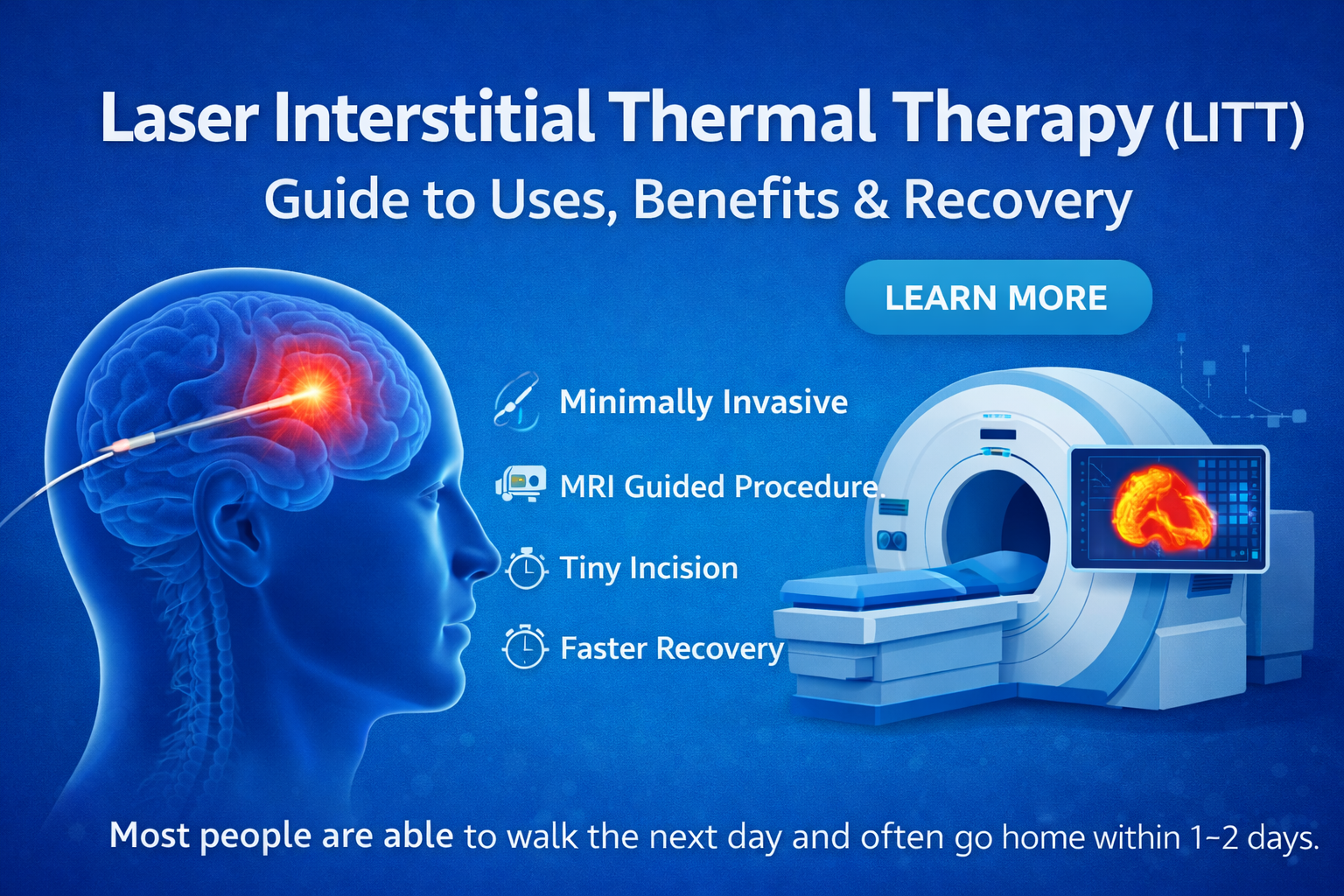
Most people are able to walk the next day and often go home within 1 – 2 days.
Thinking if LITT might be suitable for your condition?
Sometimes the fastest way to get clarity is to speak directly with a specialist who can review your scans and history.
When Is LITT Used?
Doctors usually recommend LITT when the problem area is:
- In sensitive areas that control speech, movement, or memory
- Deep inside the brain
- Hard to reach safely with regular surgery
- Recurrent (came back after treatment)
1. Brain Tumors
LITT may be used for:
- Glioblastomas
- Low or intermediate grade tumors
- Tumors that have returned after radiation or surgery
- Cancer that has spread to the brain
2. Epilepsy
For people whose seizures don’t improve with medicines, LITT can target the exact part of the brain triggering seizures.
This is often used in mesial temporal lobe epilepsy (MTLE) – a common type of drug-resistant epilepsy.
3. Radiation Necrosis
Sometimes radiation therapy damages healthy brain tissue, causing swelling or symptoms later.
That damaged tissue is called radiation necrosis, and LITT can remove it without major surgery.
Why Do Doctors Choose LITT?
- Minimally Invasive: Only a pin-sized opening.
- Faster Recovery: Short hospital stay and quicker return to routine life.
- Real-Time Accuracy: MRI helps doctors stay extremely precise.
- Reduced Risk: Lower chance of infection or long-term complications compared to open surgery.
- Helpful for Hard-to-Reach Areas: Deep lesions that were once difficult to treat may now be managed safely.
What are the Possible Side Effects or Risks?
While LITT is generally safe, potential risks include:
- Headache
- Temporary brain swelling
- Weakness or numbness
- Infection (rare)
- Bleeding (uncommon)
- Seizures in some cases
Your doctor will explain how these risks apply specifically to you, based on the lesion’s location and your health.
How Successful Is LITT?
Results depend on:
- The condition being treated
- Size and location of the lesion
- Prior treatments
- Overall health
In epilepsy patients, many experience significant seizure reduction, and some become seizure-free.
For tumors, LITT can:
- Shrink or destroy cancerous tissue
- Relieve pressure in the brain
- Control symptoms
- Delay or reduce the need for major surgery
Your specialist is the best person to explain what outcomes are realistic in your case.
What About the Cost of Laser Interstitial Thermal Therapy?
In India, the price of Laser Interstitial Thermal Therapy can vary significantly depending on several factors like:
- The hospital you choose
- City or region (Delhi, Mumbai, Hyderabad, Bengaluru, Chennai)
- How complex your treatment is
- Duration of MRI use and hospital stay
- Surgeon fees and consumables (like the laser probe itself)
A typical range for a standard, uncomplicated LITT procedure is:
➡️ Approximately USD 8,000 to USD 25,000 (INR 7,22,080 to INR 22,56,501)
How This Compares to Other Treatments
Compared to traditional open brain surgery, LITT often:
- Has shorter hospital stays
- Requires minimal recovery time
- May reduce overall costs related to long hospital care or rehabilitation
Practical Tips Before Making a Decision
Before you proceed with LITT, here are some steps that many patients find helpful:
✔️ Ask for a written estimate from the hospital that includes all expected charges – surgeon fee, anaesthesia, MRI time, room charges, and diagnostic tests.
✔️ Get a second opinion – especially if cost or treatment path feels uncertain.
✔️ Check insurance coverage – some plans cover parts of the procedure or hospital stay.
Is It Worth the Cost?
Many patients and doctors find that LITT’s precision, shorter recovery time, and ability to treat hard-to-reach brain areas make it a worthwhile option – especially when compared to extended hospital stays or more invasive surgeries.
Ultimately, the value depends on your specific condition, health goals, and financial planning – and that’s where a specialist’s guidance becomes essential.
Is LITT Right for You?
LITT isn’t for everyone – but for the right patient, it can be life-changing.
You might be a candidate if:
- Your tumor or lesion is deep in the brain
- You have drug-resistant epilepsy
- Open surgery is considered risky
- The problem has returned after earlier treatment
- Radiation caused tissue damage
A neurosurgeon and epilepsy or oncology team usually decide this together after reviewing MRI scans and medical history.
Want expert guidance for your specific case?
Every brain condition is unique. A personalized review can help you understand whether LITT is the right option for you.
Final Thoughts – Taking the Next Step with Confidence
Facing a possible brain procedure can feel overwhelming. If you’re here because you or someone close to you is navigating a serious diagnosis, pause for a moment – you’re already doing something powerful by seeking clear information and trying to understand your options.
Laser Interstitial Thermal Therapy may sound complex, but at its core, it reflects a simple goal:
Treat the problem as precisely as possible… while protecting as much healthy brain tissue as you can.
For many patients, that balance, effective treatment with less disruption to daily life, is exactly what makes LITT worth exploring.
If you’re wondering whether this approach could be suitable for your specific condition, speaking with an experienced specialist can bring clarity and peace of mind. A careful review of your scans, medical history, and treatment goals can help you decide what makes the most sense for you.
You don’t have to figure this out on your own. The right conversation can make the path forward feel much clearer.
Frequently Asked Questions
Q1. Is LITT considered brain surgery?
Yes, but it is minimally invasive. Instead of opening the skull widely, surgeons work through a tiny opening using MRI guidance.
Q2. Will I be awake during the procedure?
No. LITT is usually done under general anesthesia, so you won’t feel pain during the treatment.
Q3. How long does recovery take?
Most patients leave the hospital within 1-2 days and resume light activities within a week, depending on their doctor’s advice.
Q4. Who decides if I am a good candidate?
A team of specialists, usually neurosurgeons, neurologists, and imaging experts, reviews MRI scans and your medical history before recommending LITT.
References
Medically Reviewed by MedicoExperts Editorial & Clinical Review Board on 3 February 2026
Medical Disclaimer: This content is for informational purposes only and is not intended as medical advice, diagnosis, or treatment. Always seek the advice of your physician or other qualified healthcare provider regarding any medical condition or dietary needs.