

Liver Transplant in India — World-Class Surgery, Highest Success Rates, Affordable Cost for Indian & International Patients
Liver transplant in India costs USD 26,000–30,000 — compared with USD 1,017,800 in average billed charges in the United States (Milliman 2025). For most international families, the living-donor route means no waiting list: surgery is scheduled within weeks of evaluation, not years. India’s hospitals performed 3,920 liver transplants in 2022 across 183 registered centres, with outcomes comparable to international benchmarks. MedicoExperts coordinates every stage — clinical, documentary, legal, and logistical — for families from the USA, UK, Canada, Australia, and beyond.
| ✅ Cost (INR) | ✅ Cost (USD/GBP) | 📊 Success Rate | ⏱ Wait Time (LDLT) | 🏥 Accreditation |
|---|---|---|---|---|
| ₹19.68L – ₹25L | $26,500 – $30,000 | 90%+ | 2–6 weeks | JCI NABH ISO |
Two Pathways to a Liver Transplant in India — Which Applies to You?
International patients have two routes to a liver transplant in India. Understanding which applies to your family is the first step.
| Pathway | How It Works | Who It Suits | Typical Timeline in India |
|---|---|---|---|
| Living-Donor Liver Transplant (LDLT) PRIMARY ROUTE |
A near relative donates a portion of their liver. Both donor and recipient livers regenerate to full function within 2–3 months. | Most international families — where a near relative is able and willing to donate. |
Evaluation: 10–15 days
→ Approvals → Surgery Hospital stay: ~3 weeks → 2–3 weeks stabilisation Total India stay: 7–9 weeks |
| Deceased-Donor Liver Transplant (DDLT) SECONDARY ROUTE |
A liver from a brain-dead individual is allocated by India’s organ-sharing system. Foreign nationals may receive a deceased-donor organ — but only after no suitable Indian recipient is available nationwide. | Patients with no eligible living donor. Patient must be willing and medically stable to wait in India, with no guarantee of timing. |
Observed: 1–3 months from arrival
Based on MedicoExperts’ experience — not a commitment. Every case is different. |
⚠ No guarantee on DDLT timing
Under Indian law, priority for deceased-donor organs goes to Indian patients first. An organ is offered to an international patient only when no suitable Indian recipient is available. MedicoExperts’ observed experience for liver is 1–3 months, but there is absolutely no guarantee. The organ must become available, and the condition that no Indian patient needs it must be satisfied. Any patient considering DDLT should be medically stable enough to wait, and financially prepared for an extended stay in India.
Why International Patients Choose India for Liver Transplant
India performs more living-donor liver transplants than any other country. The combination of cost, speed, and surgical volume makes it a realistic option for families who face either an unaffordable procedure or an unacceptable wait at home.
| Factor | 🇮🇳 India | 🇺🇸 USA | 🇬🇧 UK (NHS) | 🇦🇪 UAE |
|---|---|---|---|---|
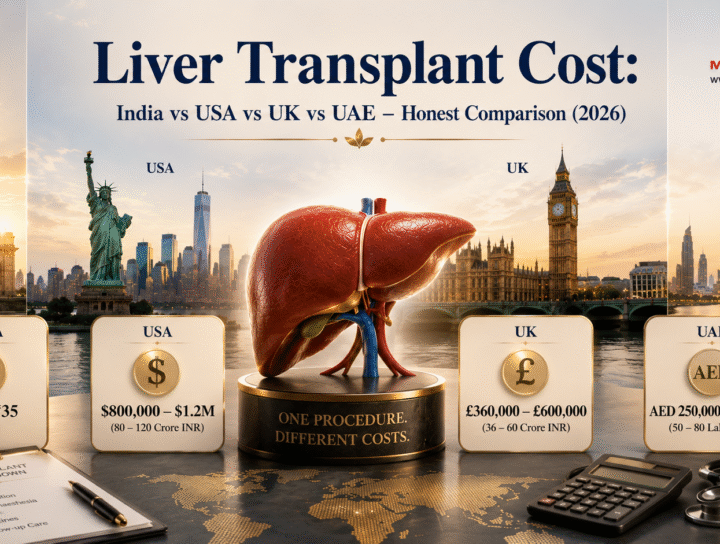
| All-in package cost | USD 26,000–30,000 + USD 2,000–3,000 evaluation |
USD 1,017,800 avg. billed charges (Milliman 2025) |
£80,000–£120,000 estimated; NHS wait applies |
USD 80,000–120,000 |
| Wait — LDLT (living donor) | 2–6 weeks Typically after evaluation |
Limited Many centres decline donors with dependent children |
Limited NHS primarily DDLT |
Available At select centres |
| Wait — DDLT (deceased donor) | 1–3 months Observed; Indian-citizen priority |
Median 4.3 months Range 0.5–47.5 months by centre (SRTR May 2026) |
1–2 years NHS national list |
6–12 months |
| Annual volume (liver) | 3,920 transplants (2022) 81% living donor · 183 centres (NMJI) |
High — deceased-donor primary route | Lower volume; deceased-donor focus | Available at select JCI centres |
| Hospital accreditation | JCI NABH At leading centres |
JCAHO | CQC NHS |
JCI |
Note on US cost: USD 1,017,800 is the Milliman 2025 average billed charge for a single liver transplant (30 days pre-admission, procurement, admission, physician, 180 days post, medication). Actual amount paid by insured patients varies. The 2020 figure was USD 878,400. Source: Milliman, 2025 U.S. Organ and Tissue Transplants: Estimated Costs and Utilization, Fig. 3.
What India offers that cannot be matched at this price
- Cost: 97% lower than US average billed charges when comparing the all-in package to Milliman 2025 figures.
- Speed for LDLT: surgery scheduled within weeks of evaluation — not subject to a national deceased-donor waiting list.
- Donor flexibility: India’s near-relative rule includes spouses — in some western countries, a spouse with dependent children may be declined as a donor.
- Volume and experience: 3,920 liver transplants in 2022, with living-donor procedures accounting for over 81% — one of the highest LDLT volumes globally.
- Surgeon training: many of India’s senior transplant surgeons trained in the UK, USA, or Japan and return to Indian practice.
- Robotic donor surgery: available at select centres in major metros — minimises donor scarring and recovery time.
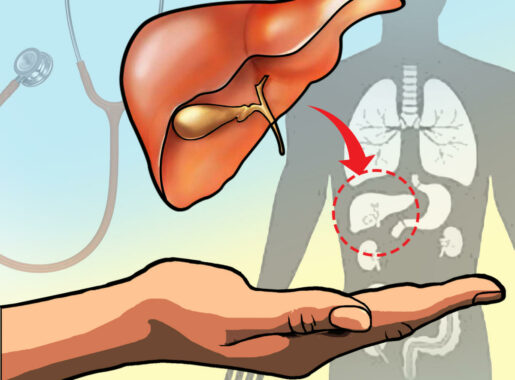
What is a liver transplant?
A liver transplant is a surgical procedure in which a non-functioning or severely damaged liver is removed and replaced with a healthy liver — or a portion of one — from a donor.
It is the definitive treatment for end-stage liver disease and acute liver failure when the liver can no longer sustain life.
What does the Liver do?
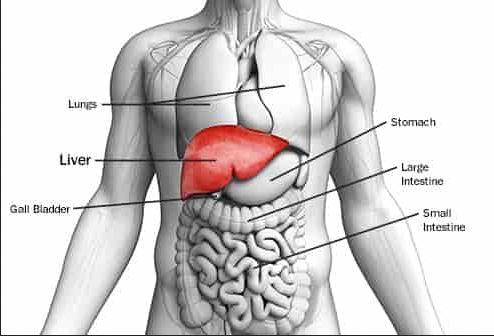
The liver is the body’s largest internal organ (approximately 1,500 g), positioned on the right side of the abdomen. It performs over 500 vital functions:
- Filtering toxins, bacteria, and drugs from the bloodstream.
- Producing bile to enable absorption of fats, cholesterol, and fat-soluble vitamins (A, D, E, K).
- Manufacturing blood-clotting proteins (fibrinogen, prothrombin).
- Regulating blood sugar by storing and releasing glucose as required.
- Controlling immune responses and fighting infection.
When the liver fails, all of these functions are simultaneously compromised — making liver failure a life-threatening multi-system emergency.
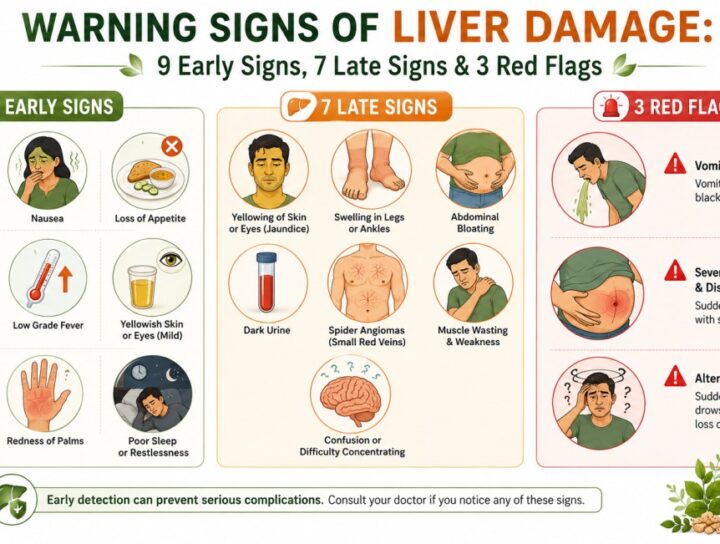
Signs and Symptoms of Liver Failure – When Is a Transplant Needed?
Liver failure presents as acute (sudden, within days to weeks) or chronic (progressive deterioration over months to years, typically as cirrhosis). The following symptoms indicate liver failure and require urgent evaluation:
| Symptom | What It Indicates | Urgency |
|---|---|---|
| Jaundice (yellowing of skin/eyes) | Bilirubin buildup — liver cannot process waste | ⚠ Consult immediately |
| Ascites (abdominal fluid accumulation) | Portal hypertension — advanced cirrhosis | ⚠ Urgent evaluation |
| Hepatic encephalopathy (confusion, disorientation) | Toxin accumulation affecting the brain | 🚨 Emergency |
| Variceal bleeding (vomiting blood / black stools) | Ruptured oesophageal varices — life-threatening | 🚨 Emergency |
| Progressive fatigue and muscle wasting | Metabolic failure — liver cannot sustain energy | ⚠ Consult within days |
| Easy bruising / uncontrolled bleeding | Clotting protein deficiency | ⚠ Urgent evaluation |
| Persistent itching (pruritus) | Bile salt accumulation under skin | Monitor + consult |
| Rapid, unexplained weight loss | Nutritional failure due to impaired bile production | Monitor + consult |
⚕ Medical Disclaimer: The symptoms listed above may have causes other than liver failure. This information is for educational purposes only. If you or a family member are experiencing any of these symptoms, please consult a qualified hepatologist or gastroenterologist immediately. Do not use this page to self-diagnose or to delay seeking medical care.
Who Needs a Liver Transplant?
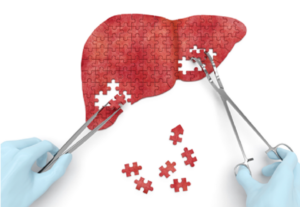
A liver transplant is recommended when the liver is too damaged to sustain life and no other medical or surgical intervention can adequately restore function.
Chronic Liver Conditions
- Alcoholic cirrhosis: Irreversible scarring from long-term alcohol use. Patients must demonstrate documented sobriety (typically 6 months) before evaluation.
- Hepatitis B and C cirrhosis: Viral hepatitis causing progressive liver scarring. Antiviral therapy is assessed first; transplant is indicated at end-stage.
- NASH / NAFLD: Non-alcoholic steatohepatitis — increasingly the leading global cause of transplant referral.
- PBC and PSC: Autoimmune destruction of bile ducts.
- Biliary atresia: Congenital bile duct condition — most common indication for liver transplant in children.
- Wilson’s disease and haemochromatosis: Inherited metabolic disorders causing toxic copper or iron accumulation.
Acute Liver Failure
Sudden liver failure from drug toxicity (paracetamol overdose), viral hepatitis, or unknown cause. Transplant may be needed within days of diagnosis.
Liver Cancer (HCC)
Patients with hepatocellular carcinoma within the Milan Criteria — a single tumour ≤5 cm, or up to three tumours each ≤3 cm, with no vascular invasion — are candidates for transplant as a curative treatment.
MELD Score — How Transplant Priority Is Determined
The MELD (Model for End-Stage Liver Disease) score determines transplant priority, calculated from serum bilirubin, creatinine, INR, and serum sodium. Scores range from 6 to 40; a higher score means more severe disease.
| MELD Score | Severity | 90-Day Mortality (untreated) | Transplant Priority |
|---|---|---|---|
| < 10 | Mild | < 2% | Low — medical management first |
| 10–19 | Moderate | 6–20% | Moderate — active monitoring |
| 20–29 | Severe | 20–50% | High — transplant evaluation essential |
| ≥ 30 | Critical | > 50% | Urgent — emergency listing indicated |
For patients pursuing LDLT with a willing donor, the MELD score helps determine timing but does not block access to transplant. Most transplant teams begin LDLT evaluation when the MELD score reaches 15–20.
Types of Liver Transplant
A liver transplant can be done in four different ways:
How It Works
A section of the liver is removed from a living donor because the liver can regenerate itself, both the transplanted section and the remaining section of the donor’s liver can regrow into a normal-sized liver. (A near relative donates 50–60% of their liver (typically the right lobe). Both livers regenerate within 2–3 months.)
Best For
Most Indian & NRI patients — no waiting list
Wait Time (India)
Evaluation + approvals ~2–6 weeks; surgery follows
How It Works
A liver from a brain-dead individual is offered via NOTTO allocation. Foreign nationals receive an organ only when no suitable Indian recipient is available.
Best For
Patients without an eligible living donor; requires patience and medical stability to wait
Wait Time (India)
1–3 months observed (MedicoExperts experience; no guarantee)
How It Works
A recently deceased person’s liver is removed and split into two pieces; each piece is transplanted into a different person, where it will grow to normal size.
Best For
Paediatric + adult simultaneously
Wait Time (India)
Depends on deceased donor availability
How It Works
Only diseased portion replaced; native liver retained to potentially recover.
Best For
Acute failure where native liver may recover (rare)
Wait Time (India)
Specialised centres only
Who Can Be a Liver Donor? — Indian Law and Clinical Criteria
The legal near-relative definition (THOTA Section 2(i) as amended 2011)
Under Indian law, a living donor for an international patient must be a near relative. The near-relative category includes:
- Spouse (husband or wife)
- Parent (mother or father)
- Son or daughter
- Brother or sister
- Grandparent (maternal or paternal)
- Grandchild
⚠ Important: spouse donors face additional scrutiny
A spouse is a near relative and may donate — but the committees will verify that the marriage is genuine and of sufficient duration, and was not entered into for the purpose of donation. Documentation of the marriage history, joint life (shared property, photographs, accounts, family records) will be required. This is a safeguard, not a barrier for genuine families.
⚠ Who CANNOT donate to an international patient
A cousin, friend, colleague, or any person not on the near-relative list cannot donate to a foreign national under Indian law. If the proposed donor is not a near relative, the LDLT route is not available and the patient would need to consider the DDLT pathway.
Clinical criteria for the living donor
| Criterion | Requirement | Why It Matters |
|---|---|---|
| Age | 18–55 years | Younger livers regenerate more effectively; older donors carry higher surgical risk |
| Blood group | ABO compatible with recipient | Essential to prevent immune rejection of the donated liver segment |
| BMI and liver quality | BMI < 28 No fatty liver (steatosis) on MRI |
Fatty liver reduces the functional volume available for safe donation |
| Medical history | No disqualifying conditions Liver disease, diabetes, cardiovascular disease, active cancer, HIV, or hepatitis |
Any of these disqualify donation to protect the donor’s own safety |
| Mental health and consent | Voluntary, informed consent Mentally competent; no pressure or financial inducement; psychiatric evaluation required |
Indian committees specifically test for coercion — donation must be entirely voluntary |
| Imaging clearance | >30% liver retained post-donation MRI volumetry + CT angiography for vascular mapping |
The donor must retain sufficient liver mass to recover safely |
What investigations are typically done before a Liver Transplantation?
Before a liver transplant can proceed, both the recipient and the living donor undergo a comprehensive evaluation. This ensures the recipient is stable enough for major surgery and that the donor can safely donate a portion of their liver.
- Blood tests: CBC, liver function tests (LFT), kidney function tests (KFT), coagulation profile (INR, PT), blood group and tissue typing, viral markers (HBV, HCV, HIV), CMV and EBV serology.
- Imaging: CT abdomen with contrast (liver volume + vascular anatomy), MRI liver, chest X-ray, 2D echocardiogram, Doppler ultrasound of liver vasculature.
- MELD score calculation: Bilirubin, creatinine, INR, serum sodium — determines transplant urgency and timing.
- Endoscopy: Upper GI endoscopy to assess for oesophageal varices.
- Cancer screening: AFP (alpha-fetoprotein) for HCC; colonoscopy and mammogram where applicable by age and sex.
- Psychiatric evaluation: Assessment of coping mechanisms, social support, and readiness for lifelong post-transplant medication compliance.
- Blood tests: CBC, LFT, KFT, blood group, viral markers (HBV, HCV, HIV, CMV), coagulation profile, genetic liver disease screening.
- Imaging: MRI liver volumetry (to calculate exact liver segments available), CT angiography (vascular mapping for surgical planning), chest X-ray, ECG.
- Physical examination: BMI assessment, cardiovascular screening, pulmonary function test.
- Psychological evaluation: Voluntary consent confirmed; independent donor advocate assigned where required.
- Final surgical clearance: The transplant surgeon reviews all imaging and labs before issuing final approval to proceed.
MedicoExperts can facilitate preliminary remote evaluation of donor and recipient documents before the family travels to India. Donors found unsuitable before travel are rare when thorough pre-travel due diligence is completed — but if a donor is found unsuitable in India, the procedure cannot proceed and the family must arrange an alternative eligible donor.
The Process for International Patients — Before Travel
MedicoExperts begins the process before the family travels to India. Six steps must be completed before the visa is released and the family can travel.
| Step | What Happens | Who Does It | Typical Duration |
|---|---|---|---|
| Step 1 Case evaluation |
The patient’s medical records are reviewed to confirm there is a genuine clinical need for a liver transplant. Transplant is never elective — there must be clinical necessity. | MedicoExperts + transplant team |
2–5 days from records submission |
| Step 2 Donor relationship evaluation |
The proposed donor’s relationship to the patient is confirmed: near relative only (spouse, parent, child, sibling, grandparent, grandchild). Donor’s initial medical fitness is also assessed remotely. | MedicoExperts | 2–3 days |
| Step 3 Document collection |
The family assembles the full docket: identity documents, relationship proofs, medical records, witnesses’ documents, and — for spouses — evidence of a genuine long-standing marriage (photographs, joint property, joint accounts, family history). See document checklist below. | Family + MedicoExperts guidance |
1–3 weeks depending on family preparedness |
| Step 4 Police clearance certificate |
A clearance certificate is obtained from the local police station in the patient’s area in India (or the relevant authority). This certifies that none of the parties is involved in any organ sale or purchase, and serves as additional residence verification. | Hospital MedicoExperts on arrival (some elements pre-travel) |
2–3 days typically |
| Step 5 Medical visa release |
Once the document docket is complete and MedicoExperts is satisfied it is genuine, the visa paperwork is released. Patient must travel on a Medical Visa (MV) — not a tourist or business visa. One first-degree family member from the donor’s side and one from the recipient’s side must also travel. Visa is the Indian mission’s decision; MedicoExperts provides the hospital invitation letter. | MedicoExperts provides invitation letter; family applies at Indian mission |
5–10 business days at Indian mission |
| Step 6 Travel |
The family travels to India. Attending witnesses — first-degree family members from both the donor’s side and the recipient’s side — are required for the affidavit signing and committee meetings. | Family | Per visa grant |
Document checklist — what the family must provide
| Document Category | Specific Documents Required | Purpose |
|---|---|---|
| Identity Patient and donor |
|
Establish identity and residence |
| Relationship proof All near relatives |
|
Prove the near-relative relationship to the committees; for spouses, demonstrate a genuine, long-standing marriage |
| Witness documents Both sides required |
|
Both committees require witnesses; they sign the affidavit |
| Medical records Patient |
|
Confirms genuine clinical need for transplant |
| Medical records Donor |
|
Initial remote donor fitness assessment |
| Financial declaration |
|
Both committees test for commercial donation — Indian law prohibits it |
The Four Approvals in India — After Arrival
Once the family lands in India, four sequential approvals are required before surgery can proceed. In the best-case scenario (well-prepared docket, no document gaps), MedicoExperts has completed all four in 10 days. A typical well-prepared case takes somewhat longer. No commitment on timing can be made.
| Approval | Who Gives It | What They Assess | Typical Timing |
|---|---|---|---|
| 1 Clinical go-ahead |
Transplant hospital’s clinical team — surgeons, hepatologists, anaesthesiologists | Full physical evaluation of donor and recipient at the transplant hospital. Both must be medically fit to proceed. This is the clinical green light. | 3–7 days Shortly after arrival |
| 2 Form 21 — Embassy clearance |
Patient’s own country embassy in India e.g. US Embassy New Delhi; UK High Commission New Delhi Not the Indian embassy abroad |
The embassy reviews the case, confirms the organ is needed for a legitimate medical procedure, and issues Form 21 — a statement of awareness with no objection. Without Form 21, the procedure cannot proceed. | Few days – 1 week Applied after clinical go-ahead; depends on embassy schedule |
| 3 Hospital internal committee |
Multi-disciplinary committee at the transplant hospital — clinical, administrative, legal, and psychological experts | Reviews all documents, family relationships, clinical records, and the team’s recommendation. Meets donor, recipient, and immediate family. Verifies:
Video consent of donor and recipient is recorded in the presence of family. Witnesses sign an affidavit. |
1–3 days After Form 21 received |
| 4 State Authorisation Committee |
State government committee — medical, legal, and psychological professionals | Independent final review — same tests as the internal committee, with independent authority. May meet the family and witnesses in person. Final say — no procedure proceeds without this approval |
2–3 days After internal committee clearance and state submission |
📋 Scheduling follows all four approvals
Once the state committee gives its approval, only scheduling remains. The hospital and doctor team then conduct the transplant with full legal and clinical readiness.
Guidelines for Indian Domestic Patients
For Indian domestic patients, the liver transplant process is governed by the Transplantation of Human Organs and Tissues Act (THOTA) and NOTTO guidelines. Key requirements:
- The donor must be a near relative — spouse, child, parent, or sibling. A distant relative or unrelated donor requires additional Authorization Committee approval.
- The donor must be aged 18–55 years, in good physical and mental health, with no pre-existing liver disease, diabetes, cardiovascular disease, or cancer.
- Both patient and donor submit an application to the hospital’s Transplant Authorization Committee, which verifies the relationship and confirms voluntary consent of the donor.
- Required documents: medical reports of both patient and donor, proof of relationship (family structure certificate with names, ages, addresses), Aadhaar or government ID, treating physician’s certificate.
- Approval is patient-specific, hospital-specific, and doctor-specific — it cannot be transferred to another hospital or another donor.
- NRI families holding OCI (Overseas Citizen of India) cards are still subject to the foreign national rule — they cannot use an Indian donor and must bring a donor from their country of residence.
The Surgery and Recovery — What to Expect
The surgery
Both donor and recipient surgeries begin early in the morning — typically around 7–8 a.m. — and run simultaneously in parallel theatres. Total operating time is approximately 8–10 hours. The donor team is finished before the recipient surgery is complete. The donor comes out of theatre first.
| Phase | What Happens | Which Team | Duration |
|---|---|---|---|
| Phase 1 Donor surgery |
The right lobe of the donor’s liver (~55–65% of total liver volume) is removed. Robotic-assisted donor hepatectomy with cosmetic closure is available at select centres in major metros — this minimises scarring. | Donor surgical team | ~4–6 hours |
| Phase 2 Recipient hepatectomy |
The diseased liver is removed — portal vein, hepatic artery, and bile duct are divided. Most complex phase |
Recipient surgical team Runs in parallel with donor surgery |
~2–4 hours |
| Phase 3 Implantation |
The donor liver segment is sutured into position. Blood vessels (portal vein, hepatic artery, hepatic vein) and the bile duct are reconstructed. | Recipient surgical team | ~2–3 hours |
| Phase 4 Reperfusion and closure |
Blood flow is restored to the new liver. The team monitors for bile leak, bleeding, and adequate graft perfusion. Abdomen is closed. | Recipient surgical team | ~1–2 hours |
Recovery timeline
| Milestone | Recipient | Donor |
|---|---|---|
| Discharge from hospital | ~3 weeks post-surgery | ~1 week post-surgery |
| Stabilisation in India | 2–3 additional weeks near the hospital for parameter monitoring and immunosuppressant balancing | Can return home or to accommodation; normal activity resumes in 3–4 weeks |
| Total India stay (from arrival) | ~7–9 weeks Evaluation + approvals + 3 weeks hospital + 2–3 weeks stabilisation |
~4–5 weeks Evaluation + approvals + 1 week hospital + recovery before flying |
| Fitness to fly home | ~6–7 weeks from arrival After stabilisation confirmed by clinical team |
~3–4 weeks from surgery |
| Return to normal activity | ~3 months from surgery | 3–4 weeks for normal activity 2–3 months for full liver regeneration |
| Complete liver regeneration | 2–3 months Transplanted segment grows to full size |
2–3 months Remaining liver regenerates to near-full size |
| Full recovery (recipient) | ~3 months from surgery | — |
ℹ Why 7–9 weeks — not 30–45 days
The 7–9 week figure reflects MedicoExperts’ actual experience: 10–15 days for evaluation and approvals, approximately 3 weeks in hospital for the recipient, and 2–3 weeks of stabilisation before the recipient is cleared to fly. Flying earlier than clinically advised is not recommended. Families should budget for accommodation for at least two attending relatives for this period. The donor can typically return home earlier.
Liver Transplant Procedure Video
Liver Transplant Cost in India — Detailed Breakdown (2026)
MedicoExperts’ package for a living-donor liver transplant is USD 26,000–30,000. A separate evaluation budget of USD 2,000–3,000 is required for the pre-surgery investigation of both donor and recipient. These are two different spend categories.
| Cost Item | Amount | Notes |
|---|---|---|
| LDLT package — recipient surgery | Included in USD 26,000–30,000 | Surgeon fee, OT charges, anaesthesia |
| LDLT package — donor surgery | Included | Donor’s surgery is part of the package |
| ICU stay (recipient) | Included | ~5–10 days |
| Ward stay — recipient | Included | ~3 weeks total hospital stay for recipient |
| Ward stay — donor | Included | ~1 week |
| In-hospital medications | Included up to standard limits | Immunosuppressants and antibiotics during hospital stay |
| Post-operative investigations (during hospital stay) | Included | Labs and imaging during the hospital stay |
| Pre-surgery evaluation — donor and recipient | USD 2,000–3,000 separately | Paid as tests occur, on OPD basis before admission for the procedure |
| Complication management (if required) | Additional — not in package | E.g., rejection episode, extended ICU. MedicoExperts provides a written estimate range before travel. |
| Total package (procedure only) | USD 26,000–30,000 | Does not include evaluation or excluded items above |
What is NOT included — budget these separately
- International flights for patient, donor, and accompanying family members.
- Accommodation in India for the full stay — for at least two attending relatives for ~7–9 weeks. Market rates near major transplant centres: INR 2,000–5,000/night for serviced apartments.
- Food, local transport, SIM cards, incidentals.
- Post-discharge immunosuppressant medications — this is a lifelong ongoing cost (approximately INR 8,000–20,000 per month depending on the regimen; the initial course during hospital stay is included in the package).
- Follow-up investigations after returning to the home country.
- Visa fees and travel insurance.
💰 A realistic total budget for an international family
Package: USD 26,000–30,000. Evaluation: USD 2,000–3,000. Accommodation for two attending relatives for 7–9 weeks at USD 30–70/night: USD 3,000–9,000 approximately. Flights: variable by origin. Total all-in budget: typically USD 32,000–45,000 depending on duration and origin city.
For context: Milliman 2025 puts the US average billed charges for a single liver transplant at USD 1,017,800. An insured US family contributing 10% would typically pay USD 100,000+ out of pocket — before flights, accommodation, or any denial-of-coverage scenarios.
Note: Payment for the procedure is typically made in full at the time of hospital admission for the transplant, not at booking. Evaluation costs are paid on OPD basis as tests are done. Some small items are settled at discharge. MedicoExperts provides a written cost estimate before the family travels.
Patient Testimonials
A Real Case — A Family from the United States
This case is shared with the written consent of the patient and donor. Some identifying details have been omitted at the family’s request.
Background: A husband was diagnosed with liver cirrhosis. Transplant was the only long-term solution. Despite being well-insured in the United States, the family had spent six months without a clear path forward.
The donor problem: The wife was willing to donate a portion of her liver. Under US practice, she was not considered a preferred living donor because she has dependent children. In India this was not a barrier — a wife is a near relative under Indian law, and committees do not disqualify donors on the basis of having dependent children.
The waiting-list problem: The deceased-donor waiting time at their US centre was 2–3 years. The patient was not clinically stable enough to wait that long.
The cost: The family’s estimated total cost of treatment in the US — including the procedure, post-operative care, and long-term follow-up — was approximately USD 2 million. Although insured, their own projected contribution was around 10%. The family could not fund this.
What MedicoExperts did: Identified a JCI- and NABH-accredited centre and a senior transplant surgeon with extensive living-donor liver transplant experience. Created a complete documentation docket, verified the genuineness of the relationship and the donation, and managed every stage — clinical, documentary, and regulatory.
In India: All four approvals — clinical go-ahead, Form 21 from the US Embassy in New Delhi, hospital internal committee, and state Authorisation Committee — were obtained within 10 days of arrival. MedicoExperts notes this was among the fastest approvals handled and should not be taken as a standard or expected timeline.
Surgery and recovery: The procedure went ahead. The recipient was discharged approximately three weeks after surgery. The donor was discharged within one week. Both are well.
The donor’s surgery: Robotic donor hepatectomy with cosmetic closure was performed. Two months after the procedure, there is no significant visible mark.
From first contact to a completed transplant: approximately 45 days. From six months without direction to a permanent solution.
The family is willing to speak directly with prospective patients about their experience. Contact MedicoExperts to arrange this introduction.
Liver Transplant Success Rate in India — What Do the Numbers Say?
India’s leading liver transplant centres report survival outcomes consistent with international benchmarks published by the European Liver Transplant Registry (ELTR) and the Scientific Registry of Transplant Recipients (SRTR, USA).
| Survival Milestone | India (Leading Centres) | USA (SRTR 2023) | UK (NHS 2023) |
| 1-year patient survival | 84.3–95% | 91% | 89% |
| 5-year patient survival | 75–82% | 76% | 74% |
| 1-year graft survival | 85–95% | 88% | 86% |
| LDLT 1-year survival | 84.3–95% | Limited LDLT | Limited LDLT |
| Donor mortality (LDLT) | < 0.5% | < 0.5% | < 0.5% |
Sources: NMJI, The Status of Liver Transplantation in India; OPTN/SRTR 2023 Annual Data Report: Liver (PMC12334193); NHS Annual Report.
Factors affecting individual outcomes include: underlying condition (cirrhosis vs acute failure vs HCC), MELD score at surgery, patient age and comorbidities, donor liver quality, surgical team volume, and post-transplant medication adherence.
After You Return Home — Follow-up, Medication, and Who to Call
The transplant is the beginning of a new phase of the recipient’s life, not the end of the process. Post-transplant management is primarily about monitoring parameters and balancing immunosuppressant dosages.
What follow-up looks like
- Immunosuppressants are closely monitored during the India stay. A slow taper of immunosuppressants typically begins after stabilisation.
- Before flying home, the clinical team confirms that parameters are stable and the patient is fit to travel.
- A full discharge summary and follow-up protocol is provided — designed to hand over to the patient’s hepatologist in their home country.
- MedicoExperts remains the first point of contact after the family returns home. The same clinical team that managed the India stay remains available online.
- If medication needs to be sent from India, MedicoExperts ensures the patient receives it with the correct guidance.
Red-flag symptoms — what to act on immediately
- Fever above 38°C / 100.4°F — may indicate infection or rejection.
- Jaundice returning (yellowing of skin or eyes) — may indicate graft dysfunction or bile duct problem.
- Severe abdominal pain — may indicate a surgical complication.
- Marked change in urine colour (dark brown) or pale stools.
- Any of these should be escalated to MedicoExperts and the local hepatologist simultaneously — do not wait.
How to Choose the Best Hospital for Liver Transplant in India
| Evaluation Criteria | What to Look For | Why It Matters |
| Accreditation | JCI and/or NABH certification | Internationally validated quality and patient safety standards |
| Annual transplant volume | >100 liver transplants per year preferred | Higher volume correlates with better outcomes and complication management |
| Surgeon experience | Fellowship in HPB surgery or Multi-Organ Transplantation; >200 personal transplants performed | Complex vascular reconstruction requires sustained high-volume expertise |
| Dedicated transplant ICU | Separate ICU with trained hepatology nurses and 24/7 specialist cover | Post-operative management is as critical as the surgery itself |
| Rejection management | On-site biopsy capability; structured immunosuppression protocol | Early rejection detection and treatment is a critical success factor |
| International patient services | Dedicated IP coordinator, translation, accommodation partnerships | Essential for NRI and overseas patients managing logistics remotely |
How to Choose the Best Liver Transplant Surgeon
- MCh in Surgical Gastroenterology or Hepato-Pancreato-Biliary (HPB) surgery, or a formal Fellowship in Multi-Organ Transplantation.
- Personal surgical volume: more than 200 independently performed liver transplants is the benchmark for high-volume expertise.
- Request 1-year patient and graft survival data specific to the surgeon and hospital — not just the hospital’s overall statistics.
- Emergency management capability: the ability to handle vascular complications, bile leaks, and rejection episodes separates experienced from average transplant surgeons.
MedicoExperts empanels liver transplant surgeons strictly on the above criteria and shares surgeon-specific outcome data with patients before they make a decision.
Why MedicoExperts for Your Liver Transplant?
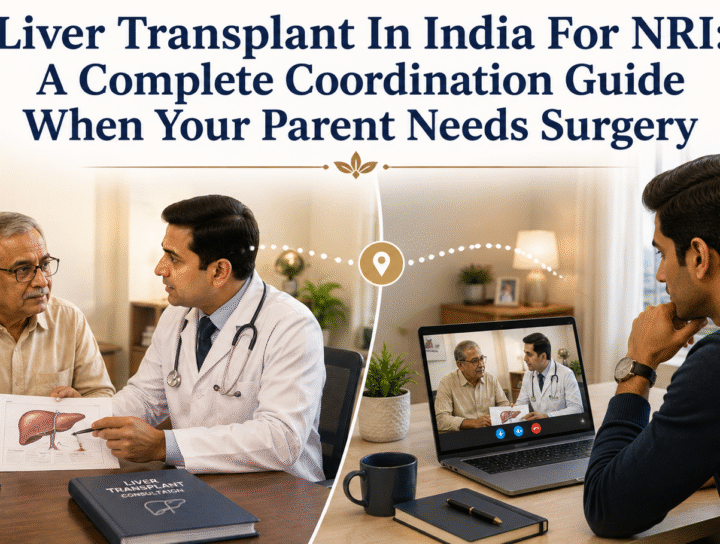
MedicoExperts is India’s leading Global Virtual Hospital for complex surgical coordination. We connect patients with the right surgeon, at the right hospital — managing all the coordination, documentation, and support a high-stakes procedure like a liver transplant demands.
| What MedicoExperts does | Why it matters for a family coming from abroad |
|---|---|
| Remote case review and expert second opinion Within 48 hours |
Confirms whether the case is suitable before the family commits to anything |
| Case-specific centre and team selection | There is no single best hospital for liver transplant. The right centre depends on the specific indication, the MELD score, the donor’s anatomy, the required surgical approach, and cost fit. MedicoExperts does not publish a fixed hospital list — it selects case by case. |
| Complete documentation docket management | The documentation process is the most common point of failure for international patients. MedicoExperts has handled the full docket — witnesses, affidavits, police clearance, embassy clearance, committee submissions — across dozens of international cases. |
| Form 21 liaison with the patient’s home-country embassy in India | Most families do not know that Form 21 comes from their own country’s embassy in India, not the Indian embassy at home. MedicoExperts navigates this with the family. |
| State committee submission management | The state committee submission requires a complete, correctly assembled docket. Gaps cause delays of days to weeks. MedicoExperts prepares this submission. |
| Written cost estimate before travel No surprises on arrival |
A clear, itemised estimate is provided before the family commits to travelling. |
| Accommodation and logistics coordination | Tie-ups with accommodation near major transplant centres; airport pickup; local support for an extended stay of 7–9 weeks. |
| Post-discharge follow-up continuity | Structured handover to the home hepatologist; the same clinical team remains reachable online after the family returns home. |
Frequently Asked Questions and patient concerns:
Q1. How much does a liver transplant cost in India compared to the USA?
MedicoExperts’ all-in package for a living-donor liver transplant is USD 26,000–30,000, plus a separate evaluation budget of USD 2,000–3,000 for pre-surgery investigations. This compares with an average billed charge of USD 1,017,800 in the United States (Milliman 2025 data). An insured US family contributing 10% would typically pay around USD 100,000 out of pocket — before flights, accommodation, and any insurance complications. The India package covers both surgeries (donor and recipient), hospital stay for both, surgeon fees, OT charges, and in-hospital medications.
Q2. Can a foreign national receive a deceased-donor liver in India?
Yes, but with conditions. Under Indian law, a foreign national may receive a deceased-donor liver, but only after no suitable Indian recipient is available nationwide. Priority is given to Indian patients first. In MedicoExperts’ experience, international patients who are medically stable and remain in India have received a deceased-donor organ within 1–3 months — but this is observed experience, not a guarantee. Timing is entirely dependent on organ availability and the absence of a matching Indian recipient. For families with an eligible living donor, the living-donor route (LDLT) is strongly preferred for its speed and predictability.
Q3. Who can be a liver donor for an international patient in India?
The donor must be a near relative under THOTA Section 2(i): spouse, parent, child, sibling, grandparent, or grandchild. A cousin, friend, or any person outside this list cannot donate to a foreign national under Indian law. A spouse may donate — but the committees will verify that the marriage is genuine and of sufficient standing, and was not entered into for the purpose of donation. Documentation of the marriage history will be required. Donors who are medically unsuitable are identified before travel when thorough pre-travel evaluation is completed; if a donor is found unsuitable in India, the procedure does not proceed.
Q4. What is Form 21 and where does it come from?
Form 21 is a mandatory clearance document without which no liver transplant can proceed for an international patient. It is issued by the patient’s own country’s embassy or consulate in India — for example, the US Embassy in New Delhi for a US patient, or the UK High Commission in New Delhi for a UK patient. It is NOT issued by the Indian embassy in the patient’s home country. The embassy reviews the case and issues Form 21 once satisfied the procedure is for a legitimate medical need. Form 21 is applied for after the clinical go-ahead is received in India. MedicoExperts liaises with the embassy on the family’s behalf.
Q5. How long does the whole process take — from first contact to going home?
A realistic timeline is: pre-travel document collection and visa (1–3 weeks, family-dependent) + evaluation and approvals in India (10–15 days typically) + surgery + approximately 3 weeks in hospital (recipient) + 2–3 weeks stabilisation in India before flying home. Total India stay: approximately 7–9 weeks. The donor can typically fly home 3–4 weeks after surgery. The best case MedicoExperts has seen — a well-prepared US family — achieved all approvals in 10 days and the full cycle from first contact to a completed transplant in approximately 45 days. This is offered as one real example, not a standard or a promise.
Q6. What happens if the donor is found unsuitable after arriving in India?
If the donor is found clinically unsuitable during in-India evaluation, the transplant cannot proceed and the family must identify and arrange another eligible near relative as donor. This is a rare outcome when thorough pre-travel due diligence is completed — MedicoExperts’ remote evaluation process is specifically designed to identify disqualifying factors before the family travels. If the procedure does not proceed for any reason, MedicoExperts discusses the financial implications of each scenario with the family before travel. The deceased-donor pathway may be explored if no alternative living donor is available.

MedicoExperts is a Global virtual hospital which is established to offer quality healthcare services at affordable pricing without compromising the success rates of the treatment.
MedicoExperts is having a network of highly experienced super specialist doctors and well equipped hospitals across the globe and offering second opinion through online video consultation and surgical interventions through its empanelled super specialist doctors at its network hospitals in 17 countries from 3 continents.
By the virtue of its approach and model, MedicoExperts is successfully achieve to deliver
- Latest and most advanced treatments with success rates of international benchmarks.
- Multiple cost options depending upon the hospital facilities, with the same doctor.
- Treatment option in multiple cities/state/countries.
- Trust and peace of mind.
Most suitable for patients who are looking for:-
- Planned Surgeries and treatment from most experienced doctors and at multiple cost options as per hospital facilities with best possible outcomes.
- Second Opinion from expert doctors.
- Complex cases involving multi specialities
- International patients looking for treatment from Indian doctors
- Milliman, 2025 U.S. Organ and Tissue Transplants: Estimated Costs and Utilization, Figure 3 — liver average billed charges USD 1,017,800. Available: edge.sitecorecloud.io/millimaninc5660-milliman6442-prod27d5-0001/media/Milliman/PDFs/2025-Articles/2-12-25_2025-US-organ-and-tissue-transplant-report.pdf
- Ministry of Health & Family Welfare, Government of India. DO letter dated 19 June 2024 on foreign citizens seeking organ transplant in India (foreign nationals / THOTA / Form 21 / deceased-donor allocation). Via: ThePrint; Indian Transplant Newsletter (ITN) Issue 72.
- Transplantation of Human Organs and Tissues Act, 1994 (as amended 2011), Section 2(i) — near-relative definition. Available: indiacode.nic.in/bitstream/123456789/15433/1/transplantation_of_human_organs_and_tissues_act,_1994.pdf
- NMJI — The Status of Liver Transplantation in India. 2022 data: 3,920 liver transplants (3,183 LDLT + 737 DDLT) across 183 registered centres; 1-year survival 84.3–95% by centre. Available: nmji.in
- OPTN/SRTR 2023 Annual Data Report: Liver. PMC12334193. Available: pmc.ncbi.nlm.nih.gov/articles/PMC12334193/
- SRTR Program-Specific Reports, May 2026 release — median time to transplant 4.3 months; range 0.5–47.5 months across centres; 58.2% of adults listed in 2022 transplanted within 1 year. Summary via: nationalfriends.org/liver-waiting-list/
- THOTA — Transplantation of Human Organs and Tissues Act. DGHS summary: dghs.mohfw.gov.in/mainsitedghs/uploads/assets/5dNgS3HryhmaL3GL47bkDozwl5GjkWW2ApJcz8Z1.pdf
The information provided on this page is for educational and informational purposes only and does not constitute medical advice, diagnosis, or treatment. Liver transplantation is a complex surgical procedure — individual candidacy, risks, costs, and outcomes vary based on the patient’s medical condition, age, comorbidities, and the treating hospital’s assessment. Always consult a qualified hepatologist or transplant surgeon before making any medical decisions. MedicoExperts facilitates patient-to-specialist connections and does not provide direct medical treatment.

Author Bio:
Dr. Subhamoy Mukherjee – Ph.D. (Oncology)
Dr. Subhamoy Mukherjee is a molecular oncologist with experience of working with genomic profiles. He has several years of experience in scientific writing. He takes strong interest in making people aware of different treatment approches in cancer, acute and chronic diseases. He also has interest in innovative approches for treating different mental and physical illnesses.
Content Medically Reviewed By MedicoExperts Editorial & Clinically Review Board