
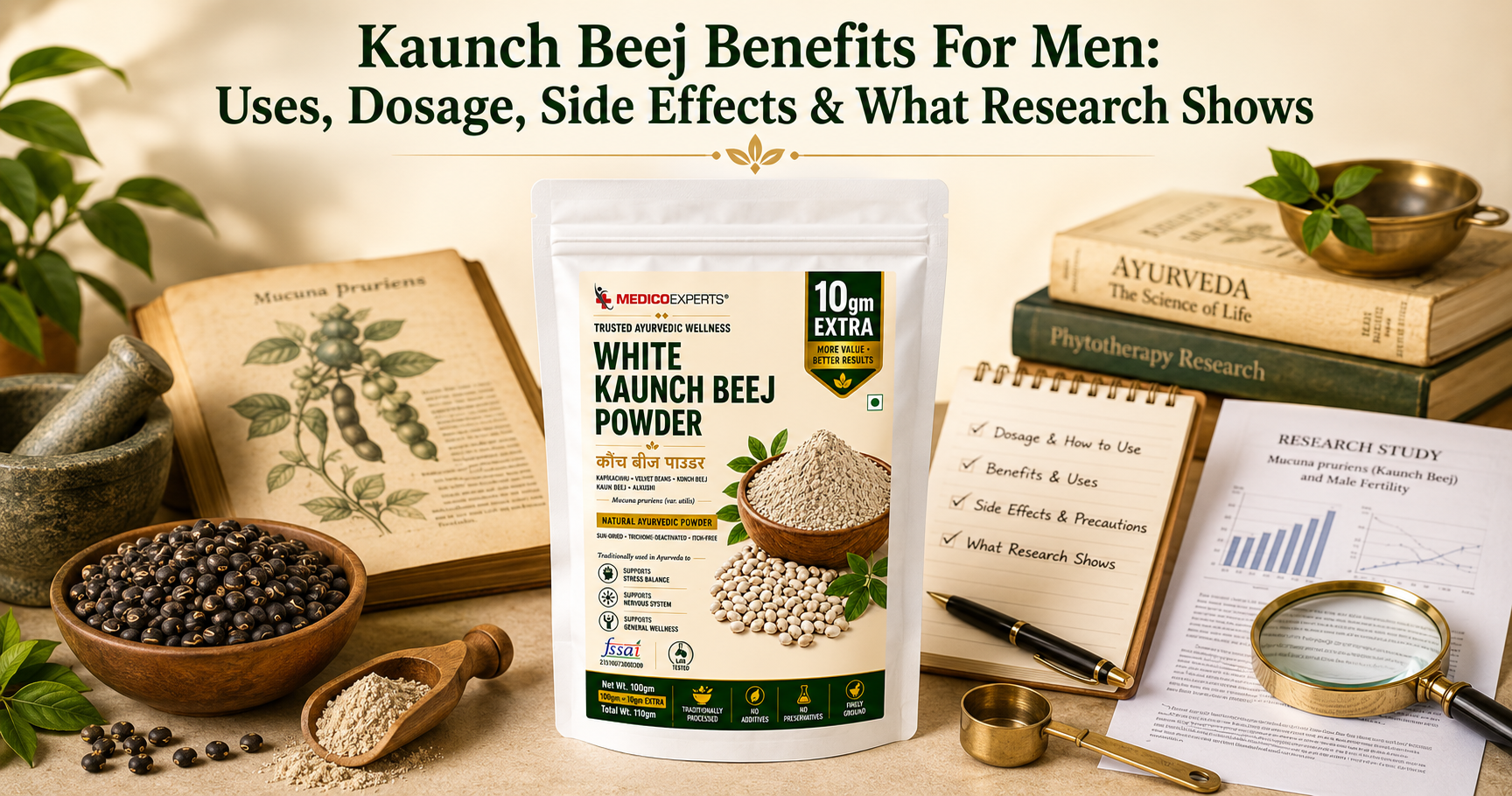
If you have poor energy, stamina, or infertility issues and you are scouring the internet to understand kaunch beej’s benefits for men and also about other natural supplements to improve your health, you need to know that Ayurveda recommends kaunch beej to increase vitality in males.
Kaunch beej is also known as Mucuna pruriens, or Kapikacchu, and it is a species of velvet bean. It is an Ayurvedic herbal medicine containing high levels of a substance called L-DOPA. Hence, it is considered great for male infertility.
Clinical trials conducted in infertile males showed that Kaunch Beej improved sperm concentration, sperm motility, hormone levels, and reduced oxidative stress.
The recommended dose is 3-6 g of an extract made from the seeds. Due to the presence of L-DOPA, the substance may interact with other medications. So, consult your doctor before use.
To help you understand its benefits, we will discuss scientific data on the topic and describe the benefits, uses, dosage, side effects, and risks of Kaunch Beej in this article.
Are you searching for genuine Kaunch Beej powder? Check out MedicoExperts White Kaunch Beej Powder.
What is Kaunch Beej? A Quick Introduction
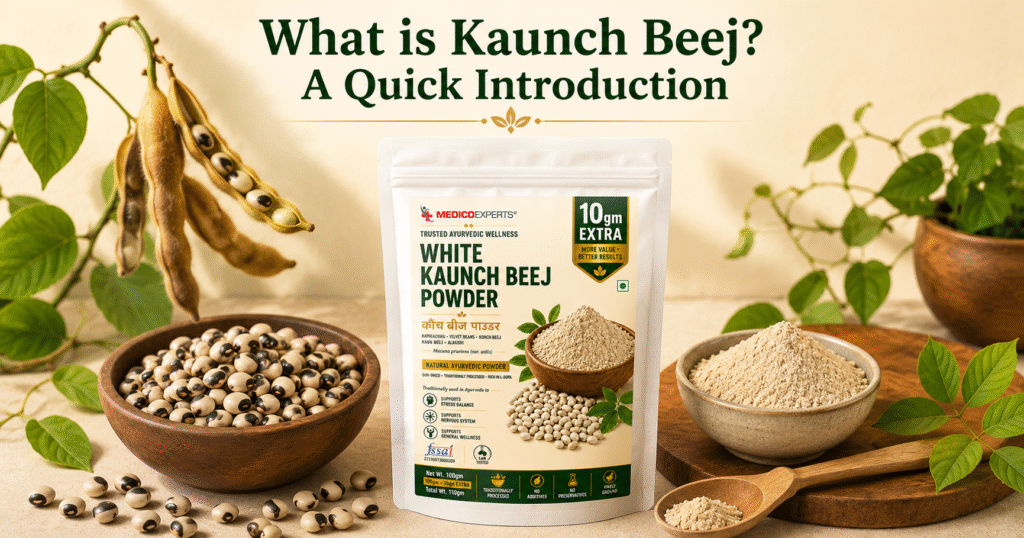
Kaunch Beej is extracted from the tropical climber plant, Mucuna pruriens, and it has been used in Ayurvedic remedies for centuries. The word “Beej” means “seeds” in Hindi. The name “Kaunch Beej” implies the seeds of this plant that have been ground into a fine powder for medicinal purposes.
Although Kaunch Beej is mainly used to enhance the sexual power and vitality of men, it is also believed to be a powerful rejuvenating herb that promotes overall well-being.
What is Kaunch Beej known as?
Kaunch Beej is known by different names across India and around the world. Below are the alternate names for Kaunch Beej:
- Hindi: Kaunch Beej, Kauncha
- Sanskrit: Kapikacchu, Atmagupta
- English: Velvet Bean, Cowhage
- Bengali: Alkushi
- Tamil: Poonaik Kaali
- Botanical Name: Mucuna Pruriens
The pods of this plant are covered with hair that causes unbearable itching when touched. Hence, the plant is also known as cowhage. But the seeds extracted from the pod do not have these hairs.
This irritating hair is present on the pods and the stems. Therefore, it becomes essential to buy an authentic product that has been processed to remove these unwanted hairs.
How Kaunch Beej Works: The L-DOPA and Dopamine Connection
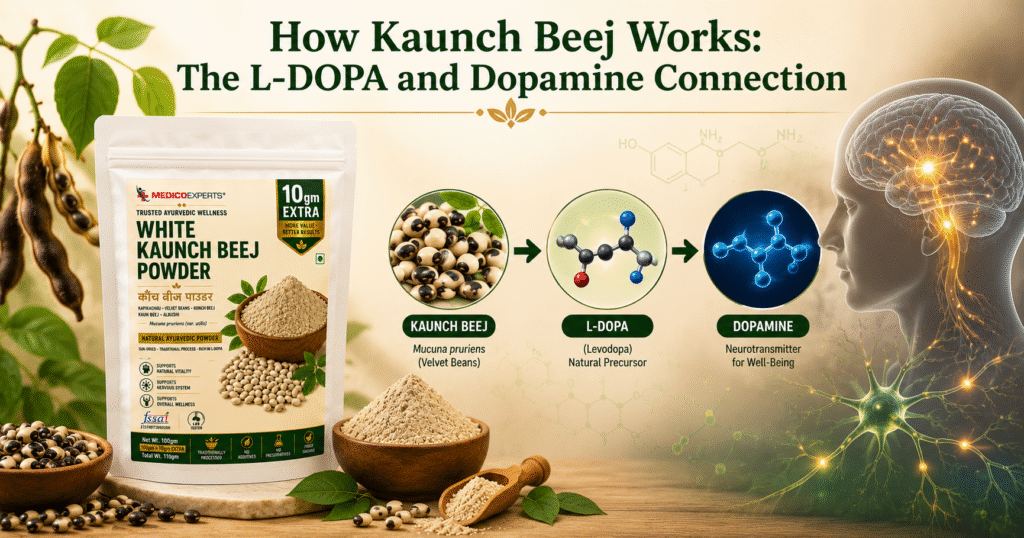
The reason Kaunch Beej (Mucuna Pruriens) is so interesting for scientists is the fact that it contains a large amount of L-DOPA, or L-3,4-dihydroxyphenylalanine.
L-DOPA is an amino acid that the human body turns into dopamine, a neurotransmitter that is responsible for motor skills, motivational level, mood, hormone production, and sexual function.
It is believed that the dopaminergic system’s action in humans is responsible for most of the health benefits attributed to Kaunch Beej.
How L-Dopa May Promote Testosterone?
The neurotransmitter dopamine has another incredibly important role in the human body, apart from being responsible for a person’s emotional state. Dopamine is partially responsible for controlling the amount of prolactin, a hormone produced by the pituitary gland.
In cases when prolactin levels are too high, they can greatly impact a man’s testosterone levels by disrupting the HPG axis, a collection of glands responsible for testosterone production.
Due to its ability to increase the amount of dopamine in one’s system, L-DOPA may prevent prolactin levels from going excessively high.
This effect is at least partially responsible for Kaunch Beej’s ability to improve semen quality and testosterone levels in men with fertility issues, as demonstrated by the clinical study.
But it is not enough of a rationale to recommend the supplement to everybody, as there is a need for additional research to arrive at more concrete conclusions.
Kaunch Beej Benefits for Men: What Research Shows
Although Kaunch Beej has had many applications in Ayurveda, not all of them have received equal research attention.
Some health effects (especially the ones linked to male fertility) are backed by human clinical data, while others depend on tradition, animal and cell culture experiments, or biology. Here is what the existing scientific evidence says.
1. May Promote Sperm Count and Sperm Motility (Human Evidence)
2. May Support Testosterone and Hormonal Balance (Human Evidence)
3. May Reduce Stress and Support Mood (Human + Mechanism)
4. Traditionally Used as an Aphrodisiac and for Libido
5. Traditionally Used for Strength and Vitality
Support your wellness journey with MedicoExperts White Kaunch Beej Powder, a single-herb Ayurvedic product made from properly processed Mucuna Pruriens seeds.
कौंच बीज के फायदे — Kaunch Beej Ke Fayde (Hindi Summary)
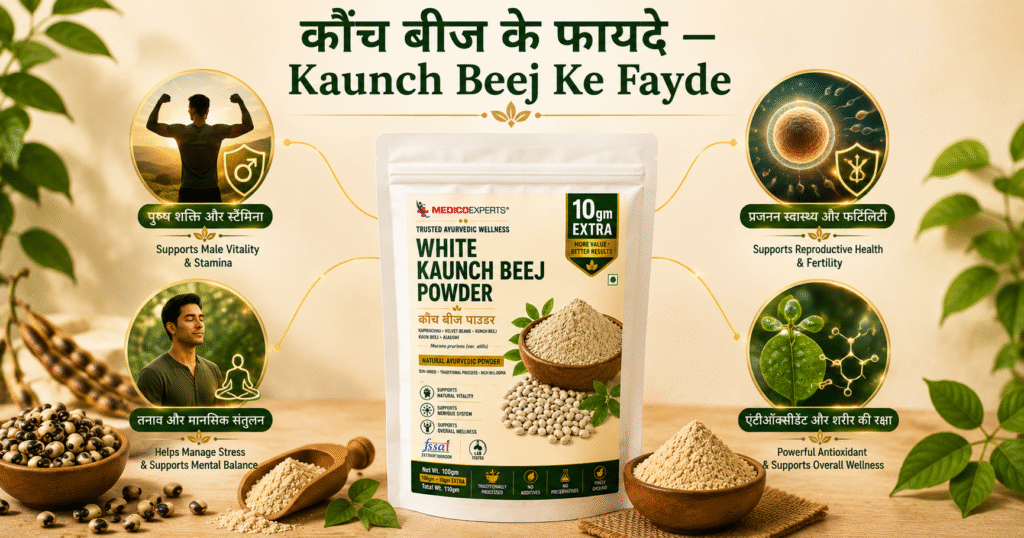
अगर आप कौंच बीज के फायदे (Kaunch Beej Ke Fayde) जानना चाहते हैं, तो आयुर्वेद में इसे पुरुषों के यौन स्वास्थ्य (sexual health), शुक्राणु (sperm) की गुणवत्ता, ताकत और स्टैमिना, तथा हार्मोन संतुलन के लिए महत्वपूर्ण माना जाता है। कौंच बीज (Mucuna pruriens) में प्राकृतिक रूप से L-DOPA पाया जाता है, जो शरीर में डोपामिन (dopamine) बनने में मदद करता है। यही कारण है कि इस पर आधुनिक शोध भी किया गया है।
मानव अध्ययन (Human Evidence): बांझपन (infertility) से जूझ रहे पुरुषों पर किए गए एक क्लिनिकल अध्ययन में पाया गया कि mucuna pruriens लेने के बाद शुक्राणुओं की संख्या (sperm count), गतिशीलता (motility) और कुछ प्रजनन हार्मोन, जैसे टेस्टोस्टेरोन, में सुधार देखा गया। हालांकि, यह अध्ययन केवल infertile men पर किया गया था। इसलिए यह नहीं कहा जा सकता कि स्वस्थ पुरुषों में भी यही परिणाम निश्चित रूप से मिलेंगे।
पारंपरिक आयुर्वेद में कौंच बीज को वाजीकरण (Vajikarana) और रसायन (Rasayana) औषधि माना जाता है, जिसका उपयोग यौन शक्ति, ऊर्जा, ताकत और तनाव कम करने के लिए किया जाता रहा है। हालांकि, इन पारंपरिक उपयोगों की पुष्टि के लिए अभी और उच्च-गुणवत्ता वाले मानव अध्ययनों की आवश्यकता है.
सावधानी: यदि आप Parkinson’s disease या मानसिक स्वास्थ्य (psychiatric) से जुड़ी दवाएं ले रहे हैं, तो कौंच बीज का सेवन शुरू करने से पहले अपने डॉक्टर से सलाह लें, क्योंकि इसमें मौजूद L-DOPA कुछ दवाओं के साथ परस्पर क्रिया (drug interaction) कर सकता है.
Kaunch Beej Kaise Khaye? Dosage and How to Take It?
For most adults, the standard dosage of Ayurvedic medicine made from processed Kaunch Beej (Mucuna pruriens) seed powder is 3-6 g per day. This figure has been established based on the standard use of Ayurvedic churna (powder).
But one’s requirements may vary depending on the case, so it is worth contacting a specialist in herbal medicine before use, particularly if there are chronic diseases or the use of prescription drugs.
| Parameter | Recommendation |
|---|---|
| Form | Processed (Shodhit) Kaunch Beej seed powder |
| Daily dose | 3–6 grams per day (approximately ½–1 teaspoon per dose) |
| Frequency | Once or twice daily |
| How to take | Mix with warm milk (traditional Anupana, the substance used to carry or enhance an herbal remedy) or warm water. Honey may also be added if preferred. |
| Best timing | Morning and/or evening, preferably after food |
| Duration | Use consistently for 8–12 weeks before assessing results. A clinical study in infertile men evaluated Mucuna pruriens over approximately 3 months. |
| Important | Use only properly processed (Shodhit) Kaunch Beej. Raw seeds should not be consumed directly. |
Why Does Processing Matter?
Kaunch Beej must always be consumed in its processed (shodhit) form. Shodhana is the traditional Ayurvedic process that is used to make the herb fit for consumption.
In its raw form, mucuna pruriens contains toxins and high levels of L-DOPA, which need to be reduced through processing. Thus, it is important to buy the product from a reputable manufacturer who sells processed seed powder.
Why is Warm Milk Recommended?
Warm milk is the traditional anupana (vehicle) recommended in Ayurveda for Vrishya (aphrodisiac) herbs like Kaunch Beej. It is used to extract maximum benefit from the formulation.
Unless you are vegan, warm milk is the best option to take Kaunch Beej. Warm water can be an alternative if you are unable to have milk, but warm milk is the traditional Ayurvedic way to take the formulation.
What is the Best Way to Have Kaunch Beej?
Like most Ayurvedic medicines, it is best to take Kaunch Beej regularly for a month or two. There are no magical potions that can show you results within days. You need to give your body some time to adjust to the formulation.
Kaunch Beej Side Effects, Precautions and Drug Interactions
Safety Note
Side Effects of Kaunch Beej
Who Should Avoid Kaunch Beej?
A Word About Safety
Medical Disclaimer
How Long Does Kaunch Beej Take to Work?
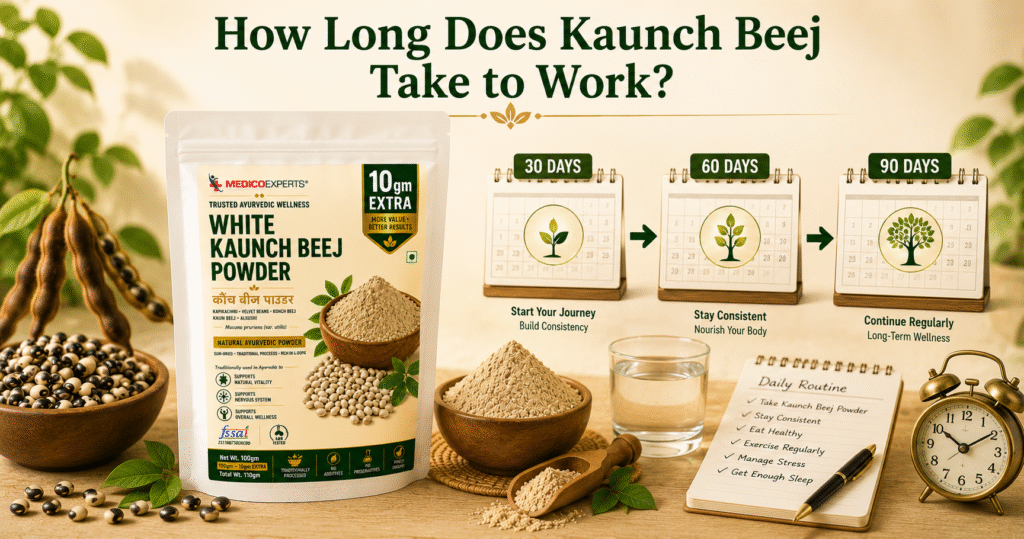
For best results, Kaunch Beej is not recommended for short-term use. In most cases, you should use this supplement for not less than 8-12 weeks to improve your health indicators.
A human study on the efficiency of Mucuna pruriens for infertile men showed the best results after participants used it for about three months.
Note that the effectiveness of Kaunch Beej varies from person to person. It depends on your current health state, what purpose you use this remedy for (infertility, menopause, etc.), your nutrition, lifestyle, and a lot of other factors. Do not expect the same result as your friend or relative who also took Kaunch Beej.
Do not try to increase the dose of Kaunch Beej, as it may be harmful to your health. Stick to the recommended daily allowance of 3-6 grams of powder per day.
If you take Kaunch Beej for the first time in your life, it is better to consult your doctor before you start your treatment. This is important if you are using this remedy for infertility or any other hormone-related issue.
Kaunch Beej vs Safed Musli: What’s the Difference?
Although Kaunch Beej and Safed Musli are both prominent herbs in traditional Ayurveda for men’s health, they have different qualities, too. The two are different in terms of origin, phytochemistry (the study of chemical compounds found in plants), and clinical evidence.
Even though Kaunch Beej is renowned for its endogenous L-DOPA content and associated clinical trials on male fertility, Safed Musli is traditionally known as a nourishing herb for the male reproductive system that contains ecologically derived steroidal saponins.
| Factor | Kaunch Beej | Safed Musli |
|---|---|---|
| Part used | Seed (Mucuna pruriens) | Root (Chlorophytum borivilianum) |
| Key compound | L-DOPA (dopamine precursor) | Steroidal saponins |
| Human evidence | Yes — human trial in infertile men | Limited — mostly animal studies |
| Main strength | May support sperm health, reproductive hormones, stress management | Traditionally used for stamina, nourishment, and reproductive wellness |
| Notable caution | Can interact with certain medications because of its L-DOPA content | Product quality matters due to possible species adulteration |
In other words, kaunch beej has more human evidence supporting its positive effect on several factors of male fertility improvement, such as sperm quality and male sex hormone synthesis (the biological process of making sex hormones).
Additionally, there is a proven biological pathway by means of which it influences the L-DOPA-dopamine system. But because of that pathway, one needs to be careful when taking Kaunch Beej, especially concerning possible interactions between medications.
Safed Musli has a centuries-old history of being used in Ayurveda and is considered to be a softer product. Nevertheless, almost all the evidence for the effectiveness of Safed Musli is anecdotal and based on the results of animal studies, whereas there are not many human studies.
That is why it is not a surprise that, because of the different modes of action, these two plants are often combined.
Related Articles:
Key Takeaways
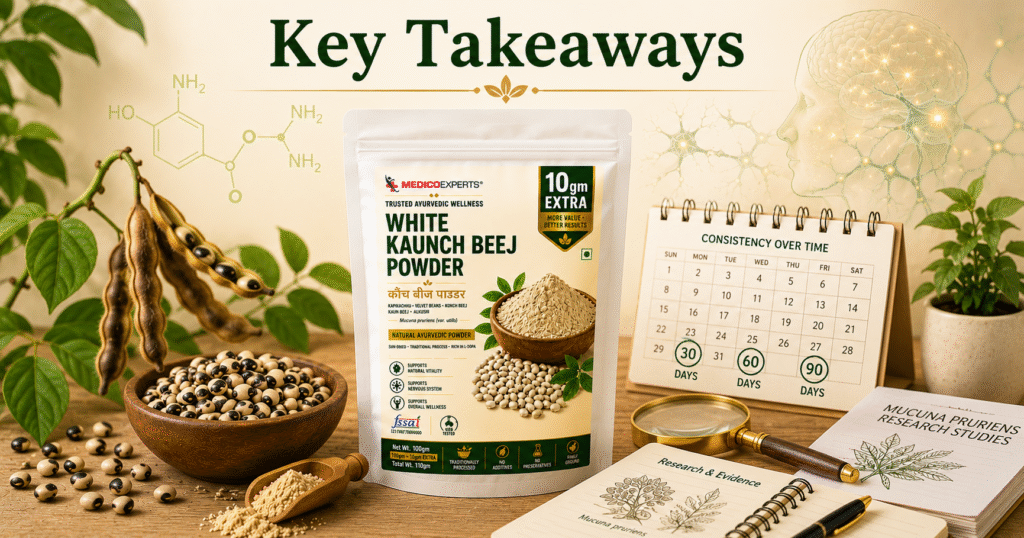
Kaunch Beej is an Ayurvedic herb seed, which is considered to contain L-DOPA, a natural amino acid. Kaunch Beej is different from many other Ayurvedic medicines, as this substance has been clinically tested on humans.
According to one of the studies, it was shown that this medicine can increase sperm count and motility, as well as male hormones such as testosterone in the bloodstream. However, there is no evidence of this effect for non-infertile males, so further research is needed.
The usual dose of Kaunch Beej (Mucuna pruriens) is 3-6 grams of Shodhit (processed) Kaunch Beej seed powder taken with warm milk daily for 8-12 weeks.
Since Kaunch Beej has L-DOPA content, it may have negative interactions with some medicines used in treating Parkinson’s disease, psychiatric disorders, diabetes, and hypertension. Therefore, it is highly recommended to consult your physician regarding taking Kaunch Beej if you suffer from any of these conditions.
It is also necessary to be sure about the origin of the Shodhit Kaunch Beej seed powder or processed powder.
Support your wellness journey with MedicoExperts White Kaunch Beej Powder, a single-herb Ayurvedic product made from properly processed (shodhit) Mucuna pruriens seeds.
Frequently Asked Questions (FAQs):
Q1. What are the benefits of kaunch beej powder for men?
A. Ayurveda recommends mucuna pruriens for men due to its purported ability to enhance virility and sexual function. Preliminary human studies in subfertile men suggest that Kaunch Beej may improve sperm count, motility, and testosterone production, possibly due to its endogenous L-dopa content, and reduce stress hormones. These studies were conducted on men with fertility problems, and the results may not be extrapolated to all men.
Q2. How much kaunch beej should I take?
A. The standard daily dosage of Shodhit Kaunch Beej (processed powder) in Ayurveda is 3-6 grams per day, either once or twice daily with warm milk or warm water. It is better to take it for 8-12 weeks before assessing the results. It is always better to use the processed powder of the mucuna pruriens seeds and consult a doctor in case you have an underlying medical condition.
Q3. Does kaunch beej really increase the sperm count?
A. As per the 2009 human study, Mucuna pruriens seed powder has a beneficial effect on sperm count and motility in sub-fertile males. This is probably one of the best-researched claims about Kaunch Beej. But the study was conducted only on infertile men. Therefore, it is better to first consult a doctor about your fertility before using it.
Q4. Does kaunch beej have any harmful effects?
A. No major adverse effects were reported for Kaunch Beej when used in recommended doses. But it may cause nausea, bloating, headache, and insomnia, especially when taken in high doses due to its high L-dopa content.
It may interact with many drugs like antidepressants, drugs for Parkinson’s disease, antipsychotics, diabetes drugs, and high blood pressure drugs, so it is safer to consult your doctor before taking it.
Q5. Can I take kaunch beej with milk?
A. Yes, you can take Kaunch Beej with warm milk. Warm milk is considered to be the best Anupana (vehicle) for Vrishya (aphrodisiac) drugs like Kaunch Beej in Ayurveda. The processed powder of mucuna pruriens is usually mixed in warm milk and taken after meals. You can also use warm water as an alternative if you do not want to take it with milk.
Q6. Is kaunch beej safe to take?
A. Shodhit (processed) Kaunch Beej is mostly considered safe for oral use in therapeutic doses unless there are certain underlying medical conditions. If you are on Parkinson’s disease medications, psychiatric drugs, diabetes medications, or high blood pressure medications, it is better to avoid it.
This herbal remedy is also contraindicated for pregnant women, lactating mothers, children, and people with liver or kidney diseases.
Q7. Does kaunch beej help with erectile dysfunction?
A. Kaunch Beej (Mucuna pruriens) is traditionally used in Ayurveda to support male sexual vitality and libido, but there is currently limited direct human evidence that it treats erectile dysfunction (ED). Some studies in infertile men suggest it may support reproductive hormones and reduce stress, which could indirectly benefit sexual health in certain individuals.
But ED has many possible causes, including diabetes, heart disease, hormonal disorders, and psychological factors, so Kaunch Beej should not be considered a proven treatment. If erectile dysfunction is persistent, consult a healthcare professional to identify and address the underlying cause.
Q8. What is the price of kaunch beej?
A. The price of Kaunch Beej depends on factors such as the product form (whole seeds or processed powder), quality, brand, and pack size. In India, processed Kaunch Beej powder typically costs ₹200–₹600 for 250 grams, while premium or certified products may be priced higher. Instead of choosing the cheapest option, look for properly processed (Shodhit) Kaunch Beej, clear ingredient labeling, and quality testing to help ensure safety and authenticity.
Q9. What are the benefits of कौंच पाक (Kaunch Pak)?
A. कौंच पाक (Kaunch Pak) is a traditional Ayurvedic herbal preparation made using Kaunch Beej (Mucuna pruriens) along with ingredients such as ghee, milk, sugar, and other herbs. Unlike plain Kaunch Beej powder, it is a compound formulation designed to nourish the body.
Traditionally, Kaunch Pak is used to support male vitality, reproductive health, strength, stamina, and overall energy. However, the scientific evidence for these benefits is limited because most research has focused on Kaunch Beej itself, not Kaunch Pak as a finished formulation. Since recipes vary between manufacturers, consult an Ayurvedic practitioner before using it, especially if you have diabetes or take prescription medications.
References
Relevant Articles For You
Safed Musli Benefits for Men
Safed musli is an annual herb that belongs to the family Asparagaceae. Though the herb has leaves and…..Read More
Ashwagandha Benefits for Men
Ashwagandha shows promise for men dealing with stress or fatigue, or trying to boost energy. Studies say it…..Read More
Gokhru Benefits for Men
Gokhru is a small, low-growing annual herb from the Zygophyllaceae family. It grows wild across India, particularly…..Read More
Benefits of Ayurvedic Medicine for Men
When you think of men’s health, you might picture gym sessions, diet plans, and doctors’ visits. But here’s the thing…..Read More
Recommendations To Understand Different Treatments
MedicoExperts’ White Kaunch Beej Powder
White Kaunch Beej (Mucuna pruriens, white variety) is one of nature’s richest sources of L-DOPA, the direct precursor to dopamine, the…..Read More
Medically Reviewed by MedicoExperts Editorial & Clinical Review Board on 14 August 2026
Medical Disclaimer: This information is intended for educational purposes only and should not replace professional medical advice, diagnosis, or treatment. Always consult a qualified healthcare provider before starting any herbal supplement, especially if you have an existing medical condition, are taking prescription medications, or have concerns about whether these products are appropriate for you.