
Last updated on July 25th, 2026 at 05:12 pm
Medically reviewed by Dr. Kukreja A. Kalani, BHMS, MD – Homeopathy
Most people with cerebral palsy have a normal or near-normal life expectancy. Cerebral palsy life expectancy depends mainly on severity — mobility, feeding and swallowing ability, intellectual function, and conditions such as epilepsy — rather than on cerebral palsy itself. People with mild cerebral palsy often live as long as the general population. A smaller number with severe, combined impairments have a shorter lifespan, and modern care keeps improving these outcomes.
Talk to a cerebral palsy specialist about your child’s care plan
Cerebral Palsy (CP) is one of the most common neurodevelopmental disorders affecting children around the world. In India, cases can be higher than the global average of 2 per 1,000 live births.
You may wonder what the cerebral palsy life expectancy is if you have someone in your family with this neurological disorder.
As a parent, family member, or loved one, you may constantly wonder, how long will my child live? This concern is natural, and the answer isn’t the same for everyone because life expectancy depends on the type of CP, severity of symptoms, and quality of care provided.
Let us help you understand how these factors impact CP patients’ life expectancy and also treatment options that can boost it and overall health.
Cerebral Palsy Life Expectancy at a Glance
| Cerebral palsy type | Main effect | Typical severity | General life-expectancy outlook |
|---|---|---|---|
| Spastic hemiplegia / diplegia | Stiffness in one side or the legs | Often mild to moderate | Usually near-normal; many walk and live independently |
| Spastic quadriplegia | Stiffness affecting all four limbs | Often moderate to severe | More variable; reduced when combined with feeding, breathing or intellectual difficulties |
| Dyskinetic (athetoid / dystonic) | Involuntary movements | Moderate | Often near-normal to moderately reduced, depending on feeding and swallowing |
| Ataxic | Balance and coordination | Usually mild to moderate | Generally near-normal life expectancy |
| Mixed | Features of more than one type | Variable | Depends on the most severe features present |
Life Expectancy by GMFCS Level (Severity)
Doctors describe cerebral palsy severity using the Gross Motor Function Classification System (GMFCS), a five-level scale of movement ability. It is the strongest single predictor of long-term outlook, which is why families searching for “level 4” or “level 5” cerebral palsy life expectancy are asking exactly the right question.
| GMFCS level | Movement ability | General life-expectancy outlook |
|---|---|---|
| Level I | Walks without limitations | Near-normal life expectancy |
| Level II | Walks with some limitations | Near-normal life expectancy |
| Level III | Walks using a hand-held mobility device | Close to normal for most; depends on other conditions |
| Level IV | Limited self-mobility; may use powered mobility | Can be reduced, mainly when feeding or breathing are affected |
| Level V | Transported in a manual wheelchair; needs full support | Most reduced, especially with tube feeding and severe intellectual disability |
For the small group of children with the most severe, combined impairments — unable to move independently, tube-fed, with significant intellectual disability — older research suggests roughly half reach their early teens and about a quarter reach age 30 (Hutton & Pharoah; NIH-referenced data). These figures are sobering, but they describe a minority, they come from earlier decades, and they continue to improve as respiratory care, nutrition and surgery advance. They are not a fixed timeline for any individual child.
What Does Life Expectancy Mean in Cerebral Palsy?
In simple terms, life expectancy is the average number of years a person is expected to live. For children with cerebral palsy, this can range widely, from a near-normal lifespan in mild cases to reduced survival in severe cases with complications.
The factors that impact life expectancy are mobility limitations, feeding ability, and swallowing safety, associated with conditions like epilepsy, vision, or hearing loss. Apart from that, access to proper medical care and rehabilitation.
Children with mild cerebral palsy live as long as a neurotypical person, most of the time, while children with severe forms may have a shorter lifespan if not managed properly.
Let’s learn about the factors in detail:
What Most Affects Cerebral Palsy Life Expectancy?
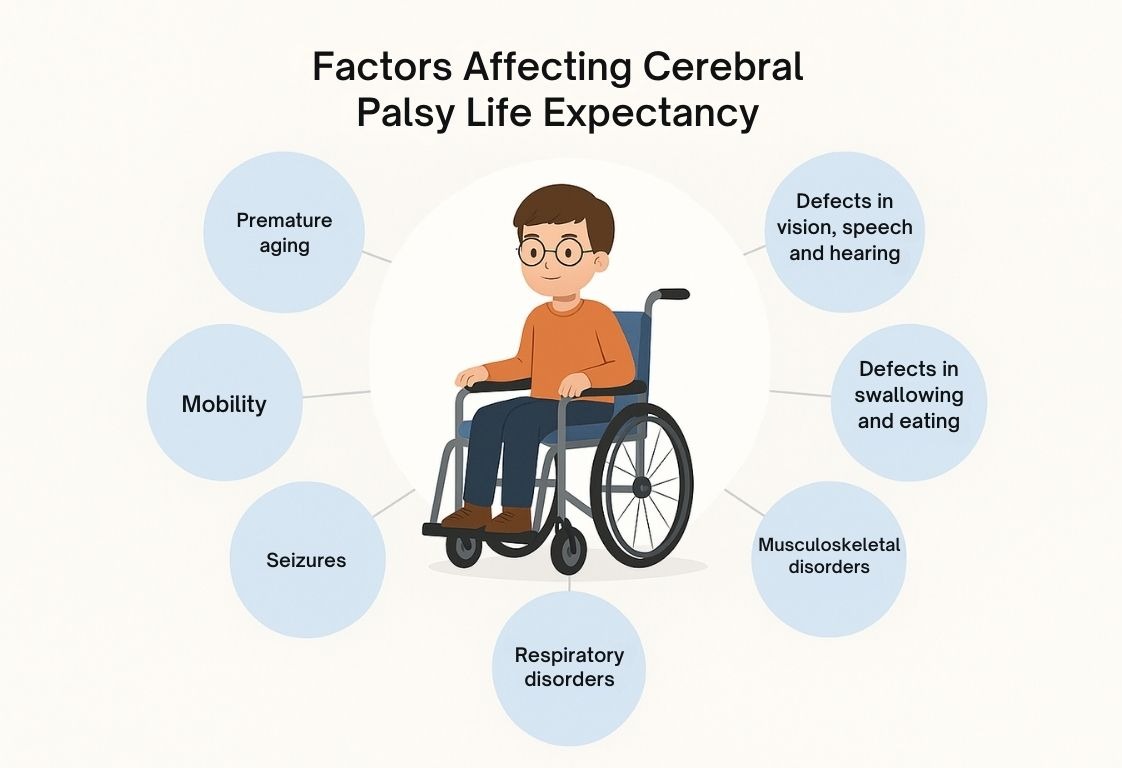
Understanding the factors that influence life expectancy in people with cerebral palsy is crucial for healthcare professionals and families, as various medical, social, and environmental factors can significantly impact the longevity and overall well-being of those with this condition.
1. Mobility:
Mobility is another factor affecting the life expectancy of people. People with mobility problems are confined to wheelchairs, and as a result, they develop pressure sores (injuries that break down the skin and underlying tissues). These are life-threatening infections and can reduce the life expectancy of cerebral palsy patients.
2. Defects in swallowing and eating:
These patients generally have problems with swallowing and eating, resulting in choking, dehydration, and aspiration pneumonia (the inhalation of food or liquid into the airways or lungs rather than its intended passage through swallowing). These conditions greatly reduce the life expectancy of cerebral palsy patients.
3. Respiratory Disorders:
Chest infections and pneumonia are the most important health risk in severe cerebral palsy, which is why respiratory care is central to living longer and better.
4. Premature Aging:
People with cerebral palsy have a chance of premature aging and compromised immune systems. Therefore, they have a low life expectancy.
5. Defects in vision, speech, and hearing:
Cerebral palsy patients with defective sensory abilities need the help of others, and their life expectancy can be reduced.
6. Musculoskeletal Disorders:
Musculoskeletal disorders like the curvature of the spine and hip dysplasia can severely affect health and shorten the lifespan.
7. Seizures:
It has been observed by the Center for Disease Control that 4 out of 10 children who have cerebral palsy suffer from epilepsy. Epileptic seizures can be very frequent and can lead to sudden death.
Average Cerebral Palsy Life Expectancy by Type
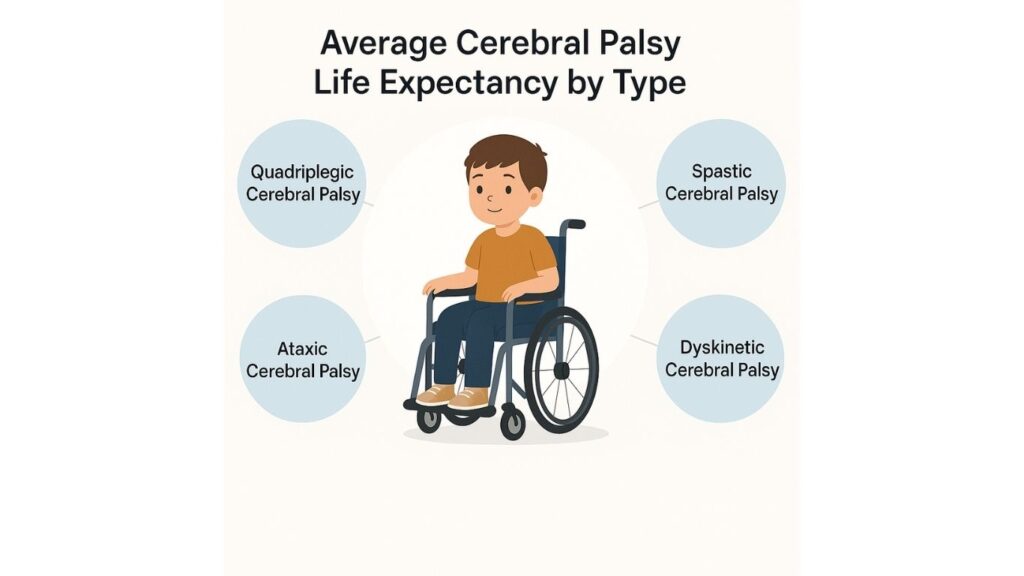
The average life expectancy of people with cerebral palsy can vary significantly depending on the type and severity of their condition, making it an important factor to consider in understanding the long-term outlook for those with this neurodevelopmental disorder.
So, here is the average life expectancy as per the type of cerebral palsy:
1) Quadriplegic Cerebral Palsy
If a child has quadriplegic cerebral palsy (meaning disability in all four limbs), they are expected to suffer severe symptoms resulting in a shorter life expectancy till 40 years of age.
2) Spastic Cerebral Palsy
Children with quadriplegia who also have spasticity (abnormal muscle tightness due to prolonged muscle contraction) suffer from the worst survival outcomes. Children with spastic cerebral palsy also have intellectual disabilities, resulting in poor quality of life and survival till 20 years of age.
3) Dyskinetic Cerebral Palsy
Children with dyskinetic cerebral palsy have problems with chewing and oral muscle disabilities. They have problems with feeding and can suffer injury due to choking. Malnutrition can also affect the lifespan of these children.
4) Ataxic Cerebral Palsy
Children with ataxic cerebral palsy have motor skills issues; they have problems with movement. As a result, they have to rely on others to perform their daily tasks. They can suffer injury from sudden falls or accidents, which can limit their survival chance till 30 years of age.
Want to know how to boost the life expectancy of a cerebral palsy patient? Tell us more about the challenges your dear one is facing and the type and severity of them.
Leading Causes of Death in Cerebral Palsy — and How Care Reduces Them
The most common serious health risk in cerebral palsy is respiratory illness — pneumonia and aspiration-related infections — followed by cardiovascular and other organ-related conditions. A 2023 systematic review and meta-analysis confirmed that respiratory infections are the leading contributors to mortality in cerebral palsy. This matters because these are exactly the risks that proactive care can lower: protecting the airway, treating chest infections early, keeping vaccinations up to date, managing reflux, and supporting good nutrition all directly improve the odds. Framed simply, the biggest threats to life in cerebral palsy are largely preventable and treatable.
Can Cerebral Palsy Life Expectancy Be Improved?
Yes. While cerebral palsy cannot be cured and the brain injury cannot be reversed, the complications that shorten life can be prevented and managed — and that is what improves both length and quality of life. A coordinated, multidisciplinary plan is the goal, not any single treatment.
- Respiratory care — early treatment of chest infections, airway clearance, and vaccination protect the lungs, the organ system that matters most.
- Nutrition and feeding support — good nutrition and safe swallowing (including a feeding tube when needed) reduce aspiration and build resilience.
- Physiotherapy and mobility — maintaining movement and posture supports breathing, circulation and comfort.
- Seizure management — controlling epilepsy lowers a meaningful source of risk.
- Orthopedic and spasticity care — managing muscle tightness, hips and scoliosis protects mobility and lung capacity over time.
- Regular specialist review — as children become adults, ongoing care catches problems early, when they are easiest to treat.
Traditional therapies like physiotherapy and surgery are helpful, but they may not fully prevent complications or improve longevity.
That’s why MedicoExperts has come up with a combination therapy. Let’s learn more about it:
Combination Therapy for Cerebral Palsy

Cerebral palsy happens due to brain injury during childbirth or early development. Though the condition is non-progressive, its symptoms can become severe with age if not managed properly.
Conventional treatments, such as physiotherapy, the use of orthotics, and electronic wheelchairs, can help manage mobility issues. Speech therapy improves communication, and occupational therapy helps patients handle daily activities better. In cases of spinal deformities like scoliosis, surgical intervention may be necessary.
Many CP patients also suffer from chronic pain requiring regular painkillers, and those with severe swallowing issues often need gastrostomy tubes for feeding. While these interventions support daily life, they rarely address the underlying neurological damage or significantly enhance long-term outcomes.
At MedicoExperts, we go beyond traditional care. Our combination therapy is a doctor-guided, personalized treatment plan that combines advanced regenerative medicines with holistic approaches like homeopathy and Ayurveda to boost the treatment outcome.
This comprehensive approach focuses on improving life expectancy, reducing complications, and giving patients a chance to live with dignity and independence.
Want to know if combination therapy is right for your loved one?
Managing Cerebral Palsy in Adults
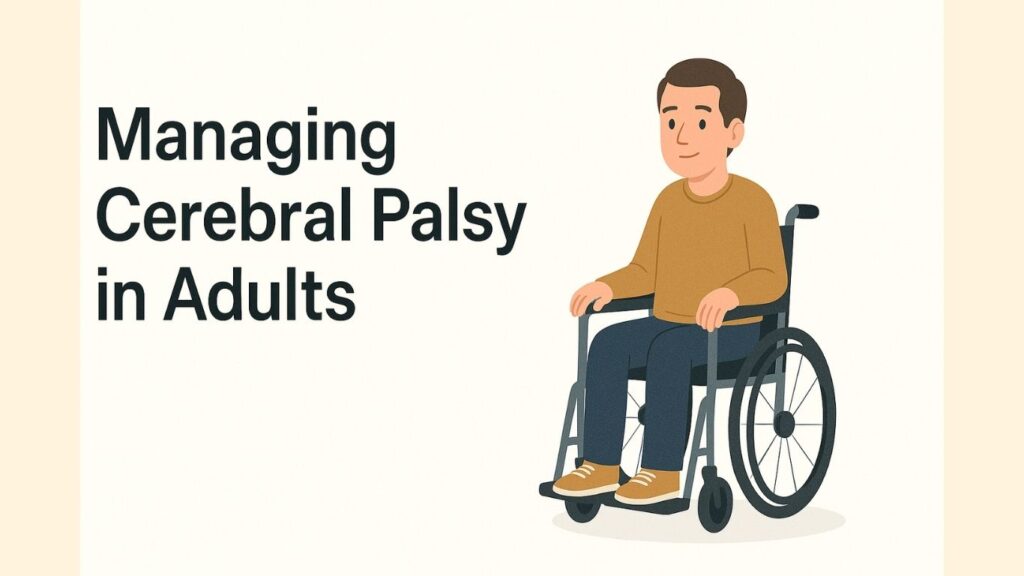
Adults suffering from cerebral palsy should attend educational lectures to improve their social, cognitive, emotional, and fine motor skills.
They should consult counselors to adapt to the professional work conditions. They should also learn how to utilize public transport since they are unable to drive by themselves.
Here’s what you should do to manage cerebral palsy in Adults:
- Should go for regular medical check-ups to monitor overall health and address specific CP-related issues.
- Try physical therapy to improve mobility and prevent muscle contractures.
- Opt for occupational therapy to enhance daily living skills and independence.
- Use medications to manage spasticity, pain, or other associated conditions.
- Use assistive devices such as braces, wheelchairs, or communication aids.
- Provide psychological support to address emotional and mental health challenges.
- Get access to vocational and educational programs for employment and personal development.
- Get help from social support networks to foster community inclusion and well-being.
A Note for Parents of a Newly Diagnosed Child
If you have just received a cerebral palsy diagnosis, it is natural to worry about the future. Hold on to the most important fact: the great majority of children with cerebral palsy grow up, and most live long lives. Your child is not a statistic, and averages cannot tell you their story. What you can do — building a good care team, supporting nutrition and breathing, and staying on top of check-ups — genuinely shapes their outlook. You are not facing this alone.
When to See a Doctor
Seek prompt medical advice — or emergency care — if a person with cerebral palsy shows any of the following: difficulty breathing, a persistent or worsening cough or chest infection, choking or frequent coughing during meals, a marked drop in eating or weight, new or more frequent seizures, unusual drowsiness or unresponsiveness, or a fever that does not settle. Early treatment of chest and feeding problems is one of the most effective ways to protect long-term health.
Takeaway

Advanced approaches like combination therapy can give your child a better life. At MedicoExperts, our doctor-guided combination therapy integrates regenerative medicines, Ayurveda, and homeopathy with rehabilitation techniques to manage symptoms and improve mobility, cognitive function, and overall well-being.
As a global virtual hospital, MedicoExperts ensures 24×7 care, expert consultations, and continuous post-treatment follow-up, so your loved one receives the best care.
Give your child the gift of a healthier, more independent future.
Frequently Asked Questions (FAQs):
Q1. Does cerebral palsy shorten life expectancy?
For most people, cerebral palsy does not meaningfully shorten life. People with mild cerebral palsy usually have a near-normal life expectancy. A reduction is mainly seen in those with severe, combined impairments, and even then it is caused by complications such as chest infections rather than by cerebral palsy itself. Because those complications are largely preventable, good medical care can improve the outlook.
Q2. What is the life expectancy of a child with severe (GMFCS level 5) cerebral palsy?
Life expectancy is most reduced for children at GMFCS Level 5 who are also tube-fed and have significant intellectual disability. Older research suggests roughly half reach their early teens and about a quarter reach age 30. These figures describe a small minority, come from earlier decades, and keep improving with better respiratory care, nutrition and surgery. They are averages, not a set timeline for any child.
Q3. Can a person with cerebral palsy live a normal life?
Yes. Many people with cerebral palsy live full, independent lives — working, studying, driving and raising families — especially those with milder forms. Cerebral palsy is lifelong but not progressive, so it does not worsen over time. The support a person needs depends on severity, but a normal lifespan and a rich life are common and realistic outcomes for the majority.
Q4. Can a person with cerebral palsy have a baby?
Cerebral palsy does not affect fertility. Male cerebral palsy patients can have normal babies, and female cerebral palsy patients can also give birth to normal children without miscarriage.
Q5. Can cerebral palsy run in families?
Cerebral palsy does not run in families. It is not congenital or hereditary.
Q6. Does cerebral palsy get worse with age?
The brain injury that causes cerebral palsy does not get worse over time — cerebral palsy is not a progressive condition. However, its effects on the body, such as muscle tightness, joint problems and fatigue, can change as a person ages. Regular physiotherapy, orthopedic care and specialist review help manage these changes and protect mobility and comfort throughout adulthood.
Q7. How do seizures or epilepsy affect cerebral palsy life expectancy?
Epilepsy is common in cerebral palsy and, when seizures are frequent or difficult to control, it adds to health risk. Well-managed epilepsy has much less impact. Because of this, consistent seizure control — through the right medication and regular neurology review — is an important part of protecting long-term health for anyone with cerebral palsy and epilepsy.
Q8. Can cerebral palsy life expectancy be improved with treatment?
Cerebral palsy cannot be cured, but the complications that shorten life can be prevented and managed — and that improves both length and quality of life. Respiratory care, good nutrition and safe feeding, physiotherapy, seizure control and regular specialist review all make a real difference. A coordinated, multidisciplinary plan built around the person’s needs is the most effective approach.
Relevant Articles For You
Parents’ Guide To CP Prevention
You should know about cerebral palsy prevention to keep your child safe. Keeping your baby and yourself safe is…..Read More
Can CP Patient Walk?
A spectrum of different motor impairments come under cerebral palsy. It affects how a person moves, balances, and…..Read More
Exercises For Cerebral Palsy
If you or your dear one has CP engaging in exercises that improve cardiovascular health, muscle strength, and range of…..Read More
Best Food For Cerebral Palsy
The best food for individuals with cerebral palsy should be rich in vitamins, minerals, proteins, and other vital…..Read More
Recommendations To Understand Different Treatments
Combination Therapy for Cerebral Palsy
Cerebral palsy affects movement, muscle tone, and coordination. Relying on a single therapy often falls short because CP impacts multiple areas: physical, neurological, and…..Read More
Medically Reviewed by MedicoExperts Editorial & Clinical Review Board on 25 July 2026
- Alnaaim SA. Risk Factors for Mortality in Patients With Cerebral Palsy: A Systematic Review and Meta-Analysis. Cureus. 2023;15(5):e39327. doi:10.7759/cureus.39327
- University of Michigan Institute for Healthcare Policy & Innovation / Michigan Medicine (Peterson MD, et al.). Cerebral palsy doesn’t cause death in adults, so why is it still listed as an underlying cause? 2022.
- Brooks JC, Strauss DJ, Shavelle RM, et al. Recent trends in cerebral palsy survival. Part II: individual survival prognosis. Dev Med Child Neurol. 2014;56(11):1065–1071. (landmark)
- Hutton JL, Pharoah POD. Life expectancy in severe cerebral palsy. Arch Dis Child. 2006;91(3):254–258. (landmark)
- Westbom L, Bergstrand L, Wagner P, Nordmark E. Survival at 19 years of age in a total population of children and young people with cerebral palsy. Dev Med Child Neurol. 2011. (landmark)
- Oskoui M, Coutinho F, Dykeman J, Jr N, Pringsheim T. An update on the prevalence of cerebral palsy: a systematic review and meta-analysis. Dev Med Child Neurol. 2013;55(6):509–519.
- Cerebral Palsy Alliance Research Foundation. Facts about cerebral palsy. 2018.
- Centers for Disease Control and Prevention (CDC). Data and Statistics for Cerebral Palsy.
This article is for informational and educational purposes only and is not a substitute for professional medical advice, diagnosis, or treatment. Always seek the advice of your physician or other qualified health provider with any questions about a medical condition.